Category Archives: Film

MAYER BRINGS A BEAUTIFUL SIDE TO “SHUN”

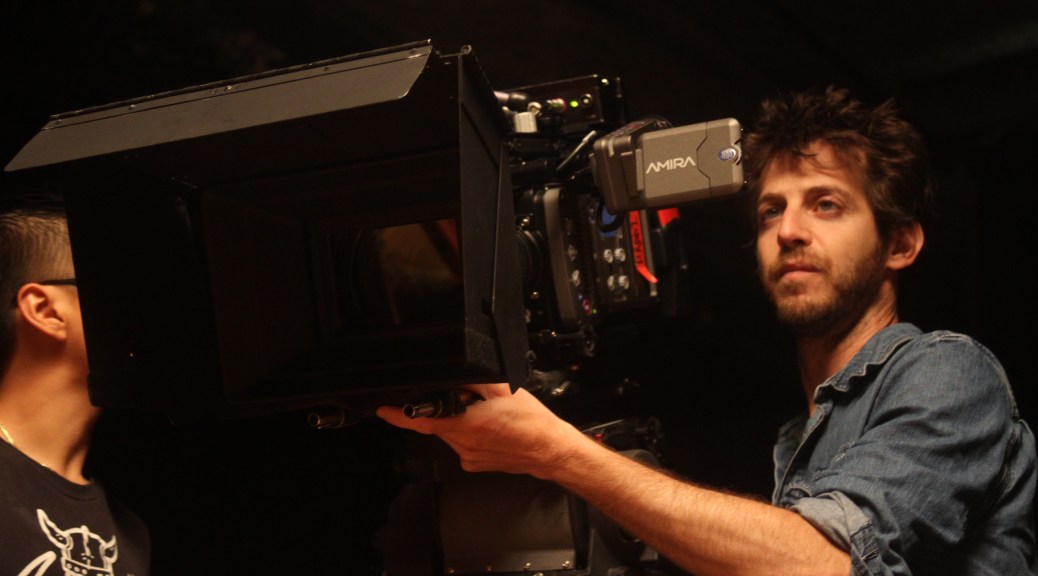
So much of life is about perspective. The way which we view the situation we find ourselves in, the circumstances that surround us, even the interpretation of this by others…all of these things factor into how happy or fulfilled we are at any point in our lives. The 2015 film Shun depicts these factors in the story of two chefs who happen to be father and son. As cinematographer for Shun, Avner Mayer is in charge of so many points of perspective that it’s practically dizzying. Mayer helps the audience (that’s perspective #1) to see things the way that the son (perspective #2) and father (that’s #3) do, by using his (#4) exemplary skills to communicate director/writer Shiyun (Lavi) Hu’s (#5) story. While many might see the cinematographer’s role as sitting at the camera and making sure the action is in focus, they fail to understand the depth of planning and all-seeing overlook of professionals like Mayer. Great cinematographers not only capture the action during filming but they become the eyes of both the production and the audience, coloring the emotional content to heighten what every other aspect of film creation has done, breathing life into the corporal vessel that is film. If that sounds hyperbolic to you, you don’t have experience in the film industry. A smart director understands that a cinematographer will lift a film to new heights or send it all crashing down in spite of its other redeeming qualities. Shun’s director has worked with Avner successfully on two films (the films Beyond and On The River) and it was due to his ability to cultivate depth in a film that she contacted him to be the DP for this production.

Shun is a very emotional movie for a number of reasons. It deals with a conflict between family, work, and self. Kazuki is a fifty-year-old Sushi sous chef and the right hand of his father (Yoshi) in the high-end grip sushi restaurant “Hasimoto”. Kazuki has worked under his father for the past 30 years but they have very different ideologies regarding food and life. Yoshi runs his restaurant with a strict, traditional, and almost sterile approach. He treats his food like a piece of art and believes others should do the same. For Kazuki food is a way to a man’s heart and soul, a tool to connect to people’s emotions. When Yoshi falls ill, he decides to pass the control of the restaurant to his son. Kazuki finds himself trapped between the need to continue his father’s heritage and in his own wishes. The deceptively simple storyline introduces many difficult emotional ideas. Dealing with the ailments and aging of one’s parents, the desire to find your own path in life and career while also desiring the approval of your parents; these are difficulties that many of us can relate to regardless of our country of origin or vocation. The universality of the theme allows everyone to access the filmmaker’s frame of reference but it was Mayer’s role to make it interesting for the audience. It’s obvious that this goal was well attained with Shun as it was an official film selection for such festivals as: Salento international Film festival (2016, Italy), Montreal World Film Festival (2016, Canada), the Toronto Reel Asian international film festival (2016, Canada), and as a finalist in the “Vizio” and “Dolby Vision” Filmmakers Challenge – Cinematography awards – 2016.

The differences between father and son in Shun establish the conflict that Kazuki (and we suspect Yoshi as well) must deal with throughout the film. Kazuki and Yoshi have drastically different approaches and opinions towards food and the process of creating it. Yoshi has an almost surgical, scientific approach to food making. He runs his kitchen like a Swiss clock factory. The work must be done in a precise predetermined order. Improvisation is not allowed. Yoshi’s connection to food is different. Preparing food is instinctual to him, full of flavor and improvisation. For Yoshi, food is a process of connecting with other human beings rather than a planned and organized ritual. To highlight this, Avner explains, “In order to show the differences between the father and son, we used our lights to create different energy. The lighting is clear, blue and bright when Yoshi runs the kitchen. It has an almost ambient/office feeling.  When Kazuki is in charge, the lighting changes to a dimmed yellow-red environment. This creates a much more comfortable and inviting atmosphere; like being at home.”
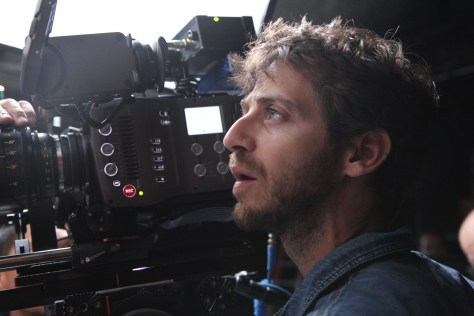
shun-head-shot-with-camera

Mayer also customized the lighting for the lighting for the restaurant location in Shun. The choice to create the restaurant on set rather than a preexisting location gave the production the availability to take the time and movement needed for their shots. Avner chose to use ambient studio lighting from above to again capitalize on the freedom of movement during filming. He notes, “The general approach to the lighting was high key and natural. We didn’t want the movie to feel lit but we still wanted to establish a high key ambience. In order to create this effect, we rigged big top light sources to create a soft, natural light. We aimed for a natural Japanese look and I feel we were very successful in achieving the proper look and feel. Camera wise, we wanted to be patient and static. We decided to tell the story mostly using the blocking and editing (different camera positions) and to keep it as simple as possible. This is the way the characters in Shun see the world so we adopted this approach in telling their story.”

While you can see a great deal of Mayer’s talent and skill as a cinematographer when viewing Shun, you won’t see the largest part of it. Director Shiyun (Lavi) Hu declares, “Avner is very precise in his planning. This was a great benefit to Shun since we shot almost everything in a studio, which limited our shots selection.  Avner’s preparation work with our Production Designer allowed us to maximize the space to our need’s, using lighting built into the design and creating moveable set walls for extra flexibility. I had the pleasure to collaborate with Avner as my cinematographer on previous projects. At this point we have a blind understanding of each other, which makes the filmmaking process fast and efficient.” Shun’s producer, Cedric Gamelin, states, “Usually when you shoot a movie, you have surprises in every step. In this project the process was the smoothest I have ever encountered, I must say that Avner and the team’s preparation work made it seem easy. Avner did all of that without jeopardizing the images, which were magnificent! I’m very proud to be a part of the team who created Shun.” Avner Mayer is happy to be a cinematographer that is appreciated and respected among his peers in the film industry, whether it be for his work on set or the planning of it. He relates, “Since I discovered in my early twenties that I wanted to be a part of filmmaking, to arouse that same excitement that I felt sitting in a theater…I’ve always been excited about all the parts of the process. I feel that the key for a successful project usually lays in the preparation work. It requires a lot of communication between all the key groups involved in order to be synched on one vision. When everybody is synched like that, the set can be a big celebration…and who doesn’t want to be a part of a big celebration!”
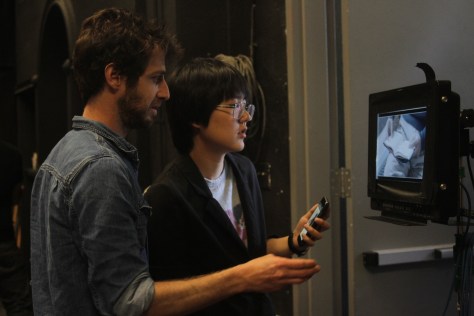
shun-with-director-lavi-hu


ARCIONI’S ECLECTIC TALENTS PAVE A NEW PATH FOR TODAY’S EDITORS

There is no questioning the fact that the way the world disseminates and receives information and entertainment is forever changed. “Appointment TV”, a staple of the home viewing industry only ten short years ago, is almost nonexistent thanks to the DVR. You can watch a film that was released in the theater within almost three month’s time on a plane. Digital Downloads now result in more viewers watching on their computer or smartphone than any of the traditional means previously commanded. News and entertainment go everywhere on the planet and they get there quicker than ever before. While this has caused previous models to take a financial hit, it has also produced an industry that has more creative professionals involved in production that at any point in history. The belief is that that not everyone succeeds but, as the saying goes “the cream rises to the top.” Ana Arcioni is among this new breed of professionals. A highly in demand editor with a widely diverse resume, Arcioni has the ability to work with productions around the globe who seek out her consummate abilities. Empowered with a wider sphere of influence than that afforded to previous professionals means that editors like Ana are offered a host of diverse opportunities, something which is a part of Arcioni’s list of desirable qualities. Productions like the animated film Reality Takes Place, EATV (Educational Access Television), and Premiere Pictures International Inc. are just a short list of the employers who have enlisted this talented editor to make their creations even greater than before.

When Ron Merk, owner/president of San Francisco based Premiere Pictures International Inc. approached Ana about working on the company’s new S.E.Q.U.E.N.C.E. project (as a film/video Editor and Artistic Supervisor for Trailers, Promos, Teasers, and interviews), it seemed to her like an opportunity to be really creative and on the ground floor of something new to the industry. It also gave credence to the company’s belief that Arcioni could display their technology and approach to the best and brightest of the industry. The owner and president of Premiere Pictures International Inc. declares, “Ana’s work with S.E.Q.U.E.N.C.E. proves to the world that It does exactly what I had in mind; it gets the viewer intrigued and want to ask ‘what is this and when can we see it?’ Editing has its own rhythm and pace, and the project itself is going to tell you when to stop. I love that Ana can read my director’s mind and put together a video like if she was? reading my mind. We’re in the business of giving great editors great tools, look no further than Ana Arcioni as proof of this.” In addition, Ana participated in the projects Outrageous, Repeace, and Harvest during her time at Premiere Pictures International Inc..

Ana’s work with EATV is yet another example of the difference in content that she edits. Ana utilized a variety of skills at EATV; doing promos, intros and station ID’s. Some of her editing work with EATV has been viewed at the Festival of Moving Image 2016 (Roxie Theater in San Francisco) and the animation film festival at the Niles Essany Film Museum. Working with producer Jody Yvette Wirt, directed by Maya Prickett, and starring Maya K Chenille, Shoebox Circus was one of the most popular productions at EATV. Shoebox Circus’s content is meant to appeal to a mainly young audience, something that Ana sees as inconsequential to her role as editor. She states, “The fact that the programs are dedicated to children or adults is only a subtle difference, as in the case of a program of urbanism or any other nature. Politics, art, geography, travel, cooking, science, new discoveries, astronomy, there’s an infinity of things. I love them all as long as there is variety. What I love most is the absence of routine. One of the most appealing factors in my line of work is diversity. For Shoebox Circus, Jody raises the idea and gives the tone of the idea. I work with that idea with After Effects editing to have a product which matches that idea. I’m happy to be working with Jody because she has a unique voice and that makes it interesting for me.”

Proving that her work bridges the gap between child and adult is the animated production Reality Takes Place. This inspirational drama discusses friendship, positive perspective and thinking, as well as death vs. life. The topics can be light and then switch quickly to having substantial gravitas. Reality Takes Place was selected and screened at: City Shorts Film Festival at Diego Rivera, Artist Television Access, Festival of the Moving Image, and the Bernal Heights Outdoor Cinema. Ana felt that her work on this production revealed things to her about editing as well as the role of all filmmakers. She explains, “Reality Takes Place is drawn and animated by myself using the Adobe Flash program. The voices are recorded in a small studio through Pro Tools, as well as the Foley effects. The first-line editing was made with AVID. The tweaks, and retouches (including sound design) were made with Final Cut Pro. On and off it was a total one-year project. In my opinion (and I know that not everyone will agree) every independent filmmaking process starts from the editor’s point of view. The more you get to edit and the more you gain experience at it, the more expert you become in shooting and in directing because you know what you want, you know the type of shots that you need. If an editor has a say in the production, or has a good relationship with a director who listens to him/her then the film benefits. I think the editor is the one who understands the most because they have the film in their head and know what shots are needed in order to make the finished piece look good. The editor can advise the director with insight like “don’t do that because it will be impossible to fix in post” or the opposite, “don’t worry about that because I can fix it in post. Being a part of any production is about teamwork. Of course I see the importance of my role as an editor. I also understand that my greatest asset is my ability to make everyone else’s work look even better, that’s why I enjoy editing so much.”

pic-for-ewg-headshot1


PRODUCING A PAINFUL WAR FILM WITH “DAVID” YU HAO SU IN “RESURGENT”

Yu Hao Su is Harvey Keitel. Okay, maybe he isn’t the Oscar nominated actor but just like Keitel’s character Mr. White in Quentin Tarantino’s Reservoir Dogs, David (as Su in known) has a reputation for being a “fixer” in the film industry. When the 2016 Action/Thriller Resurgent needed to do a reshoot for scenes which take place in Afghanistan, David was contacted to contribute his exemplary producing skills. A reshoot is so crucial to a film because it has to match the existing footage in so many ways as to seem and feel that it was part of the original filming. Any deviation from the tone and mood of the existing principal footage could derail the already massive amount of work a production has executed, to say nothing of completely distracting the audience. As the editor of this film, no one is more qualified than James Stiegelbauer to comment on the work of David on the reshoot. Stiegelbauer proclaims, “Yu-Hao was calm under pressure. When our director made last minute script changes, everyone was concerned it couldn’t be pulled off but Yu-Hao didn’t even flinch. He made a few calls and quickly got everything that was needed. Yu-Hao is detail oriented, resourceful, and is never afraid to get his hands dirty. I would ask him to work on every job if I could. We could not have finished Resurgent without his hard work. He coordinated with the actors, locations, and crew quickly making all the necessary arrangements to meet our needs. As an Editor, I’m not on set, but I do need to be in constant communication with the director and cinematographer. Yu-Hao was crucial in this communication. This ability to be able to keep the work flowing even as unforeseen factors arise and must be dealt with…that’s what the truly great producers possess.”

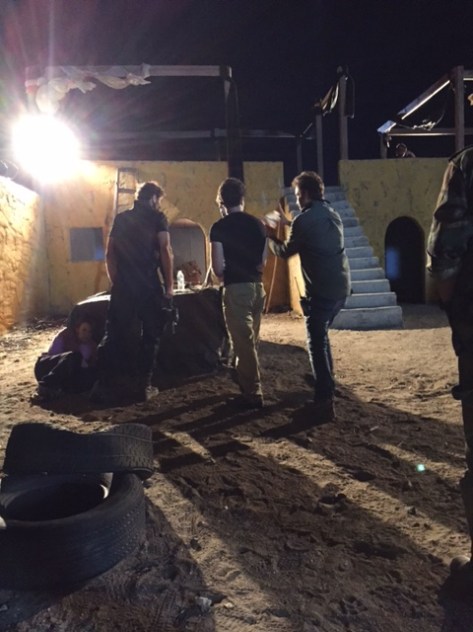
Resurgent is a film which depicts the story of a mercenary who must come to terms with a botched mission in order to return to the battlefield. Max, the main character (played by Manny Cartier) is suffering from the pain of his partner who has died in a military missionary with him in Afghanistan. The action and military theme of this film necessitates stunts, something which David is familiar in dealing with. Setting the table in a safe manner for these stunts is highly important to him. He notes, “We have a lot of stunt in the film. I need to make sure the stunts are done right in order to make sure the actors are completely safe. We not only have the stunt coordinator on set but also a set medic. This may seem obvious but every little situation must be planned for regardless of if it ever needs to be used. We also have a weapon wrangler on set to make sure people are aware on set, even though the weapons are just props. My job is not only to make sure the stunt scenes are well-planned but also to make sure the set is safe. I take stunts very seriously. Because it’s an action film with a lot of stunts (and we filmed in a dessert to cheat it as Afghanistan) I needed to make sure our production was a self-contained unit with everything we could possibly need at a moment’s notice. It’s not easy to shoot stunt scenes with weapon props in the desert. I need to make sure everyone is safe not only because of the stunt actions but also the difficult shooting environment.”

For those of us who don’t work in the film industry, it might be hard to understand exactly what a producer does on set. For those who do work in film, it’s difficult to overemphasize the impact a producer has on any film. A producer’s role can be described as parent, police officer, president, healer, and best friend…all in one person. A producer is the person who supplies what you need even before you understand and comprehend that you need it. It’s a conflicting situation for most producers. They love what they do but they rarely are afforded the opportunity to lose themselves in the fun of watching the movie magic they help to create. David states, “Being in charge of the reshoot for Resurgent was fun, there’s no mistaking that. I just had to always be thinking a few steps ahead. There is really no time for losing yourself in the moment. It’s interesting to shoot an action film. The stunt sequences with the stunt coordinator are fun and look amazing in the film. Watching that when the film is finished is fun. There are always challenges that are unique to each film. The desert location we filmed didn’t have a phone signal or Internet. It’s very hard to run a set without this technical stuff. We ended up planning it well and got the work done in spite of this. There is nothing to complain about for me. I’m so excited to be a part of this industry. To focus on the story and tell the story from an essential human’s point of view. I believe truth and humanity is the key to delivering a story everyone can understand and connect to.”

img_7923


ALL HEED THE MESSAGE OF AWAKEN

The arts have been the creative analogous tool of creative types for centuries. This format to communicate the real life situations with which society is confronted must often be done in a covert manner. In order to avoid strife and previously held opinions, avenues like music, literature, theater, and film, are utilized to help us see things from other perspectives. This methodology often finds us sympathizing in a first person sense, placing ourselves in the shoes of others and their circumstances. Historically, great art has struck a chord in the collective society and spurred on movements that create change. This is the story told in the film Awaken by Bruce Sze Han Chen. It is a lofty idea that he proposes in the film. In order to successfully bring about his vision, Bruce obtained the successful production talents of “David” Yu Hao Su. The many accolades and recognitions that the film has received prove that this decision was well founded for all involved parties. Some of the achievements include: Accolade Competition 2015 (Winner-Award of Merit), Alaska International Film Festival (Winner-Northern Lights Emerging Talent Award), California Film Awards (Winner-Diamond Award), Los Angeles Independent Film Festival Awards (Best Production Design), Mexico International Film Festival (Winner-Golden Palm Award), World Film Awards, Jakarta (Award of Merit), and on and on. Regardless of geographic location, audiences were captivated by Awaken’s message, a message which was delivered exactly as its creator had envisioned thanks to the support and talent of his producer David (as well as co-producer Pin Chun Liu). As with any great artist, having the professionals around you to allow you the freedom to create your art is paramount.

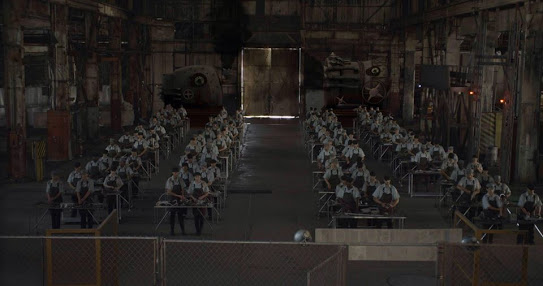
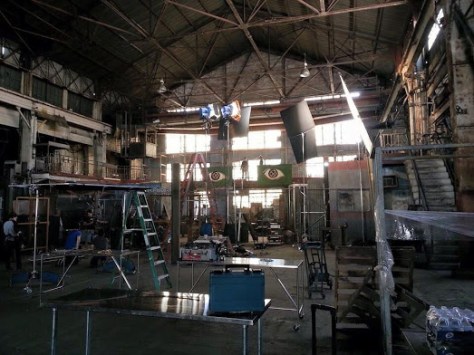
Awaken is a story which is applicable to any society, political system, or theology on the planet. The heroine of the film is Sophie. She has spent her life working in an enormous factory. In this facility, the workers’ minds are controlled by the music which is ubiquitous. One day, Sophie is suddenly impervious to the effects of the music and she decides to destroy the music system in order to free everyone from its effects and the factory’s dictator who is in control. The message is thinly veiled but easily understood; be in control of your own life rather than to unconsciously follow a path which is handed down to you by others, others who may be less concerned about your well-being than their own. As a producer on Awaken, it was David’s role to assist Bruce (the director) to find a production designer, costume designer, and other principle team members. Location and casting was a particularly vital part of this film. The lead actress playing Sophie is a minor which meant that scheduling needed to be coordinated around strict guidelines. The futuristic location of a massive factory was coordinated among three different venues. To further complicate things, an enormous amount of extras were cast and then supplemented with VFX to complete the proper feel of the factory and its workers. David reveals, “We needed to create a lot of workers to show how big the factory is and how many people are controlled by the dictator. We decide to use VFX to duplicate the workers. We found an excellent VFX team to helps us prepare the work and coordinate it with the Camera and Art departments. Even though we decided to use VFX to duplicate the workers in the factory, we still needed a huge amount of extras to create the materials for the VFX team. Also the location we had for the factory was huge, so it required us to have an enormous amount of extras on set. My production team and I posted casting information online and called all the actors we knew in order to have so many extras come to our set. The VFX works is the most challenging part for me because we had a very limited budget and time to plan the VFX. It ended up that the VFX scene worked very well and it’s all because of the teamwork each department devoted.” To fully understand the role David played in Awaken, consider that the actual principal filming took five days. His preproduction involvement began two months prior to filming and his post-production work took place for three months following its conclusion. That’s a ratio of 1/20 or more. The beauty and strength of the message in Awaken solidify the fact that when creative artists of all vocations work together, they can create and communicate in a manner that reaches the public and critics. The beauty of this film lies not only in its aesthetic but also in its content, both of which are fueled by the amazing team that brought it into existence.


awaken-set-photo

Actress Anele Morris is jack-of-all-trades in film ‘Bloggers’

Someone with a true vision is hard to come by. It’s easy to have an idea, but bringing it to fruition is much more difficult. Anele Morris knows this better than most.

Inspiration struck, and this versatile South African actress came up with a concept for a film about the ancient African humanist philosophy ‘Ubuntu’, which shapes the journey of six young multinational blogging entrepreneurs who come together in Los Angeles to launch a blogging business. Now, Bloggers has been submitted at multiple film festivals worldwide.

The film, which Morris considers to be the highlight of her career, raised 130 per cent of its budget on Indiegogo. Morris not only has a starring role as the character Anna, but she also was the executive producer and writer. Her character, Anna, blogs about everything from dating to paying the bills. Anna decides to start and head the bloggers’ website that the film centers around.

“Working on Bloggers was a dream come true. I have always wanted to write a story like this and it was awesome being able to make my debut as a writer, producer, and actress to film festivals in this fashion,” said Morris.

Morris created the concept and worked on pre-production for it with her two best friends. They decided to fundraise for the campaign on Indiegogo, which many young filmmakers are doing. With the financial investment from the campaign they were able to create the film.

“I liked that it was a story that I could relate to in many different aspects,” said Morris. “Also having creative control in many areas was an absolute joy.”

Despite starting out as a small project between friends, the film grew to much more. The editor of Bloggers is Paul Skorich, a professional editor, producer and composer. He has produced over fifty specials for the cable network TV ONE and two of his shows have been nominated for NAACP Image Awards.  He is currently supervising post production and editing the feature film Revival! along with Emma E. Hickox (Bad Moms, Pirate Radio, A Walk to Remember). Revival! is written by Harry Lennix (Batman vs Superman: Dawn of Justice, The Matrix: Reloaded; Revolutions) and directed by Danny Green (Star Trek, Coach Carter).

“Working with Paul introduced me to how story telling is hugely done in the editing room. Working with him was a delight,” said Morris.

In addition to Skorich, Morris also worked with the director of Bloggers J.R. Curry, the head of the film production company Benevolent Pictures. Curry previously directed M.A.G., which screened at the Martial Con Film Festival in August. He has also directed films such as Silent Voices and Butterfly which have been accepted into multiple film festivals.

“Anele’s knowledge, creativity and instinctive grasp of what makes a successful actor are all second to none. Her work has enabled her to carve a career as a talented actress in films such as Debris: The Ganymede Event and Arsenic,” said Curry.

Morris has also acted in films such as After, the upcoming film Snake Outta Compton. She also appeared in the series Adopted, where she worked with Jeff Larson. Adopted is a web series that has been running since 2013. Larson won the Vancouver Web Festival award for best overall series which he shared with three other producers of the series. One of the directors is Oscar Rene Lozoya II who has edited multiple episodes of NBC’s Chicago Fire. Despite Morris’ past achievements in acting, working on Bloggers still taught her to trust in her abilities.

“I learned to figure things out and to say what you mean and mean what you say,” she said.

The biggest challenge Morris’ experienced at the beginning of her acting career was self-confidence. Now, she is very confident in her acting abilities, but in the beginning it wasn’t so easy. She now uses what she knows to walk onto any set with the natural creativity she brings to each role, and her love of writing helps her visualize a story for each character, making her fully embody each role she portrays.

“I am a lover of life and really, that’s what acting requires,” she concluded. “It requires you to be alive, to be present and open to the possibilities of any experience.”


You can view Blogger’s trailer here.

Producer Michelle Solomon talks award-winning film Emma and telling important stories

simon-paluck
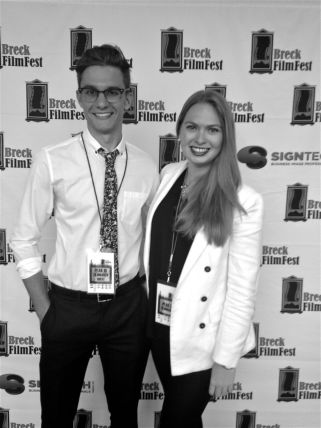
Actor Simon Paluck and Michelle Solomon at the Breckenridge Film Festival premiere of Emma.

“I will never forget the universal and palpable emotional state the audience was in while the film played. It was the first time the audience was not made up of family or friends. It was a humbling reminder of how communicative film can be and that it’s important to use the medium to tell meaningful stories.”

Those are the words of Toronto-born producer and graphic designer Michelle Solomon when talking about the highlight of her career. She was talking about her first feature film Emma premiering internationally at the Breckenridge Festival of Film in Breckenridge, Colorado.

Solomon has had ample amounts of success in her career. She transformed the brand Ace Building Materials by making them current and relevant with her graphic design skills. She produced the award-winning film Chalk Dust and the upcoming film Sunny Side Up. She is set to work on a television show with former NBA star Kareem Rush, and co-founded the production company Picosphere Inc. She founded the company Adoorn, an app which will revolutionize social shopping right in the palm of your hand, which is set to release early next year. Despite all of these successes and achievements, and being known internationally for both her producing and design abilities, the premiere of Emma still stays with her, and working on the film shaped who she is today.

“Emma is a realistic look at the world of childhood cancer and how the disease goes beyond just the person diagnosed. It’s important to not commodify and exploit a very real experience that, unfortunately, many kids and their families go through,” said Solomon.

Emma tells the story of seventeen-year-old Jayson. Jayson thinks too much. He is introverted, friendless, and wakes up wanting the day to end. That is until he meets Emma, the captain of his school’s dance team. After his psychiatrist tells him to be more involved, Jayson joins the school newspaper and is sent to write an exposé on Emma’s rumored pregnancy. Instead, Jayson uncovers that Emma has cancer. Suddenly, Jayson is pulled into a vibrant world where real love and true sacrifice flourishes. Through Emma, Jayson learns about life, love, and the importance of letting go.

“Emma was a story that needed to be told. It was based on the personal experiences of the writer, Simon Paluck. What initially drew me to the film was the way that childhood cancer wasn’t glamorized or made effusive. Many films showcasing kids with terminal illnesses, often portray an idealized version of the truth. The illness becomes a tool that convinces characters to fall in love or travel the world. Experiences surrounding childhood cancer goes deeper than that. It is specific and nasty. With Emma, I like to think we showed one of many truths,” said Solomon.

The film has gone on to win a list of awards. These include: the “Royal Reel Award”, Canada International Film Festival, in 2015, the “Best Feature: Venture Category” at the Paris Online Film Festival 2016, “Freaky Feature” (Best Feature) at the Broken Knuckle Film Festival, 2016, and “Best Indie Film” at the Los Angeles Film Awards, 2016. At this year’s Festigious International Film Festival it won “Best of Fest”, Best Narrative Feature”, and “Audience Choice Award: Narrative Feature”.

“It’s entirely humbling to know many are responding to the film’s message.  With film production, there is always a moment of doubt where you think others will not understand what you’re trying to do and critique it unmercifully. Thankfully, this has not been the case for Emma,” said Solomon.

But what is perhaps Emma’s greatest achievement is not the official selections at film festivals or it’s long list of awards, but the work it has done for the Make-A-Wish Foundation.

To raise funds for the film, Solomon came up with the innovative idea to partner with Make-A-Wish foundation and hold a silent auction. She wanted to give back to the community through the film, so the silent auction was to raise funds for both the film and the Make-A-Wish Foundation.

“This type of innovative fundraising is just one of the ways Michelle has proven she is a natural, talented producer,” said Veronica Porfilio, the film’s executive producer.

As a non-writing producer, Solomon says she is always trying to find creative ways to expand a film’s reach.

“My personal mantra is that instead of thinking outside of the box, recognize that there is no box,” said Solomon. “Personally, I felt compelled to use the film to make a greater difference. I was able to gather over $17,000 worth of donations and raised enough money to not only finish funding the film but also donate a major portion to the Make-A-Wish Foundation. Our contacts at the organization really took to the idea of spreading awareness through the ‘show-don’t-tell’ approach of film.”

Solomon’s approach to producing earned the entire cast and crew’s respect immediately, despite being her first feature. The film had a small budget for such a massive project. They employed union actors and shot at over ten locations. Solomon would not let these challenges negatively impact the story.

“Michelle was able to secure a highly sought after location that was instrumental to our film without going over-budget. Without that location the film would not have been as successful as it was. When she first spoke with the location manager it seemed we would not be able to use the space to film Emma, but that did not deter Michelle from bargaining because she knew the location was key to the film’s success. After weeks of negotiation Michelle secured the location.

Michelle’s talent as a producer shone through every task while working on Emma, and it shaped the producer she is today,” said Porfilio.

Including Solomon, there were ten young, dedicated professionals lead our executive team working on Emma. Solomon says each person was there because they were committed to telling the story.

“That type of energy is powerful and we kept each other motivated, especially through the challenging parts of independent filmmaking,” she concluded.

Graphic Designer Jiping Liu: An Unstoppable Force In Modern Film

1
Graphic Designer Jiping Liu

From designing props and key costumes to the film titles and posters that grab our attention and make us want to run out and watch them on the big screen, graphic designer Jiping Liu has found a unique niche for herself in the film industry, both in the U.S. and China.

By the time Liu made the decision to break into the film industry, her talent as a graphic designer at home in Beijing, China was already well-known throughout the design industry thanks to her work as a lead designer for Tencent and Inforgence. While the endless creative opportunities and potential collaborations Liu could immerse herself in through film ignited her inner passion, the choice to step away from a good job as a designer in the corporate world required her to set the safety net aside and take a leap of faith.

After graduating with her bachelor’s degree in digital media from Beijing Jiaotong University, Liu says, “I got the chance to go for my master’s degree with a full scholarship in China and I was also offered a good graphic design job, but I felt I was too young to settle, so I gave up the opportunities and applied to school in America to study filmmaking.”

This was barely three years ago, but the number of high-profile film productions she has contributed her skills to since confirm that the life changing choice she made leaving everything she knew behind in order to pursue her true passion was definitely the right one, as is often the case, but rarely do the results come as quickly as they have for Liu.

For Liu 2016 has been insanely busy with her doing the graphic design for the films “Red Cherries,” “She Gives Me Sight,” which earned awards at the Hollywood Boulevard Film Festival, LA underground Film Festival and the Hollywood International Moving Pictures Film Festival, “Escape,” “Don’t Touch Me,” “Successor of the Southern Star” and several others.

Her adept skill as a graphic designer combined with her knowledge of the filmmaking process has provided Liu with a strong creative foundation that has allowed her to apply her talents to various other areas of a production such as costume design as well. Earlier this year Liu costume designed the dramatic crime film “Locked” directed by Ye Kuang (“Harmonica,” “Love Behind”), whose film “Harmonica” took home the Grand Prize at the Carnegie Mellon International Film Festival.

As the costume designer of the production Liu used her graphic design background to draw out all of the costumes we see in the film before constructing them.  “Locked,” which stars Leanne Agmon from “Blue Bloods” and “Unforgettable,” and Johanna Finn from the multi-award winning film “14 Days” and the series “My Haunted House,” has proven to be a resounding success with the film taking home the LAIUFF Awards for Best Actor and Best Narrative, as well as the Audience Award for Best Film and Best Actor at the 2016 Los Angeles International Underground Film Festival,

Liu used her design skills once again as the costume designer of the recently released “Lordwolf” commercial for Beard Guyz directed by Mauro Borrelli (“The Ghostmaker,” “Haunted Forest”) who earned the Audience Award at the Los Angeles Italian Film Awards for “Goodbye, Casanova” and the Venice Film Festival’s AIACE Award for “La Donna del Moro.”

As a graphic designer Liu has an expert eye when it comes to color, a necessary strength and crucial component in designing the costume for the commercial’s leading wolf man played Daniel Sobieray from “Days of Our Lives” and “The Young and The Restless.”   You can check out the new commercial here.

Since moving stateside Liu has landed a job as the lead graphic designer for Alpha Pictures, a Chinese based production company that recently opened their LA branch.

Alpha Pictures
Poster for the film “The Death God’s Plot” by Jiping Liu

“We are trying to turn the most popular comics in China to feature films in next two years in America,” Liu says about her work with the successful production company. “I love both filmmaking and design, so I feel very lucky to be a graphic designer at a film production company, because I’m passionate about my work.”

Liu has put her creativity to paper designing a plethora of posters and presentations that Alpha is currently using to gain funding and get the word out about several upcoming films such as “Female Robot,” “Spore,” “The Death God’s Plot,” “Rain Village,” “Meet William,” “Moon Vortex,” “Requiem Street” and many more.

Alpha Pictures
Poster for the film “Spore” designed by Jiping Liu

Whether she’s designing film posters to grab the audience’s attention or spark the interest of potential investors, or using her graphic design talent to create graphic props and costumes for productions, Jiping Liu is one creative artists who’s found her rightful place in the international film industry.


Director of Photography Sergey Savchenko “not working for industry, but making it”

sergey-3
Sergey Savchenko was born in Siberia.

“I meet people, I listen to their stories and watch their lives. I see and try to understand the visual styles and colors of different countries and places. Every day I try to develop myself, to apply my experience in creating my own style, and hone my skills.”

Those are the words of Siberian born Sergey Savchenko, when describing what he does as a director of photography. Those are the words of someone who does what they do because they love it. Every project Savchenko works on is a learning opportunity. He constantly aims to be better, and he is already respected in the industry for what he does.

“Once, when I was experimenting with video, I noticed something. It was a feeling that I was not previously familiar with. It was seeing how my thoughts and ideas became a reality through film. I understood that I can capture a mood, an attitude, a feeling. It was the spark of creation. I can’t compare this feeling with anything else. I can not only consume, but create. From that moment, this feeling for me becomes one of the most strong and pleasant. I feel that I’m alive when filming and create a certain style or idea,” he said.

Savchenko’s work is recognized across the globe, and has been nominated for several awards. He worked with REN-TV on That’s My House, which was a finalist when it was nominated for “Best Leisure and Lifestyle program spot” at the Promax BDA Europe in 2015. This year, his work on the promo Americans won Bronze in the “Best Drama Promo” category of the Promax BDA UK awards. Savchenko considers these true victories, but they still came as a big surprise.

The feeling is hard to describe. In our work, we constantly ‘run’, focusing on the ‘road’, not looking around. When your job gets to the finals of the international competition, you start to ‘look around’, trying to figure out where you are and realize that you are ‘running’ in the company of giants like the BBC and Discovery. It’s an interesting feeling,” he said.

While at REN-TV, Savchenko worked closely with Roman Toloknov, the chief Director of the Promo Department and the two became close. Tolokonov says Savchenko has a loud voice, joking that he can’t decide if it is a good thing or not, as he Savchenko is never afraid to tell even his boss when something “sucks.”

“Sergey came to our department in late summer of 2013. I immediately saw in him a man who can give good advice and bring our ideas to life. We worked for three years and got a huge number of promotional projects. Sergey is like an engine. You start the engine and it works,” he said. “Sergey has this massive energy, he loves what he does – that’s what really got to me when he came for an interview. He is not working for the industry, he is making the industry.” 

Savchenko describes Toloknov as having an excellent sense of style and humor, producing more great ideas than he team can manage to film. For Savchenko, despite the awards and recognition, it’s the people he has worked with that have made his career into something he loves.

“You know, it is always a surprise to receive awards, it’s very nice, but this joy fades away. It’s always a pleasure to share this joy with someone, but a reward by itself does not bring happiness. The award is a measure of official recognition, it affects to your confidence, but the support of a family and friends, and their faith in you, is much stronger than any award,” he said.

Having this attitude keeps Savchenko humble. Despite his many accolades, he does what he loves for himself and the people he loves. He is motivated by the challenges of the profession, which one can only do when they are truly passionate about something. He knows that every take can have a different approach, and every other director of photography will do it differently, but he takes his time and finds the best approach.

“It’s similar to how you tune a musical instrument, feeling only the vibration from it in your body. You don’t hear the sound, you only see the faces of those who listen to your music. The best gift is to see smiles on faces, this means that your music is resonance in the hearts of the audience. Your instrument is tuned. Constant practice and selfless love helps along the way. Any task has 100 ways to solve and we are always looking for the best choice. The storytelling language, the style and the color is very similar to our speech, if we start talking randomly – we might upset or offend someone, nobody likes scrappy speech. Video products directly affect the consciousness and sub consciousness of an audience, therefore it is necessary to control the quality and check 10 times to make sure, that what you’re doing is right and carries a beautiful thought,” he advised.

Savchenko is not simply a director of a photography. He is an artist. He is a creator. He knows this, but uses his gift to positively affect not only the people directly around him, but those that see his work. There is no doubt that his name will continue to roll through the credits in film and television for years to come.

“I want to grow as a director of photography and work in the film industry. I truly love what I do the more than anything in the world,” he concluded.

THIS CANADIAN ACTRESS PROVES THAT HER ACTING AND DANCING ARE ON POINTE

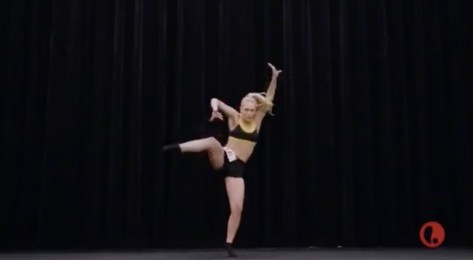
Lanie McAuley is a dancer, and she plays one on film. In real life, McAuley made the switch from concentrating on a dance career to choosing acting as her focus. However, she returned to dance with her role in Center Stage: On Pointe. It’s not often that one gets to appreciate who they were as a younger person and who they are just a few years later with such contrast. As a gifted young dancer from Canada, Lanie moved to New York when she won the audition for a production there. These days, as a successful actress she spends her days on film sets. Though she still pursues a creative life, the avenue which she pursues flexes different muscles, literally and figuratively. McAuley is a self-described practical person yet the vocations she has chosen to pursue seem to contradict that idea. A dreamer who began her professional career a little more than a week after high school graduation (with great success), it seems impossible to imagine her doing a job which involves a nine to five schedule and a 401K. Lanie’s view of herself is probably a product of her middle-class work ethic coupled with a desire to work her entire life at something which inspires passion in her. Even when she alters her path, Lanie McAuley always finds her way back to doing something creative…sometimes a number of things at the same time. It’s serendipitous that years after leaving dance for acting, Lanie’s acting career has brought her back to dance to star in the sequel to her all-time favorite dance film, the original Center Stage.

A young Lanie followed her sister’s footsteps into dance. At 18, McAuley attended a dance competition called New York City Dance Alliance, where auditions were being held for a tap/jazz show called Revolution. Her dance teacher suggested she go to the audition just for the experience; hundreds of female dancers were narrowed down to four and soon, Lanie was offered a spot in the show. She had just graduated from high school a week before. Suddenly she found herself moving into an apartment in Queens and taking the train to Manhattan every day for rehearsals. Literally overnight, she went from high school and living as her parents’ sheltered little girl to living alone in New York with a full time dance job. The hours were long and it was both physically and mentally exhausting. She was the youngest member in the cast and had to learn quickly. It was a quick and amazing kick off to adulthood and a professional career in dance. In addition to the achievement of being in a successful New York production, Lanie also made it into the finals of So You Think You Can Dance. Her focus changed from dance to acting as she became keenly aware of certain factors. She reveals, “I was clear on my love of dance but I started questioning how viable my career options were in that world. I’m a very practical person and the idea that an injury can blow your entire career seemed so frightening to me. I’d been acting since I was a toddler and acting had always been a part of my life. Though I still loved dance, I’d always wanted to make acting more of a focal point in my life rather than a side interest. I think my background in dance has been a huge asset in helping me gain roles as an actress. It made me very comfortable performing, whether on stage or in front of a camera. My dance training definitely gave me a posture and poise that I never would have had otherwise. I also think growing up in the dance world (particularly ballet) gave me a lot of discipline. Being an actor requires a lot of discipline, involving everything from memorizing sides, to committing to a scene, to taking care of yourself emotionally.”

lanie-mcauley-center-stage-1

It has often been said that nothing worth having comes easy. This can be true even if you have a head start. When McAuely’s agent called her about the audition for Center Stage: On Pointe, the actress was ecstatic. The original [Center Stage] is her favorite dance movie of all time and a highly motivated actress with a strong dance background was required for the role. Lanie’s character, Wendy, is meant to be a strong dancer who’s the measuring stick against which Bella (played by Nicole Munoz) is compared at the audition. The legendary Director X was involved in the production and ran a rigorous dance audition composed of ballet and modern dance styles. McAuley notes, “Auditioning for Director X was an intimidating experience. At the dance audition, I remember doing the ballet combo and him saying, ‘Again. Again. Again.’ I think he was testing my endurance. By the time I’d done it four or five times at 110%, I was exhausted. I had to hold my breath when they spoke with me afterward to hide how badly I was panting.” Lanie was awarded the role of Wendy in the film. Her costar, Nicole Munoz comments confirming the facets which made McAuley such a vital part of the film, “Captivating to watch, Lanie performed a contemporary dance solo. Her commitment and bright energy inspired the other dancers and raised morale on set. Multi-talented, Lanie was able to bring the character ‘Wendy’ to life by bringing an emotional depth that touched the cast and crew. We were filming on a tight schedule. Being a true professional, Lanie was able to bring a powerful energy to each take. Never once stumbling, she was always more than prepared. Lanie stands out from the crowd with her multiple talents, each and every one of them groomed and ready to go.”

Center Stage: On Pointe premiered with great success on the Lifetime network. While Lanie feels fortunate to have been in the cast of this popular film as well as challenging herself to unearth her dance proficiency, she concedes that she feels a reaffirmation that she made the correct choice in acting. She declares, “I think the main similarity between a career as a dancer and as an actress is that both careers are based on art and passion. Most people don’t enter these careers for the money; they enter them because they love the work. There are definitely some big differences between the two. Truthfully, acting is more lucrative, if you’re able to find success in it. There just doesn’t seem to be the same kind of funding and opportunity in the dance world that it deserves. There are certainly people who are enterprising enough to have thriving careers in dance (I’m so impressed by their drive and initiative) but for me, my passion for dance didn’t run deep enough to create those opportunities for myself. That’s likely because my practical brain couldn’t rationalize the risk of injury and the deterioration of opportunity with age. One of the coolest things about acting is that you can act professionally at any age. Acting is the art form of life…and life is all ages. When you’re 75 years old, there’s still a role for you. That’s a big part of why I focused on acting as my career.”

Processed with VSCOcam with p5 preset


SIMU FENG CREATES A DARK AND MYSTERIOUS CHINA IN “SHOP OF ETERNAL LIFE”

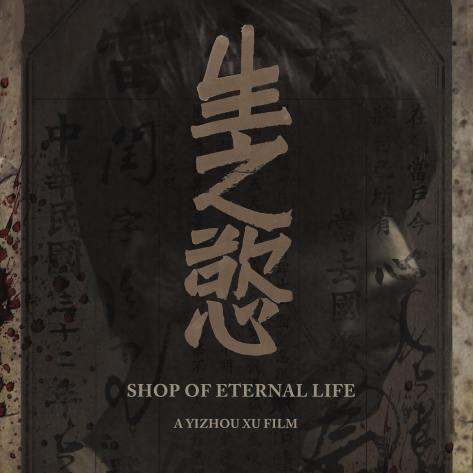
Shop of Eternal Life is the passion project of director/writer/producer Yizhou Xu. In the film, he uses an almost literal metaphor to show the dangers we humans can make in times of desperation. It’s an evergreen tale that applies to all peoples of this planet. It just so happens that Xu’s film takes place in two by gone eras of his homeland, 1920’s and 1950’s China. Not only is there an other-worldly occult thread in the film but the obstacle of transforming downtown Los Angeles into an almost hundred-year-old China. While giving great credit to his crew and cast, Xu admits that his secret weapon for this transformation appearing so convincingly on screen was Shop of Eternal Life’s cinematographer Simu Feng. The award-winning Yizhou Xu declares, ““Simu is the most professional cinematographer I have ever worked with. Simu is such a vital part of this project because he is the metronome of the production. The most time consuming part of any film production is the lighting and camera positioning. We had a lot of shots in the film and it was paramount to have a cinematographer with the confidence to finish those shots with the highest quality and to do so very quickly. Simu finished the task without wasting a single second; and his efficiency didn’t harm the result of the image at all. Simu knows how to take limitations and challenges and transfer them into creativity.” The filmmaker’s peers and public definitely agreed with the finished product as it was an official selection at: the 36th Hawaii International Film Festival, the 20th Los Angeles International Short Film Festival, the 10th Bali International Film Festival, and the 8th San Jose International Short Film Festival. The look which Feng bestowed upon Shop of Eternal Life belies the budgetary confines which Xu relates. A story which spans the struggles of its main character, his transformation, and the cautionary tale it communicates deserves a beautiful and elegant aesthetic; one which it richly possesses thanks to Simu Feng.

shop-of-eternal-life-screenshot-1

Shop of Eternal Life is a film full of fantasy and terror, relating the choices we sometimes make and the unexpected results they have on us as well as others. Even the best of intentions can result in malevolent outcomes for all involved parties. The film is the story of a poor man in 1920’s China who ventures to a pawnshop, hoping to sell his wedding ring to save his sick wife. The shop owner offers only a pittance…or a deal. Rather than money, the pawn shop owner suggests that the husband sell his heart for a great deal of money to him. The man feels he has no choice but to take the offer in hopes of saving his spouse’s life. Many years later, the husband returns to the shop to redeem his heart, but his time without a heart has transformed him into a monster. He discovers that his heart is no longer at the shop. Doomed to a heartless life (literally), he kills the pawnshop owner and assumes duties as its proprietor.

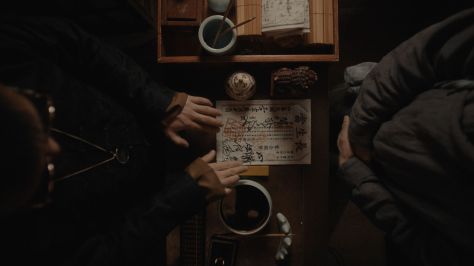
The storyline itself immediately conjures mental images of fright and fantasy infused characters and their surroundings. It was Simu’s task to make the images visible on screen to match the reality of China in the 20’ and 50’s as well as the mystic ideas presented by the subject matter. Feng relates, “The film’s visual dark tone is the key element for the story. We did this through lighting and camera work. I did thorough tech scouting with my long time gaffer Toshi Kizu and planned out the whole low key lighting scheme. I wanted the pawnshop owner character to be part of this darkness; I wanted him to feel inseparable from the shop itself. We hid several single tube kinoflos to give some small pools of light in the room and to add to the depth of the set. Camera movement was also very carefully planned out so the move was always motivated. We didn’t want the audience to feel the existence of the camera. Combined with the blocking of actors, we were able to create tension and a sense of the mystery at the same time. I’ve always felt that, by planning things out appropriately, you can help the audience forget about the technical aspects of a film and thereby lose themselves in the story…which is what we want as filmmakers and what the audience wants as well.” Yizhou Xu confirms, “Simu achieved a very strong visual style in Shop of Eternal Life; a mystery and a sense of darkness. I think this stylish look is the most important part of the film and it’s the first thing people talk about concerning this film. Because of the fascinating visual style, people have the patience to dig deeper on the subject and theme of the film. As a filmmaker, that helps me to tell the story.” Feng continues to explain the look of the film in commenting, “Because the film consists of two different time periods (the 1920’s and the 1950’s.), we wanted them to be really different, making sure the audience gets the idea that the poor man has changed into a monster. The production designer (Dara Zhao) did a great job building the set to be authentic to the time periods yet retaining our own dark and mysterious style. When we discussed the practical lights in the shop, we decided that for the 1920’s we would dress the shop with candle lanterns, and for the 1950s we went with tungsten bulbs. The practical lights are always important for me because all my lighting is motivated from these practical lights. The warm color given off by the lanterns, combined with the black pro-mist filter I put in front of the lenses, gave the 1920’s a softer and warmer tone. I shot the 1950’s with no filter and the tungsten bulbs flaring directly into the lens, making the look harsher and brighter. With more desaturation in color correction, the 1950’s looked pale and cold, fitting the change of the character.”

shop-of-eternal-life-3

Both the look of Shop of Eternal Life and the lesson of the film itself are entertaining and gripping. Yizhou Xu uses his film to communicate the idea that in our sacrificial attempts to help those we love; we risk the danger of turning into monsters. Making a deal with the devil may be very literal in this film but it has great relevance to many everyday choices. The film production itself conceals the challenges that the cast and crew overcame to create such a polished film. Simu Feng is thankful for the creative and unique approaches the production was forced to invent as he states, “Working on a small budget film is always difficult but it can be a truly fun experience if the filmmakers try to make a difference. Every filmmaker will face the situation in which they don’t have enough resources to achieve what they imagined and planned. I always believe certain limitations help yield better result by forcing creative people to come up with ‘poor man’ solutions. The luxury of a big budget does make a lot of things easier, but working on small-scale project helps me to keep the spirit of being flexible and the ability to adapt myself to changing circumstances.”


shop-of-eternal-life-4

shop-of-eternal-life-screenshot-poster