Category Archives: Feature Film

Filmmaker Hollis Sherman-Pepe on Craft, Creativity, and Her Feature Debut

Though she has become known for dreaming up fantastical worlds and elaborate stories through her work as a filmmaker, Hollis Sherman-Pepe insists she’s not a dreamer, she is a doer. And after looking at all that she has accomplished over the course of her more than two-decade career in the industry, it is a statement one can only agree with.

Writer-Director-Producer Hollis Sherman-Pepe

Hollis began her industry journey as an actress. Over the years she has played a wide range of roles in films such as Between Wars starring Primetime Emmy Award winner Michael Imperioli (The Sopranos), Twenty-Minute Exotic Getaway, Adrenochrome, Green Piece, and series such as NCIS and 1000 Ways to Die.

She wrote, directed and starred in the short film To Quiet My Mind, her directorial debut, which was the Festival Award winner for Best Experimental Film at the California Women’s Film Festival, as well as Valediction, for which she received Best Actress Awards from the Los Angeles Cinema Festival of Hollywood and the Los Angeles International Underground Film Festival, along with the Women Filmmakers Award of Merit from the Best Shorts Competition. In 2021 she also wrote, directed and starred in the sci-fi fantasy film Twenty Minute Exotic Getaway, which took home two Best Sci-fi Awards from the Jim Thorpe Independent Film Festival and Pasadena International Film Festival. Additionally it was the winner of Best Cinematography and Best Set Design at NewArk Independent Film Festival.

One of the aspects that makes Hollis such a unique talent is her curiosity; and it is something that has led her to step outside the path of acting, and explore the myriad of other production roles that bring a film to life. Early on in her career she worked as a production assistant, using the opportunity to learn as much as she could from every department willing to take her under their wing. She says, “I still approach filmmaking this way: ask questions, stay curious, work hard and be proactive.”

In 2015 she started Farmer’s Daughter Productions, a women-helmed production company dedicated to bringing powerful cinematic experiences to the screen. Over the years she has produced numerous award-winning films through Farmer’s Daughter Productions, including YES, the winner of Planet Female’s Best Festival Short Award and Noci Film Fest’s Audience Award and Young Jury Award, A Couple of Secrets, which won the awards for Best Film Trailer at Mindfield Film Festival, the screenplays Foxes, a Semi-Finalist at Richmond International Film Festival and Cordillera International Film Fest, and Right Hand Man, which took home the Bronze Medal Award at LGBTQ Unbordered International Film Festival.

Now, as she prepares to release her first feature film, Tenants of Carver Hill, we were lucky enough to catch up with Hollis for an interview about her creative inspirations, her evolution as a filmmaker, and the deeply personal experiences that helped shape her latest project.

For Hollis, the impulse to tell stories has always been rooted in curiosity. She is fascinated by the space between what we know and what remains unexplained, and that fascination has become a recurring thread throughout her work. “There is far more unknown than known to humankind,” she explains, describing the questions that arise from that uncertainty as a source of endless inspiration.

That curiosity doesn’t stop at the page. Hollis approaches filmmaking as an exploratory process, researching everything from philosophy and science to poetry and the ideas of thinkers who have grappled with the mysteries of human existence. She then looks for ways to weave those discoveries into her stories, often using fantastical beings and supernatural spaces to give physical form to thoughts and emotions that might otherwise remain invisible.

It is perhaps fitting, then, that her first feature would be a supernatural thriller — and even more fitting that it would draw on experiences that are very close to home.

“I grew up in a haunted house,” Hollis says. “I think it was perhaps my destiny to make a cinematic ghost story.”
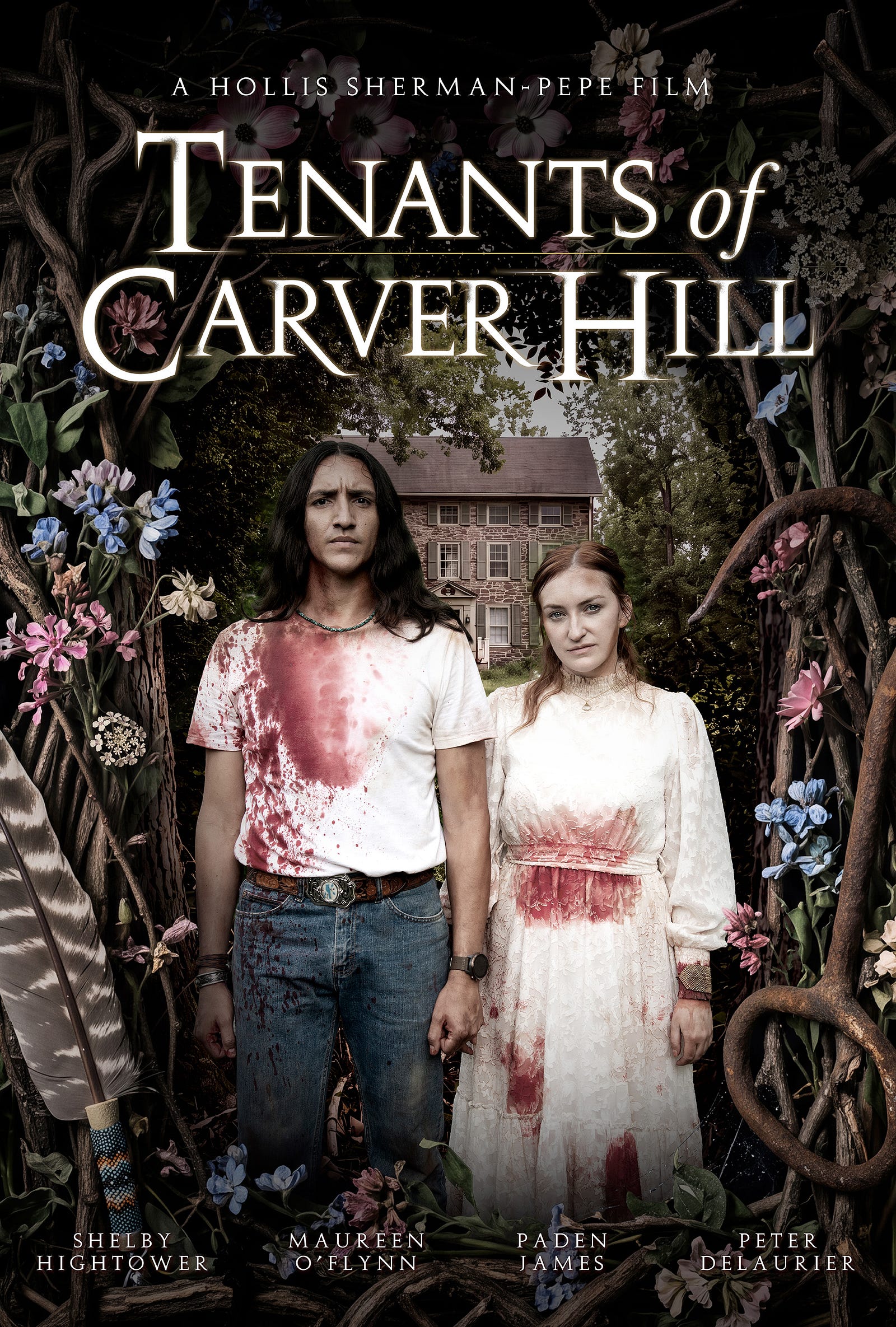
Film Poster for “Tenants of Carver Hill”

With Tenants of Carver Hill, Hollis has taken those real-life experiences and transformed them into a story that explores the mysterious and unseen while remaining deeply connected to its characters, its setting, and the history embedded within it.

A supernatural thriller, Tenants of Carver Hill follows a stranded young couple who spend the night at Carver Hill, only to awaken the spirits haunting the house — transforming one fateful night into an inescapable nightmare. The film features standout performances by Shelby Hightower (HBO’s Task, Netflix’s Tires), Searra Sawka (Hell House LLC: Lineage), Paden James (Prime’s No Rest For The Wicked) and features legendary opera diva, Maureen O’Flynn and theater luminary, Peter DeLaurier.

Welcome Hollis, such an honor to catch up with you. Can you start by telling us where you’re from originally and when you started getting into film?

I am so grateful to be speaking with you. I grew up in rural Southeastern Pennsylvania, outside of Philadelphia. I was always a very creative child and began writing at a very young age. I wrote my first novella by age ten. By my teens, my first camcorder changed how I saw and interacted in the world. I was obsessed with turning our games of playing dress-up into real stories. I made movies all the time: live action, stop motion, documentary. I simply just loved to shoot what I saw.

I was able to save most of my childhood tapes, digitizing them some years back. One of my favorite early films documented an architectural preservation event on our family farm. I set the whole event to Moby’s album Play, and dragged around a boom box on a 100-foot extension cord as I shot beautiful images of construction against a backdrop of blue sky, puffy clouds, and all these wonderful people who came to celebrate the event. I recently dug out the footage and recut it, using the same music and presented it to my family as a special screening. This absolute nostalgia gem meant as much to them as it meant to me.

How did you know that film would be a part of your life for the long haul? And how has it influenced your life?

I was an actor. As young as preschool, I was determined that acting would be my life’s pursuit. I chased that dream, earning my BFA degree at University of the Arts in Philadelphia and making a move to Los Angeles where I continued the work and the training. I loved being on set and wanted to learn as much as I could about production. I started as a hardworking and eager production assistant, garnering as much knowledge as I could from every department that was willing to take me under their wing. I still approach filmmaking this way: ask questions, stay curious, work hard and be proactive.

The first time I wrote and starred in my own short film was in 2012. In that, I found what I was really searching for, creative fulfillment and control of the narrative. It snowballed from there. In 2015 I started my production company, Farmer’s Daughter Productions. I have been producing, directing and shepherding other filmmakers ever since.

My passion for storytelling and art is in consistent bloom. I find my inspiration in nature, art, books, and in folklore. I go to the movie theater often and watch films across all genres and time periods, finding inspiration and studying — how did they shoot that? The language of film is my vernacular, my orbit. I love talking about both the art and the business of film and I feel incredibly fortunate to be surrounded by an ever-growing circle of filmmakers who support, challenge, and celebrate one another.

Making movies is difficult, expensive and time-consuming. These truths are ever present, but they also make the community around filmmaking all the more meaningful. I believe there is room at the top for everyone. Every artist has a voice that can only belong to them. Cinema speaks on such a deep level, providing hope, catharsis and offering windows into experiences we may never otherwise know. I feel incredibly lucky to spend my life creating within that sphere.
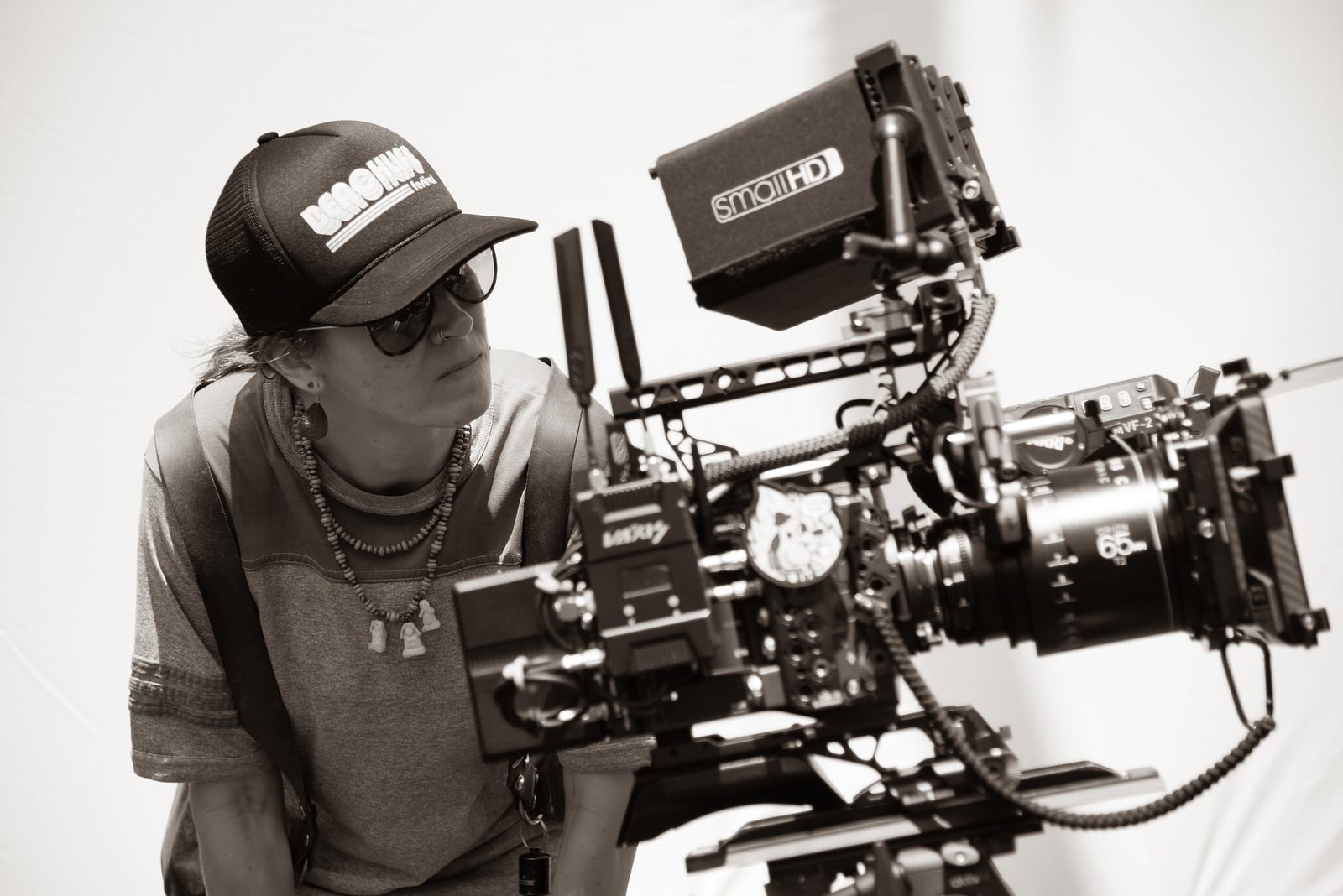
Director Hollis Sherman-Pepe checking the shot

“Tenants of Carver Hill” marks your feature directorial debut. Looking back, what does reaching this milestone mean to you personally and creatively?

I am proud of the work it has taken to get here. I am not a dreamer; I am a doer. My gosh, I have learned so much as a filmmaker over my two-plus decade career and have profoundly grown as an artist. Cultivating my vision and translating it clearly with my team so we can work toward a common goal feels really satisfying. I have never been afraid to ask questions and push my abilities beyond my comfort zone.

Completing a first feature film, particularly one with financial limitations and visual effects demands, feels like an awesome launching pad into the next film and the one after that, and so forth. I intend to keep learning and pushing myself to expand upon what I believe I can create.

Over the past 20 years You’ve worked as an actor, writer, producer, and director. How has your experience in front of the camera influenced the way you direct actors?

Acting is such a vulnerable and beautiful art form. My job as the director is to provide the incubator for the actor to thrive in. As a screenwriter, I love the exploratory aspect. As a director, I like to share the pearls I found along the way with the actors. The pearls include reading material, inspirational art, poetry, music, anything I can offer for their character development. That said, ultimately, I trust them to make unique and honest choices. Often actors will find their own inspiration that they share with me and I then find ways to incorporate their ideas into the story.

As an actor for most of my life, one with a BFA degree and endless training, I have a good eye for what is working and honest within a performance. Sometimes a spark needs a bit of coaxing to become real fireworks and that is when my own training comes out. I love that I can sometimes share the perfect tool from my own toolbox to help an actor realize their fullest potential. I have some absolute favorite acting exercises that I employ behind the scenes. I’ve used them during casting, in rehearsals, and on set to help guide an actor’s sensitivity, connection to co-stars, or even to break a repetitive performance. I would encourage all directors to dive into some acting classes, not scene study, but rather classes that focus on the more subtle aspects of the art.

Sometimes the acting exercises can be physical and I will get right in there with the actor and engage them. The crew on Tenants Of Carver Hill got a real hoot out of watching me jumping and shouting alongside one of the actors. I needed intense frustration and anger from a particular moment, so I got down and dirty with my roots. We jumped up and down to a point of exhaustion. I had him shout the line in my face. I told him to scare me. I would shout it back. We got there. He got there and it paid off tenfold in the cut.
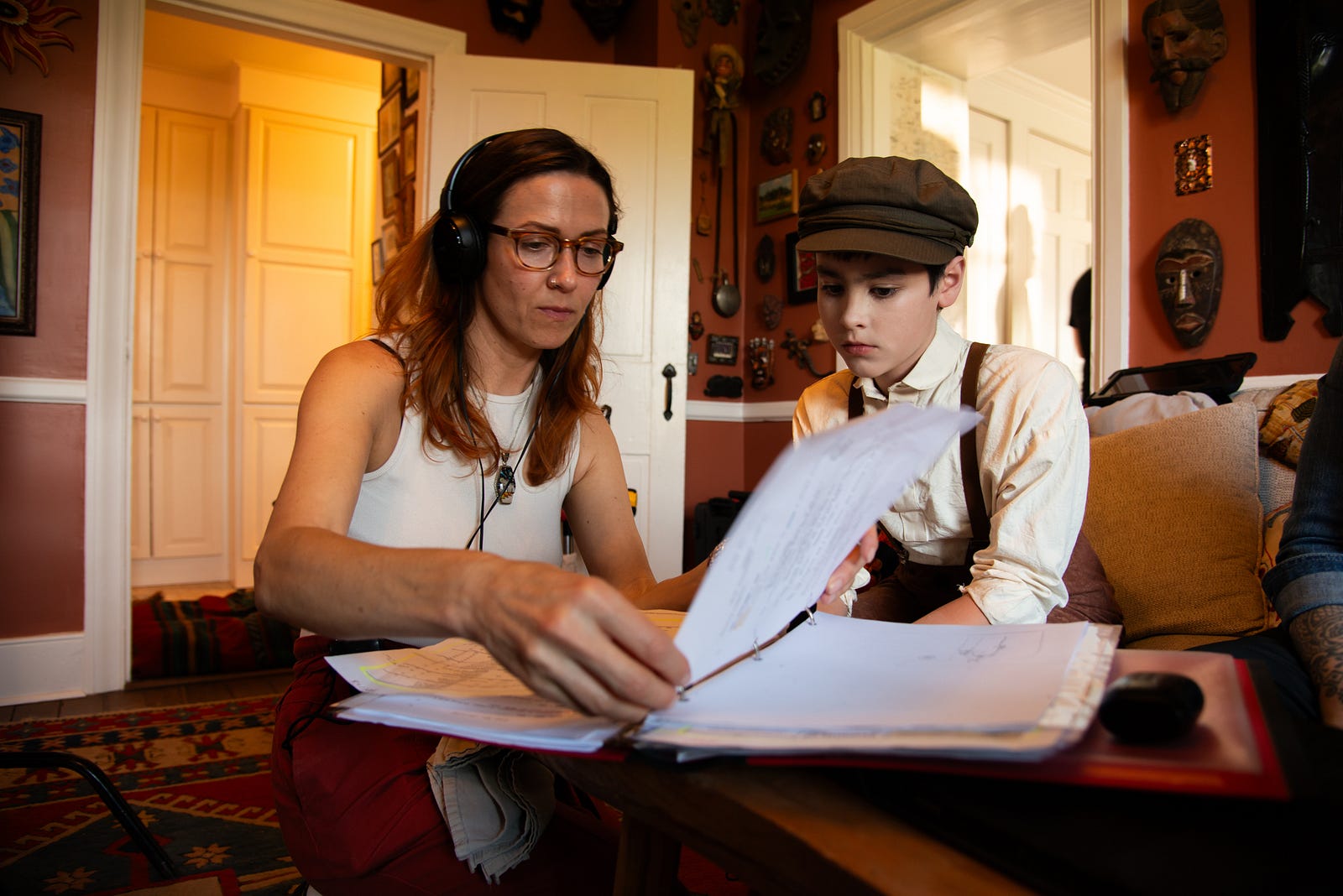
Director Hollis Sherman-Pepe looking through script notes with actor Adam Provo

You often describe your work as exploring the unseen forces that shape our lives. What draws you to stories where mystery, folklore, or the supernatural become a lens for examining human nature?

Unseen forces shaping our lives have been a through line in my work thus far. As human beings, our life cycle is short, and our place in the universe is a marvelous mystery. We are all story tellers; functionally recounting events, replacing lost facts with emotional impressions, as well as inventing explanations for the unknown. From prehistoric cave painters to the legends of the Qing Dynasty, and the traditions of the modern American ghost story, as a species we love to share, imagine and invent. Here on Earth, we are but a pin prick in the vast and ever-expanding Universe. There is far more unknown than known to humankind.

I love the questions that arise from that uncertainty. They give me a reason to research, to read books, papers, and studies written by philosophers, scientists, poets and thinkers. My private holiday is to lose myself in it all, then find clever ways to hide the gems within the stories I build.

Characters interacting with fantastical beings and supernatural spaces gives me an avenue to materialize thoughts and feelings that would otherwise be difficult to see. It opens the door to humanizing concepts and questions. People are marvelously complex. Behavior for most of us is multifaceted. The choices we make are based on morals, emotions and culture. When you introduce spirit realms like magic, faith, consciousness, and new dimensions the possibilities are endless. The supernatural isn’t an escape from human nature, it is a way of looking at it from a different angle.

Although “Tenants of Carver Hill” includes supernatural elements, it feels rooted in history, place, and character. What inspired the story, and what were you most interested in exploring beneath the mystery?

I grew up in a haunted house, so I think it was perhaps my destiny to make a cinematic ghost story. This film became my opportunity to share some of my real-life haunting experiences as well as honor my appreciation for the past.

Tenants of Carver Hill was written specifically for our filming location. Setting the story on a property dating back to the 1700s allowed me to intertwine the real-life history of the house and the Pennsylvania Dutch culture into my story. These early American settlers had their own language, faith, and traditions, and their simple farming lifestyle helped lay the groundwork for the Mennonite communities that followed. I loved the idea that one house could carry all of those eras, lives, and people’s stories vibrating within the walls.

I am fascinated by the idea of destiny versus free will. As modern Americans, we are constantly driven toward success. Our culture is always evolving toward better, bigger, newer, and more efficient. We celebrate the idea that we are free to command our own destiny, but what if we aren’t? What if our position in life was actually predetermined? Like, what if we are part of a much older cycle, a cog in a never-ending wheel, destined to repeat the history of those who came before us?

Our culture prizes youth and beauty. I wanted to play with these roles and expectations, so I set my hopeful heroes in a world that forces them to experience the past, confront duty and preservation. I gave them this challenge but funneled it through a supernatural lens, letting it be enchanting and simultaneously unsettling.
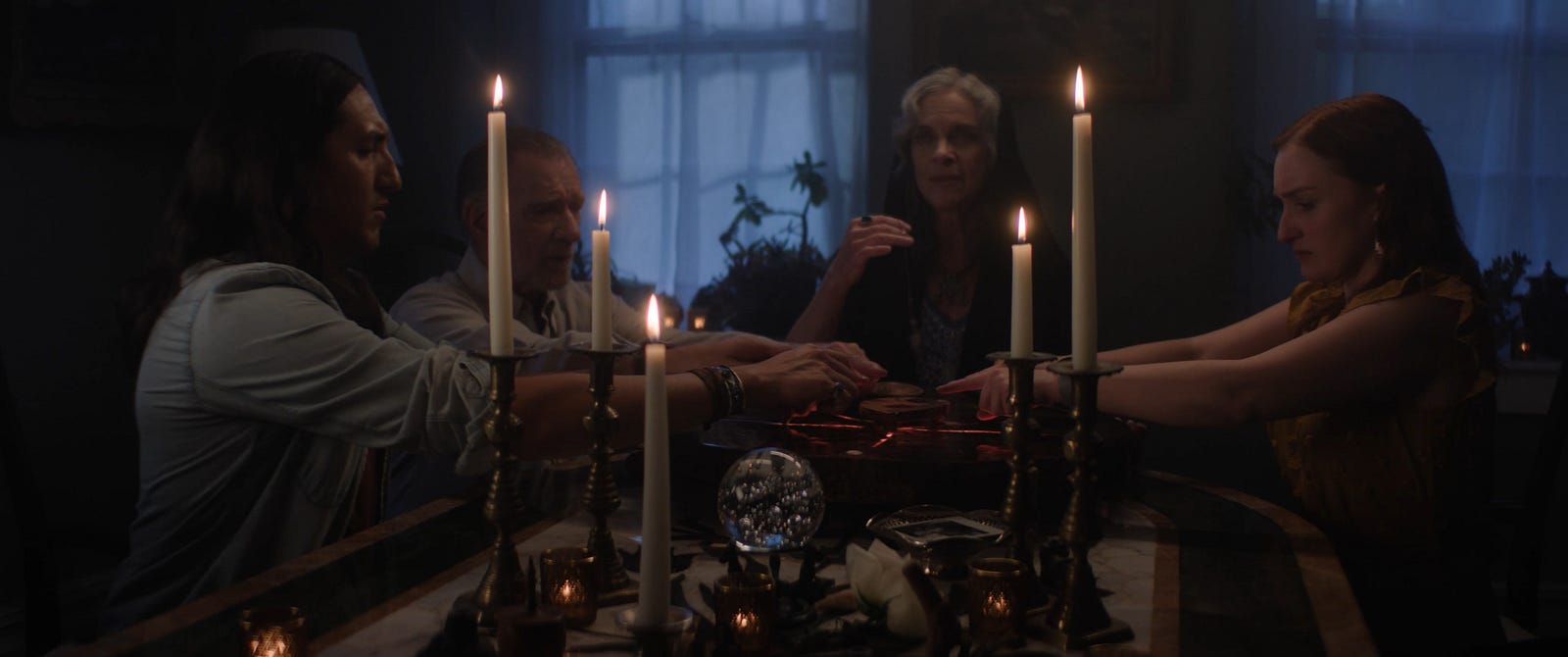
(L-R) Stil of Paden James, Peter DeLaurier, Maureen O’Flynn, and Shelby Hightower conjuring the spirits in “Tenants of Carver Hill”

Your films are known for layered storytelling and richly imagined worlds. What makes “Tenants of Carver Hill” different from other supernatural thrillers audiences may have seen?

I love creating worlds that invite you in, only to later reveal something much darker underneath. Spooky but charming. Warm but secretive. Beauty that fills you with unease. The world of Carver Hill is dreamy. Springtime blooms are as welcoming as the tenants that live there. The perfect misdirection.

I wanted to try something fresh with the look of our ghosts and chose to make them photosensitive. Developing this look with the artist was a lot of fun. The mysterious house was to feel mazelike at times, filled with a collocation of museum-like antiquities and preternatural relics, alive and watching, offering clues to the decades encapsulated within the walls.

I don’t think genre films have to be simple or formulaic. Of course, some formulas work for a reason and Tenants of Carver Hill includes some of those familiar beats and the inevitable “don’t go in there” moments. But ultimately, I love to find ways to break the mold. I’m not a fan of stereotypical characters. I would rather build characters with layers and contradictions. When a character fights with their own belief system or moral code, we as an audience become more invested in the cause and consequence. Watching a complex character make choices is far more intriguing to me.

World building is certainly a specialty for me as a filmmaker. My previous Sci-Fi film, Twenty Minute Exotic Getaway explored a wild variety of environments, from dead planets with suns on the verge of burning out to creatures and ghosts that walked through dimensions that would feel familiar and yet foreign. My unproduced folklore horror scripts also push the envelope of imagination with worlds and creatures. I can’t wait to bring them to life next.

The film incorporates both early American settler history and Native American perspectives, including tailoring your lead character’s background to reflect your lead actor’s Navajo heritage. Why was authenticity so important, and how did those cultural influences enrich the story?

At its core, this ghost story is one about history repeating itself, and memories being alive within the walls. Because the story was site specific, it was important to be authentic with the historical storyline. I wanted the multi-cultural aspects to be organic, not just a flavor enhancer. The male lead is Native American. This felt right for the story because I wanted his connection to the land to be old, an inheritance bestowed for the Settlers arrived, and before the House itself. I left some of the integral parts of his scripted dialogue and action open-ended until we completed our casting. That way my actor could inform some of these choices with their own tribal heritage.

The character is played by a Navajo actor, Paden James. I worked with him directly as well as with a Navajo consultant so I could approach the language and tradition authentically and respectfully. I learned a lot and found meaningful ways to include what I had learned into the story. I learned that a specific prayer is said aloud when a Navajo person enters and exits a graveyard. I included this into one of the earlier scenes of the film. I also included blessings with corn pollen and a prayer song in Navajo asking for protection.

I also wanted the house itself to feel like a character in the story. Using real historical events allowed me to honor the home and memories associated with it. I wove in documented stories, such as how an 1800s patriarch died after being kicked by his horse. The tenants of the estate, characters played by Maureen O’Flynn and Peter DeLaurier, both express their admiration for the home and bestow history of the Pennsylvania Dutch settlers. I sought out consultation for that unique language as well.

Ultimately, by weaving together these various histories allowed me to give the house a truer sense of memory. Not just a haunted-house, but one where generations have left their mark and that is what makes it feel so alive.

Pennsylvania becomes almost another character in the film. What made it the perfect location, and how did filming there shape the atmosphere of “Tenants of Carver Hill”?

Being from Southeastern Pennsylvania, it was personal and meaningful to return and shoot my first feature film here. It was a wild full-circle moment. I knew I wanted my ghost story to feel like a fantasy, harkening back to Ridley Scott’s Legend. We used a variety of filters to create ghostly blooms of light, and we built our shooting schedule around the Springtime blossoms. We planned for scenes around particular trees and flowers as they came into bloom, racing to capture them before the petals fell.

Pennsylvania is incredibly green and lush. This helped our location to feel particularly isolated, making it a little fantastical bubble all on its own. The heroes, played by Shelby Hightower and Paden James arrive at Carver Hill after an ill-fated, cross-country truck breakdown, but soon they are completely enraptured by the beauty surrounding them. The green floral atmosphere feels more like a gift than a warning, a wolf in sheep’s clothing.

And of course, there is the history. Philadelphia was the first capital of the United States. The Northeast is old. If ghosts are the echoes of the past, these walls have a lot to say. There is something inherently uncanny about being alone in a big, old space. It gives you the feeling that you are not really alone. I wanted to capture that feeling in my film.

The production also received Pennsylvania’s film tax incentive. How did that opportunity impact what you were able to accomplish as an independent filmmaker?

We are incredibly grateful for the Pennsylvania film tax incentive. The story takes place in the Keystone State, so shooting there was non-negotiable for us. We took the time to carefully prepare our application and raise the full production capital prior to filming, as required by the Pennsylvania Film Office.

Creating a truly independent film is a monumental undertaking at every step. After completing the project, receiving this incentive feels like a gift. Having fresh funds available to put toward marketing and bringing the film to audiences is an invaluable final piece of the filmmaking process.

Every independent production comes with unexpected challenges. What was the biggest obstacle during production, and what did you learn from overcoming it?

Being ready for anything and willing to adapt and shift gears is essential for independent filmmaking. My show bible is extensive. The script pages are filled with color coded notes and hand drawn diagrams. I keep the pages in plastic sleeves and consult them while shooting. My shot lists are specific and detailed. My cinematographer Nick Pietroniro and I were so incredibly in-tune with one another, creating the shot list, the look books, camera and filter testing well ahead of time. The more you can control and discover in the preparation, the easier it is to change course for the unexpected.

We were shooting in April and May in Pennsylvania, so the potential for rain was a concern. Our 1st Assistant Director, Katrina Gerlach was a wizard juggling our everchanging scheduling needs, child actors that could only work on weekends or after school, talent that needed to fly out mid-shoot for a wedding, talent leaving the country on a set date. There were so many moving parts and sometimes more than 40 camera setups in a day, yet we never once hit overtime and we were able to capture everything I intended to shoot. The vibes were high on this production. I am truly proud of that.

Our principal location was a historical landmark, which brought another set of challenges. The rooms were small, our equipment couldn’t be fastened to the walls or placed on surfaces, and we had to be constantly mindful of protecting the property. Our entire crew took that responsibility incredibly seriously, and we finished without a single incident.

A favorite challenge on set was a shot with my star Shelby Hightower. The camera would spin around her as she was experiencing paranormal contact and sense memories from the past. This type of shot would normally require specialized gear and a larger space. Instead, we were working in a room with a six-foot ceiling and uneven floors. Pietroniro would have to shoot it with a Movi gimbal rather than a crane or circular dolly track. We were shooting anamorphic and had some beautiful lens flares coming in through the windows, but as the camera circled, the operator and equipment began throwing enormous shadows across Shelby. While braving the unexpected rain shower, gaffer, Colin Passman, key grip, Morgan Hartman and team kept adjusting the lights, trying to preserve the flares while eliminating the shadows. We were losing time and falling further behind schedule. Eventually, we had to get scrappy. On each pass of the camera between Shelby and the key light, we verbally cued the gaffer to kill the light. It was whacky but it worked. We captured the quintessential moment using the bare bones, a lot of ingenuity, and a determined crew, and still caught up with our schedule that day.

My takeaways from the experience are to prepare intensely but be ready to adapt, combine and adjust. Always work in service of the film. Stay true to the vision, but ultimately stay true to what the film decides it wants to be. It’s easier to make jazz when the foundation is strong.

On the other hand, was there a moment on set that reminded you, “This is exactly the film I wanted to make”?

That is such an interesting question. From conception through production and post, my expectations evolved with the film. Putting together this stellar ensemble cast really brought it to life uniquely. No other combination of actors would breathe life the same way. Choosing key crew like my cinematographer gave a specific flavor to the film. Working with my editor Brian Ufberg to craft the final picture gave birth to yet another new perspective. Killing my darlings was a powerful benchmark as well, eliminating five scenes from the director’s cut, more tightly crafted the vision. During my pickup days, I added new scenes, and new characters. I also expanded the role played by Searra Sawka, which gifted the final picture in such a paramount way. From the first draft to the final cut, Tenants of Carver Hill developed into something unique. In a funny way, it will never be exactly what I envisioned, but rather it is its own being. The film speaks for itself, a culmination of choices I made along the way with the support of a dedicated team of collaborators.
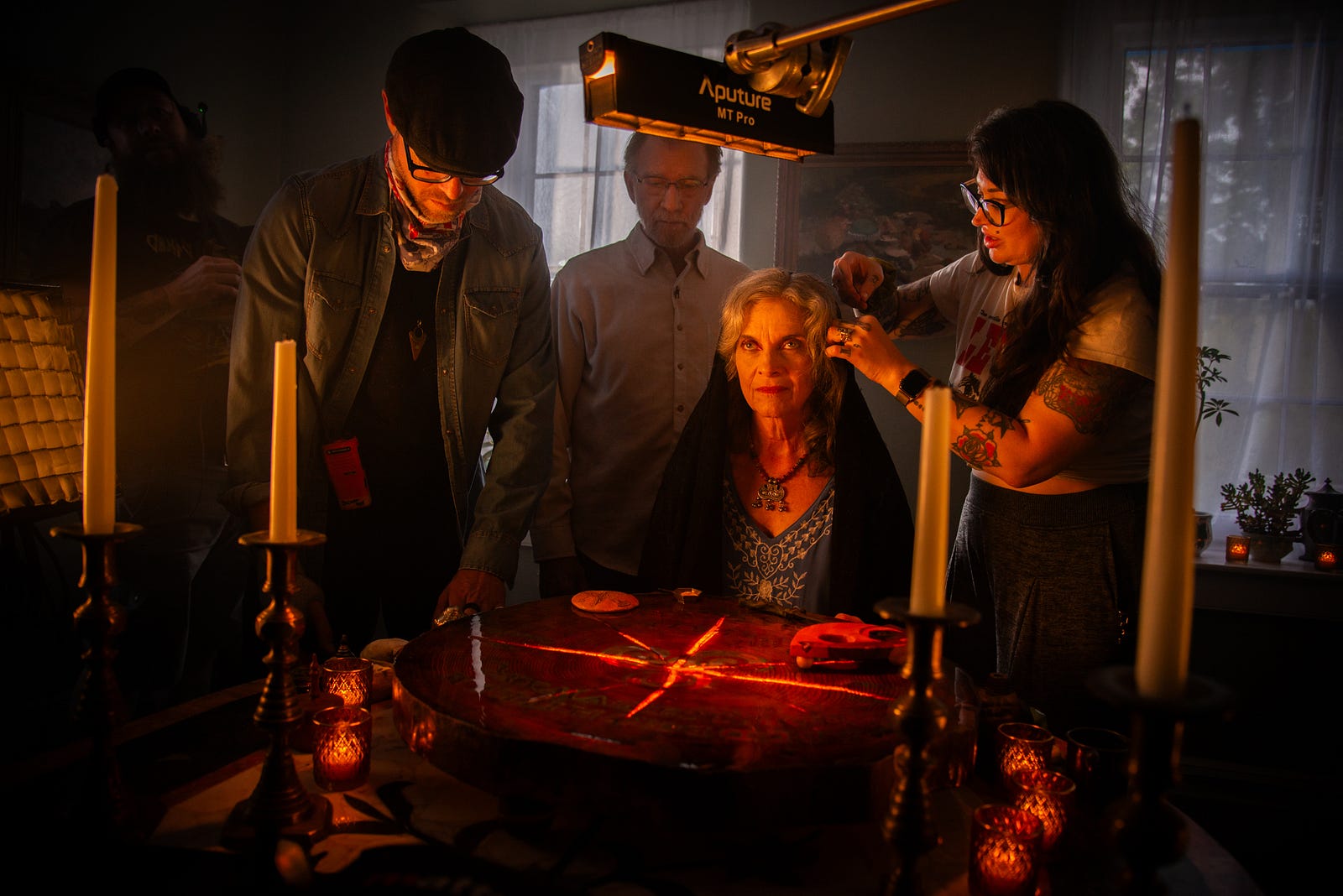
(L-R) Producer Scott Fleisher, actors Peter DeLauier and Maureen O’Flynn, and HMUA Jessica Saint gathered around the custom built spirit board, perform last looks before shooting a “Tenants of Carver Hill” scene

Your bio mentions that you’re a collector of art and antiquities, and that you’re drawn to color, texture, and layered imagery. How do those personal passions find their way into your filmmaking?

I am a more is more person. It’s in the clothes I wear and how I style my home. I’ve always been drawn to color, pattern, art with feeling, fashion with flair. I am drawn to quality craftsmanship and artisan made pieces. I approach my filmmaking this way. Every element is considered and imbued with care. I love to travel, to read, to absorb art and nature. My personality inevitably splashes onto the screen. All of my films have been slightly off-skew from the straight and narrow. Despite what genre I happen to be tinkering in, my voice is clear. I love to fold in layers, ask questions that reveal more questions, explore and invent. Art gives us the ability to expand ourselves in magical ways. Cinema is a particularly limitless medium to do just that.

After completing your first feature, what surprised you most about yourself as a filmmaker?

I might be allergic to keeping it simple.

Every filmmaker grows from one project to the next. What lessons from Tenants of Carver Hill will you carry into your future films?

I have ambitious projects in the queue. A lesson learned from Tenants Of Carver Hill is the value of bringing key collaborators to the table earlier in the game. Having a strong Executive Producer that wants to meet me on that quest will be a game changer.

I would prefer to have my editor on board prior to shooting so that way we can work in tandem as we shoot. With each project, my visual effects needs have expanded. Each time I have had marvelous consultation prior to shooting and exceptional guidance during post. For Carver Hill we created a playbook for how to tackle each shot and we executed accordingly. Going forward I would prefer to have my Visual Effects Supervisor on set, that way we can more easily switch gears, adapt, adjust on the fly, solving problems creatively and professionally as they arise. Ambitious filmmaking requires incredible collaboration. The earlier the right people are in the room, the more possibilities you have when it comes time to make the movie.

Beyond festival recognition or distribution, what do you hope audiences take away after experiencing “Tenants of Carver Hill”?

My hope was to bring a fresh perspective to the genre film world, bridging the gap between the hardcore horror hounds and the introspective indie aficionados. I wanted to celebrate the charm of Pennsylvania with all its history, natural beauty, open spaces, historical landmarks, and hopefully inspire people to appreciate and want to preserve those things.

I’d be tickled if viewers walked away considering that consciousness may be deeper than human thought. That perhaps it is an energy within physical spaces or that conversely, material objects are living within a greater cosmic consciousness. Memories and emotions are alive and transferable, whether we consider them spirits, ghosts, faith or something beyond our current understanding.

My film is chocked full of Easter eggs. If someone picks up on the clues and metaphors, I hope they’ll be moved to watch it a second time and discover something they missed the first time around. Ultimately, I hope audiences appreciate the nuance and craftsmanship behind my picture. If Tenants of Carver Hill leaves you curious and questioning what lies beyond our human experience, I feel as though I did my job.
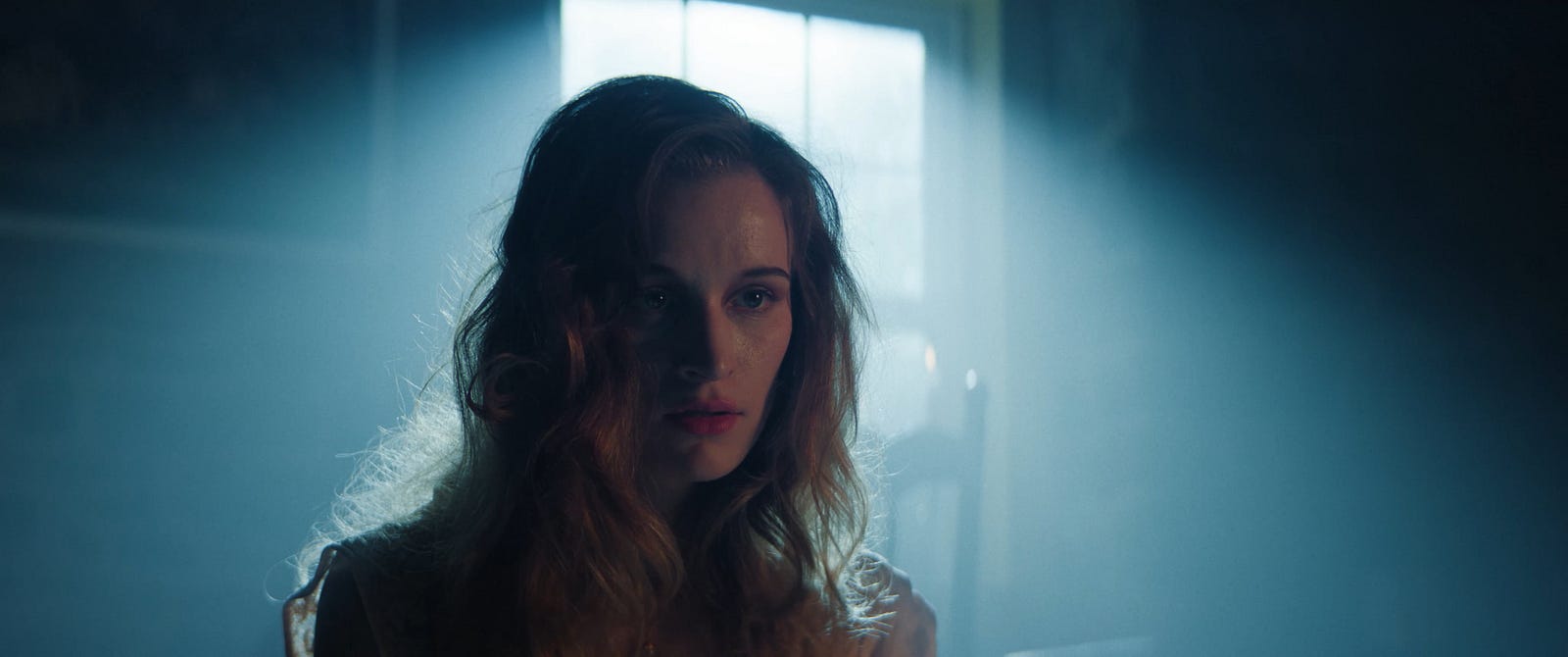
Actress Searra Sawka as Mable Marie, the origin story, in “Tenants of Carver Hill”

Looking ahead, what stories are calling to you next? Are there themes or worlds you’re excited to explore in future projects?

Oh gosh, I have quite a few scripts ready to go and projects in development, so I would hate to let the cat out of the bag. I explore a variety of genres and am eager to dive into new worlds, so I’ll keep the specifics under wraps for now. Interested collaborators can find me through Farmer’s Daughter Productions.

At the end of the day, I believe an artist always needs to be arting. The need to create is as important as the need to breathe. No matter the next picture, I will breathe my life into it and give it my heart.
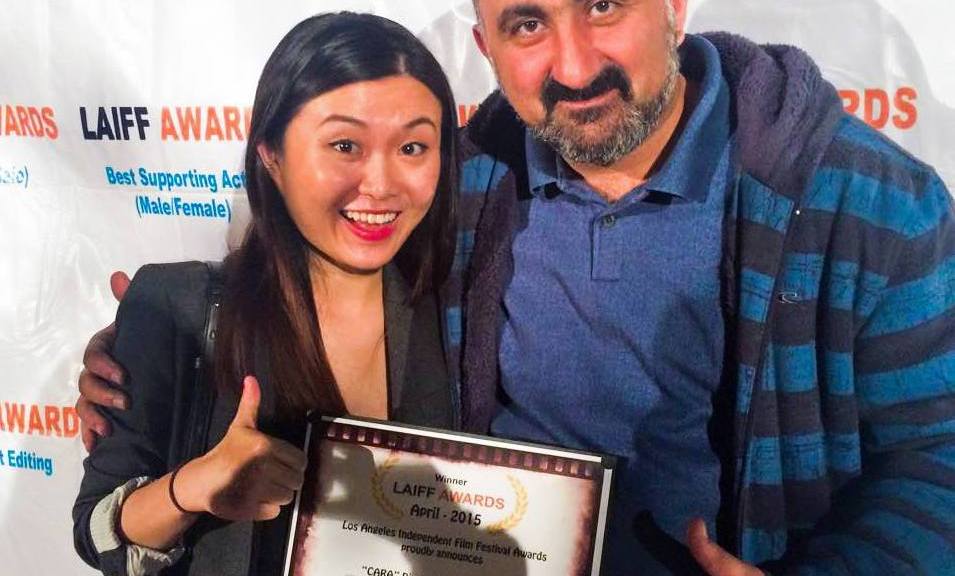
Producer Huanglizi Sun Strives for Excellence

When an audience views a motion picture they’re completely caught up in the onscreen action and story line, but there’s so much more going on behind the camera. Out of the small army of the production crew’s specialized artisans and craftsmen, there is one driving figure head—the producer—and Chinese film producer Huanglizi Sun excels in that capacity. Sun’s combination of enthusiasm, aesthetics, superb organizational skills and instinct for great storytelling qualify her as one of the brightest rising forces in international cinema.

Sun’s lifelong romance with visual storytelling made her career path almost inevitable, especially since she came of age with a major contributor to the form right in her own backward.

“I grew up in Changsha, also called ‘Star City’ which is the capital of Hunan province,” Sun said. ”Changsha is where China’s second-most-watched TV network, Hunan Television, is located and after graduating from Nanjing University of the Arts, I interned there, as assistant to the directors and producers of the 2012 Hunan TV New Year’s Concert and Spring Festival Gala.”

It was invaluable experience which led Sun to gain key insight on her professional destiny.

“After months of hard work, I realized that I wanted to become a film producer rather than a TV producer: Sun said. “Not only because I am interested in filmmaking but also always on the lookout for great stories to tell in a cinematic way. I decided to move to Hollywood where the movies are made and learn how to ‘tell’ a story as a filmmaker.”

It’s a particularly demanding role, one that encompasses virtually every aspect of a production. “A Film Producer is a person who oversees the production of a film, Sun said. “Film Producers plan and coordinate various aspects of film production, such as selecting script, coordinating writing, directing and editing, and arranging finance.”

Based in Southern California, Sun’s drive and  peerless instinct quickly distinguished her.

“I started my career as Associate Producer in Mobscene Creative Productions,” Sun said. “I coordinated multiple editors with different producing teams and acted as liaison with clients. Everything had to happen simultaneously, on a tight deadline, with a very little margin for error, since the broadcasting schedule is on the line. It honed my ability to prioritize tasks and manage a workflow, while also being adaptive and flexible in the process to the ever-changing schedules of all parties involved.”

At Mobscene, Sun quickly found success: “I produced a web-series ‘Talking to Hollywood with Betty Zhou’, which airs weekly on China Central Television Channel (CCTV) 6, Tencent and IQIYI and it quickly gained a large viewership.”

Moving on to a position with fast rising company Big Monster Productions, Sun quickly identified a unique property—the multiple award winning 2015 short, ‘Cara,’ and is currently in the process of transforming it into a full length feature

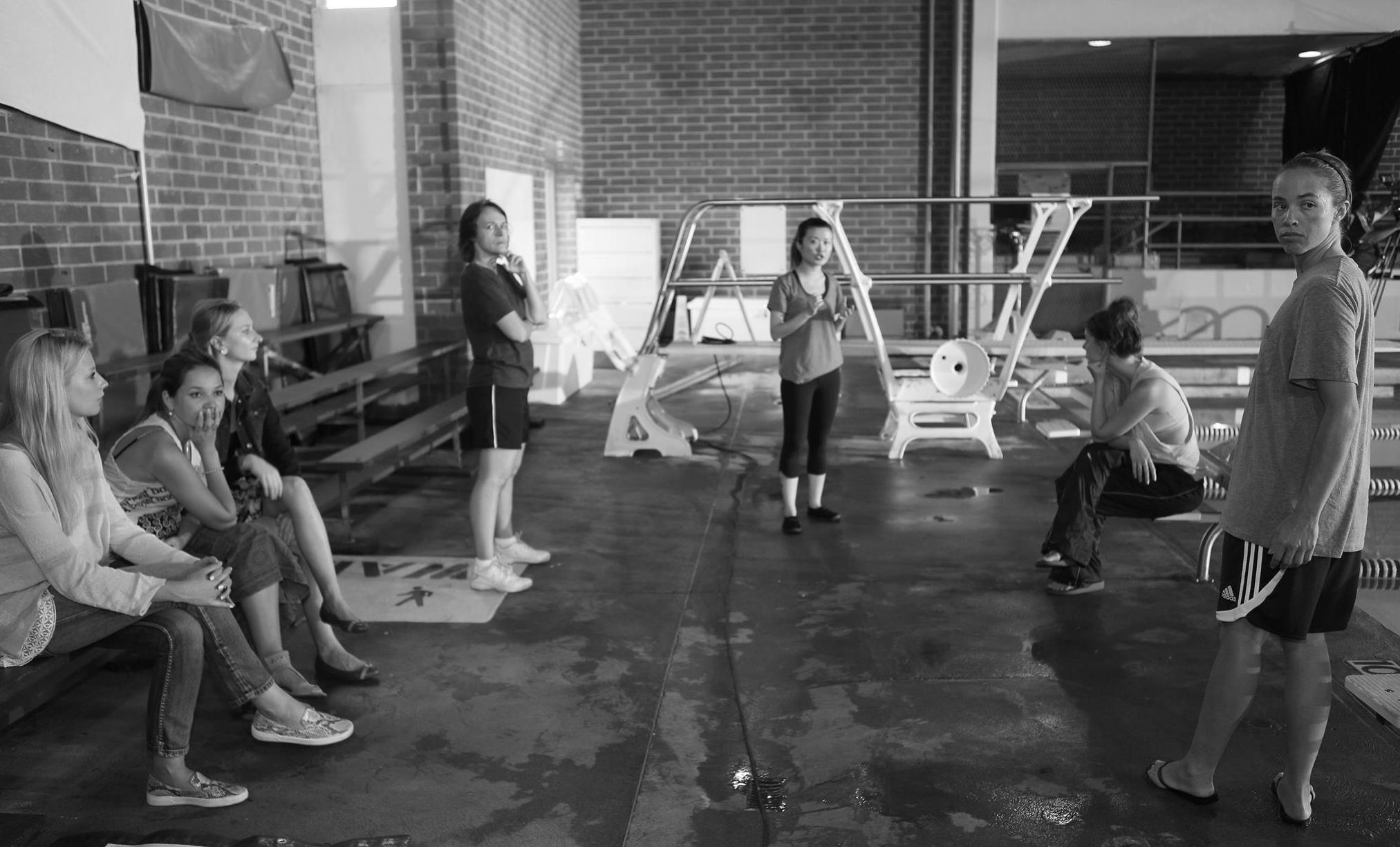
“It explores many themes and motifs that are both timely and timeless—society’s expectation of women, coming of age and the athletic soul,” Sun said. “The story focuses on a fifteen year old swimming athlete who dreams of success with the national swimming team. Two weeks prior to her most important competition, Cara learns she is pregnant. In her last attempt to reach the top, Cara needs to confront the biggest challenge of her life— a decision which could make it or break it for her.”

“In the context of a feature, those themes can be explored in more depth and detail.” Sun said. “Transitioning Cara from a short film into a feature is a decision rooted in the belief that it has the potential to succeed both critically and commercially, given that it tells a story people will truly care about.

Huanglizi Sun on the Cara set

This is where Sun’s holistic grasp on the filmmaking process really comes into play and is certain to provide the production tremendous advantage.

“Writing a short film is one thing, writing a feature can be an entirely different process, one that  presents an entirely different set of challenges,” Sun said. “The story will be significantly more complex than the original and may go through many drafts and revisions before we are satisfied. The next step is going into production and this will also prove to be a challenge—both logistically and financially. It will take meticulous planning, many supporters and a great team effort to truly bring this vision to life.”

Sun’s ability to identify, anticipate, and troubleshoot any unexpected complication or mishap is invaluable in itself, but her comprehensive vision also extends beyond film production and reaches into other key aspects of the business, branding and marketing.

“Ms.Sun is an essential member of our team,” Big Monster president Wentao Wang said. “Her expertise in producing different types of media, ranging from films, promos to branding content is paramount to Big Monster’s success. With an acutely honed ability to judge a project’s potential and the great taste to back it up, she ensures that Big Monster only brings in a roster of projects of the highest quality. From the timely story of “Cara” to pioneering the future of multi-channel network, Ms. Sun single-handedly paves the way for Big Monster to thrive for years to come.”

Having already proven herself both at home and in Hollywood, Sun is clearly a cinematic force to be reckoned with.

“I want to make successful, memorable films, focusing on small characters with big impact that definitely have the potential to take many by heart,” Sun said. As a producer, her mixture of ambition, pragmatism, artistry and understanding of what makes a story worthwhile all combine with ideal symmetry, and what really drives Sun is one simple fact: “Making films is my greatest pleasure.”


BIG STUDIO OR INDIE, THEY’RE ALL IMPORTANT TO DIRECTOR/PRODUCER JOHN ALBANIS

Education is a good thing but, consider that education alone is not indicative of the ability to master something; it’s a springboard to jump into the race. Specifically, when it comes to artistic endeavors, vision and mastery of skills easily defeats the knowledge base of how something “should” work. One can understand painting but it doesn’t make you a painter. A knowledge of the complexities of music theory does not make one a songwriter. Film school does not make you an accomplished cinematographer. While scholarly endeavors may get you in the ballpark, they won’t insure that you will make the team. Of all the aforementioned art forms, film is the newest and thus the idea of attending film school was not available until recently. The pioneers who crafted this art form and by whose hands it evolved were the men and women who learned “on the job.” Considering the fact that film has permeated almost every culture and region of the planet, they did their jobs quite well. Following in the footsteps of these giants is John Albanis. This producer/director had not planned on entering the film industry (moving from Calgary to the UK to pursue rock stardom) but made an artistic switch when he discovered he had a natural skill set that lent itself to this medium. With no formal academic film training, John learned from those he worked with; those who recognized his ability for accelerated learning. Years later, he has cultivated quite an impressive career which rests on both huge blockbuster productions as well as carefully and emotionally crafter indie art films. Feature Films, TV movies, music videos, even recording studios make up the eclectic life of this immensely talented Canadian filmmaker.

John Albanis’s work on major studio films is instantly recognizable and is not confined to simply one genre…unless that genre is “successful.” Some films perform well at the box office and also have a second life on downloads and streaming services, as is the case the Hector and the Search for Happiness. As Co-Producer on this 2014 film starring Simon Pegg, John had the herculean task of taking the production across the planet to locations which included: Canada, the UK, South Africa, China, USA, India, and Germany. The Story and its locations are entertaining and seamless, something which Albanis is quite proud of achieving.

Contributing his full range of abilities to the film Psychic Driving, John was director, producer, and writer of this Film Noir. Inspired by the great political thrillers from the 1970s films like Three Days of the Condor, The Parallax View, All the Presidents Men and based around the CIA mind control program in the 1950’s called Project MK-Ultra (a secret program that ran experiments on human subjects, often without their knowledge), Psychic Driving’s theme was perfectly suited for the Film Noir genre. It also allowed Albanis to indulge his creative side to great length, exhibiting his multiple talents. Utilizing his connections in the film industry allowed for a quick and impressive production schedule. John relates, “When I work on studio films, I build such great relationships with the crews whom I work with. One thing I quickly learned is that there are so many talented artists who are on the verge of breaking. In the case of Psychic Driving, I had recently completed working on Miramax Films’ Shall We Dance. This was pretty early in my career; I was a director’s assistant at that point. But the director, Peter Chelsom, had me very involved creatively so I worked closely with all department heads. I forged relationships with (main Camera Operator) Peter Rosenfeld and (Art Director) Sue Chan. I had written Psychic Driving shortly after the studio film wrapped and I gave the script to both of them. They immediately signed on as Director of Photography and Production Designer respectively. Since we all have contacts in the studio system, we were each able to bring those resources to this small, indie film. That’s why it has such ambitious production values.”

Not content with Feature Films or Indie Films, John also lent his production talents to a series of highly successful made for TV films (for CBS) starring Tom Selleck. Jesse Stone: Stone Cold, Jesse Stone: Thin Ice, and Jesse Stone: No Remorse were all presented in a period of five years.

As he prepares for the next obvious progression in his career, Albanis confirms, “Los Angeles is still the heart and soul of the film and television industry; it’s where all the main players are and where all the deals are being struck. I’m transitioning from being a hired gun producer/director into developing my own projects from the ground up and Los Angeles is the best place to do that. Last year, I purchased the TV rights to a book called The Mirror Thief, which I’m developing with Peter Chelsom to direct into an 8-hr series. It’s a mind-bending thriller that follows interweaving narratives of three driven men all connected by the alchemical possibility of a mysterious book, and shifts from 16th century Venice, Italy— where famed glassmakers perfected one of the world’s most wondrous inventions, the mirror (an object of fearful fascination)— to the seedy Venice Beach waterfront of the 1950’s, to the glitzy trappings of the Venetian casino in 2003 Las Vegas.”

IMG_3526

Costume designer Angela Trivino talks award-winning horror flick “Fear, INC”

For Angela Trivino, a character in any film is born in the fitting room. Yes, the writer creates a character in their mind and a director creates a vision, but the character is not fully realized until they put on their costume. That is why she is an artist and a storyteller. She takes an idea and turns it into something visual. Her talent has earned her a reputation as one of the best, but her passion for what she does as a costume designer is what drives her into work each day.

Trivino completes the transition for audiences from a theatre chair into the film. Her period piece costume design for the film Tragiometry and the commercial for Environmental Working Group Setting the Bar Low, took viewers to a different time, and her work on the film The Fog encapsulated the struggles of a war veteran, even visible in what he was wearing. With this, it was her work in the feature film Fear, Inc. starring Academy Award-nominated actress Abigail Breslin, where she created a horrifying spectacle for audiences, and was pivotal to the film’s success.

“The script was really fun, and I thought it was such a clever story. I knew right from the beginning that I was going to have fun,” said Trivino.

Fear, Inc. follows a company of degenerates who can be hired for a premium to bring your greatest fears to life. But when horror junkie Joe Foster’s customized scare seemingly begins, he and his friends must decide if this company is there to scare them, or make them pawns in their own sick game. The film has 5 bloody scenes, more than 3 dramatic days in the story, 24 characters with different costume changes, and an all-star cast.  As the head of the Costume Design department, Trivino not only designed every look, but also lead her department in different office endeavors like managing finances, scheduling fittings, doing alterations, and executing breakdowns of the script in order to keep track of continuity.

“Just as the story, the characters were young, fresh, and hip, so my inspiration was mainly contemporary trends. However, the film had a dark side to it, as it was also a celebration to horror American classics such as Scream, A Nightmare on Elm Street, The Shinning, and The Game. Therefore, keeping the aesthetic references from these films was key to creative process of the project,” Trivino described.

As a designer, Trivino wanted to make sure every character’s costume reflected who they were. She had multiple meetings with the principle cast to discuss their character, and the physiological layers to come up with the right look for the story. While filming, she was on set to give final approval on the looks, and assisted with any last-minute costume changes.

“From the moment we met Angela, we knew that she was going to be the one ready for the challenge. Angela is a hard-working designer with the absolute best energy on set to work around actors and help them find their characters through their costume. She truly helped us tell our story using wardrobe. She really understands contemporary trends, and was able to achieve an overall hip fresh look for the cast. Angela is incredibly intuitive. We never had to manage her or worry that our cast wouldn’t be in the right wardrobe. She was consistently on top of her job. Angela went above and beyond what we asked of her and that truly shows with the success of the film,” said Luke Barnett, the writer and producer of the film.

After premiering at the Tribeca Film Festival last year, Fear, Inc. went on to be an Official Selection at the Sitges Film Festival and the San Diego Film Festival. It was then released on Amazon Video, YouTube, ITunes, Vudu, Google play, and Hulu.

 “It is so gratifying, and a total surprise that the film has done so well. I knew the film was going to do great, but I think the results totally exceeded my expectations,” said Trivino. “The film was Luke’s baby and you could feel the passion around set.”

That energy on set made all the challenges that came from shooting a horror film worth it. They shot in a short amount of time, and Trivino’s department overcame any obstacles that would ordinarily arise with a tight timeline. The experience made her want to work on even more films in the horror genre in the future.

“It was a film about horror films, so the impact of these films was huge. However, we wanted to visually quote these movies in a way that they would fit in the contemporary hip, young world that we wanted the story to have,” Trivino concluded.

Viewers wanting to see Trivino’s bloody work can watch the full-length film here.

Art Director-Motion Graphics Designer Ilya Tselyutin Thriving in Hollywood

Art Director-Motion Graphics Designer Ilya Tselyutin works in one of the most fascinating, fast moving and over looked fields in modern media. Motion Graphics is a constantly evolving, creatively fertile niche that entails creating everything from eye-popping feature film title sequences to innovative television commercial applications. It’s a complex mix of graphic design, animation and cutting edge technology that requires innate resourcefulness, meticulous attention to detail and the ability to bring life to  a very broad spectrum of images—qualities which the Russian-born Tselyutin has no shortage of.


“While studying computer science at university, I developed interest in 3D graphics,” Tselyutin said. “I was always curious how this technology worked. At the same time I started looking at works by some famous graphic designers and learned about typography. I wanted to bring all of this together – 3D graphics, animation and design. Also, I drew my inspiration from title sequences from Hollywood movies, as well as the special effects in sci-fi movies.”


A painstaking, gifted craftsman whose outstanding work has been recognized with international awards—Silver winner for Art Direction at Cannes Corporate Media & TV Awards, and a Silver Win for Graphic Design/Animation at PromaxBDA, both in 2013—Tselyutin has distinguished himself with an impressive roster of career achievements. All this has led him to the field’s epicenter, Hollywood, where he enjoys a position at the prestigious Troika Design Group, a top branding and marketing agency that specializes in working with entertainment and media companies

Troika_Office_2

“Troika is one of the most notable companies in the industry,” Tselyutin said. “I had learned about it a while ago and they were looking for a lead motion graphics designer to bring the quality of 3D graphics to the next level. Paul Brodie, the Managing Director, was closely following my work and invited me to join the company in 2016, where I am currently working as Art Director/Motion Graphics Designer.


At Troika’s Design Department, Tselyutin has successfully undertaken jobs for a disparate series of high profile clients. “We have a very busy schedule with plenty of projects coming my way every day,” Tselyutin said  “The most interesting projects so far have been for AT&T Sports Network and ESPN College Basketball. The video for AT&T included working with the client’s static footage. As a lead designer on this project I suggested using a special technology in Cinema 4D software to cut the static footage into several pieces an then project them onto 3D models, and the result made both the team and the client happy.”


Tselyutin’s gift for surpassing expectations is a result of his widely varied cultural background and educational experience. With a Bachelors of Arts in Information Technologies and New Media from the Kuban State University, Krasnodar, Russia and a resume of jobs all over Europe, Tselyutin brings a refreshing international perspective to any project assigned him.


“While I was studying computer science, I started working at the local TV channel as a designer discovering the world of 3D graphics,” Tselyutin said. “I developed interest in design, typography and animation and after graduation, I moved to Moscow to work at the national largest TV network Channel One Russia, where I had the privilege to learn from the best and most experienced broadcast designers in the country.”
 

“My work brought me around the world,” Tselyutin said. “For example, I produced a 3D mapping show in at the Technology University of Mangalore, India. In 2013 I moved to work at VUCX creative agency in Cologne, Germany. Working and living in Europe with its variety of art museums, exhibitions and strong school of design was a great experience that helped me expand my portfolio and explore motion graphics even further.”

Troika_Office_1

For the driven, ambitious Tselyutin, whose formidable resume is already packed with enough accomplishments to stand as the full measure of a professional career, it is only the beginning. “I am eager to continue my personal development as an artist, 3D professional and art director while growing professionally within the company,” he said. “I see myself working on large-scale commercially successful projects.”

“My motto is: be curious, be professional, never give up.”

Film Producer Kseniya Yorsh’s Creative, Kinetic Approach to Movie Making

Film producer Kseniya Yorsh’s approach to cinematic excellence is a high-powered mixture of meticulous attention to detail and an impressive grasp of comprehensive overall scope of any project. Although a relatively recent arrival to Hollywood, Yorsh’s brief yet fruitful career trajectory encompasses a broad spectrum, including music videos, feature films, documentary and shorts—four of which were screened at the Cannes Short Film Corner. Most recently, Yorsh produced Visitors, an engrossing Science Fiction short drama that’s been getting a lot of attention and is set to be showcased in half a dozen prestigious film festivals across the country in 2017.

The Belarus-born Yorsh always gravitated towards the creative, a pursuit which inevitably led her to film. “As a kid and teenager I received all sorts of artistic training,” Yorsh said. “Classical piano, theater classes, film school, literary practice, and I learned 3 foreign languages. As a young adult I worked extensively in business, and all these disciplines have helped build my film producing career. Once I decided to devote myself fully to filmmaking, I came to the US, got a degree in Documentary Filmmaking at New York Film Academy and in Entertainment Business and Management at UCLA.”

Ambitious and focused, Yorsh perfected her craft with experience in almost every aspect of filmmaking. She has written, directed, acted, edited, and worked as an art director, make-up artist, production designer, even in the sound department. It’s an impressive background that’s created her near encyclopedic grasp of what a film producer must both anticipate and turn to the project’s advantage—locations, crew, casting, supervising daily operations on set—and her roster of achievements currently stands at 13 shorts and 3 feature films.

The intense, idiosyncratic Visitors, which combines themes of family dysfunction and chilling otherworldly suspense, offered Yorsh some unique opportunities for trouble shooting.

“Alon Juwal, the director, came to me with the script and the budget he had for the film and I transferred his ideas into a feasible reality,” Yorsh said. “We had some shots that were difficult from a technical standpoint. For example, we had a shot where we see the main character in a beam of light as if from a landing spaceship. We were filming at night so it had to be bright light coming from the sky, with a lot of wind, and us moving in closer and closer to his face. We had aerial shots; we had night shoots in a forest; we had a dog that we needed to film at night; we had guns, special effects.”

“When producing a short film, budget and logistical limitations make you become creative in solving technical challenges and making sure the shoot like this is done in comfortable and safe conditions for the actors and the crew. Figuring these things out was an exciting challenge for me as a producer.”

Characteristically, Yorsh met every concern head on and turned in a flawless finished product. Her vision and drive not only set Yorsh apart but also unfailingly impress her colleagues. “I first met Kseniya a few years ago and was immediately impressed by her clear vision, discipline, imagination and passion,” Sergei Stern, the film’s musical composer, said. “When I was recommended as a composer for Visitors, I was pleasantly surprised to find out that Kseniya was the producer. She and Alon built a great team around this wonderful project and I think we did a solid, beautiful film that combines visual beauty with an emotional, dramatic story.”

Released in late 2016, the film—like just about every project Yorsh takes on—has been well received by audiences and recognized with awards at the Boston Science Fiction Film Festival and New York City International Film Festival. And since then, she has already produced an feature film and 2 shorts and has another currently in pre-production.

“I love producing because it’s about seizing an opportunity where one doesn’t exist before,” Yorsh said. “It’s about bringing people together and being able to recognize unique skills in a person and link it to someone else’s skills or written material. I love seeing people shine professionally and I love bringing good material to life.”

UK Actor Anthony Warren Nails it Again with the Film “Hard Time Bus

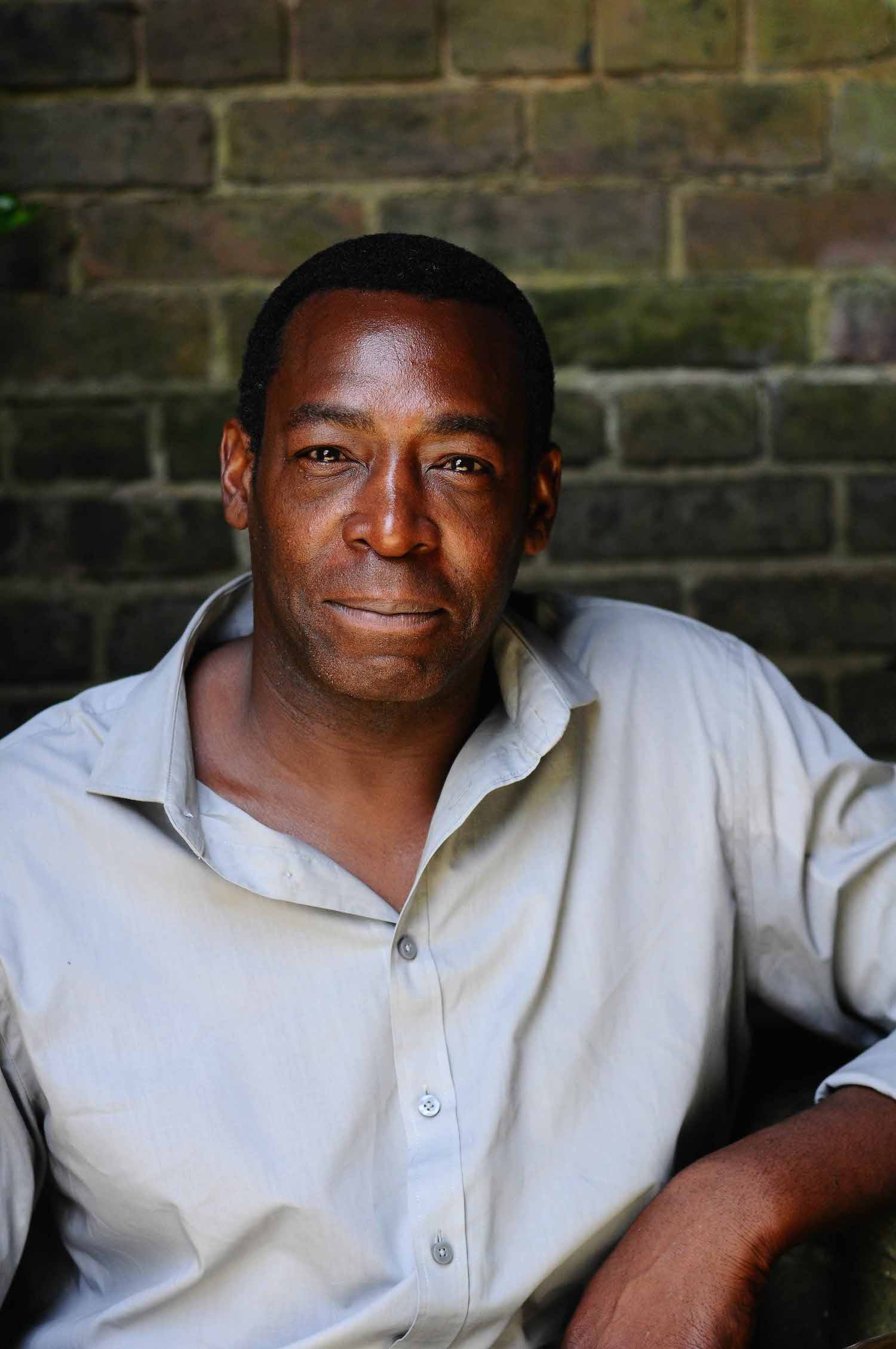
Anthony Warren
Anthony Warren shot by Will Tudor

With lead roles in several highly rated BAFTA Award winning series and now the award winning feature film “Hard Time Bus” produced by 2HotFilms, Anthony Warren has enjoyed a tremendously successful acting career. The fact that he has now appeared in so many celebrated projects, and the addition of his most recent performance in “Hard Time Bus,” have made it clear that Warren’s success is a testament to his sensational skill, hard work and magnetism on screen.

If there’s one trend in Warren’s long list of characters, it’s his inimitable ability to convincingly slip into the world of crime. Warren’s feature films include the crime drama “The Contract” where he acts opposite Golden Globe nominee John Cusack (“Serendipity,” “Maps to the Stars”), as well as the Golden Reel Award nominated crime thriller “Control” starring Ray Liotta (“Goodfellas”) and two-time Oscar nominee Willem Dafoe (“Spider-Man”).

In the world of television Warren’s taken on recurring key roles on several hit crime dramas such as the two-time BAFTA Award winning series “The Bill” where he acts alongside Simon Rouse (“The Practice”), “Eastenders” starring Patsy Palmer (“Do or Die”) and “Murphy’s Law” where he shares the screen with Golden Globe nominee James Nesbitt (“The Hobbit: An Unexpected Journey”).

With such an impressive resume, Warren has certainly forged a distinguished and unique reputation for himself in the entertainment industry on an international level.

Warren, of course, did not wake up a success overnight. “I got into acting over twenty years ago,” Warren remarks. “Initially starting as a hobby, however, [it grew] into a passion and eventually a career choice.”

It’s clear that Warren has taken his craft seriously. After graduating from one of the UK’s leading drama schools and performing with the Ovalhouse Theatre Company, Warren has gone on to act in numerous film projects in the UK and Europe. He has worked alongside twice Academy-Award nominated director Bruce Beresford, Morgan Freeman, Michelle Rodriguez and many more household names.


hard-time-bus
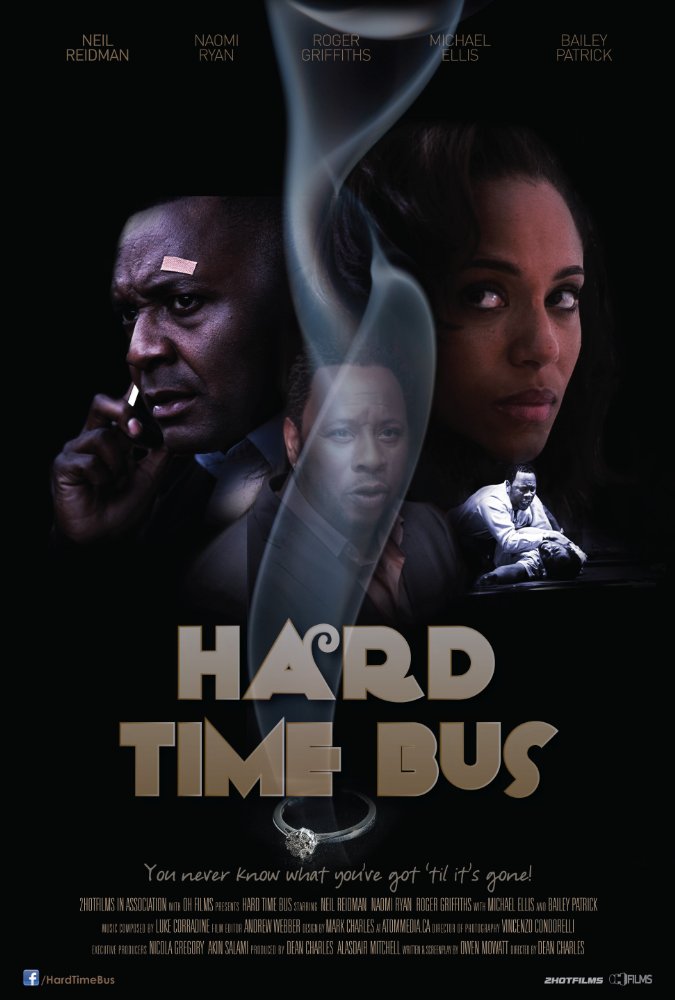
Poster for “Hard Time Bus”


Now, with “Hard Time Bus” having screened internationally and recently winning the Jury Prize at the Hollywood Black Film Festival, Warren has yet another impressive credit to his resume. Directed by Dean Charles, also known for “Birthday Treat” starring “Casualty” star Neil Reidman, “Hard Time Bus” is a multi-faceted drama that examines the complexities of modern relationships and deceptive friendships. Warren brilliantly explores the latter in the lead role of Langas, a Jamaican-Patois speaking character who has no problem with bullying or cheating money from others.


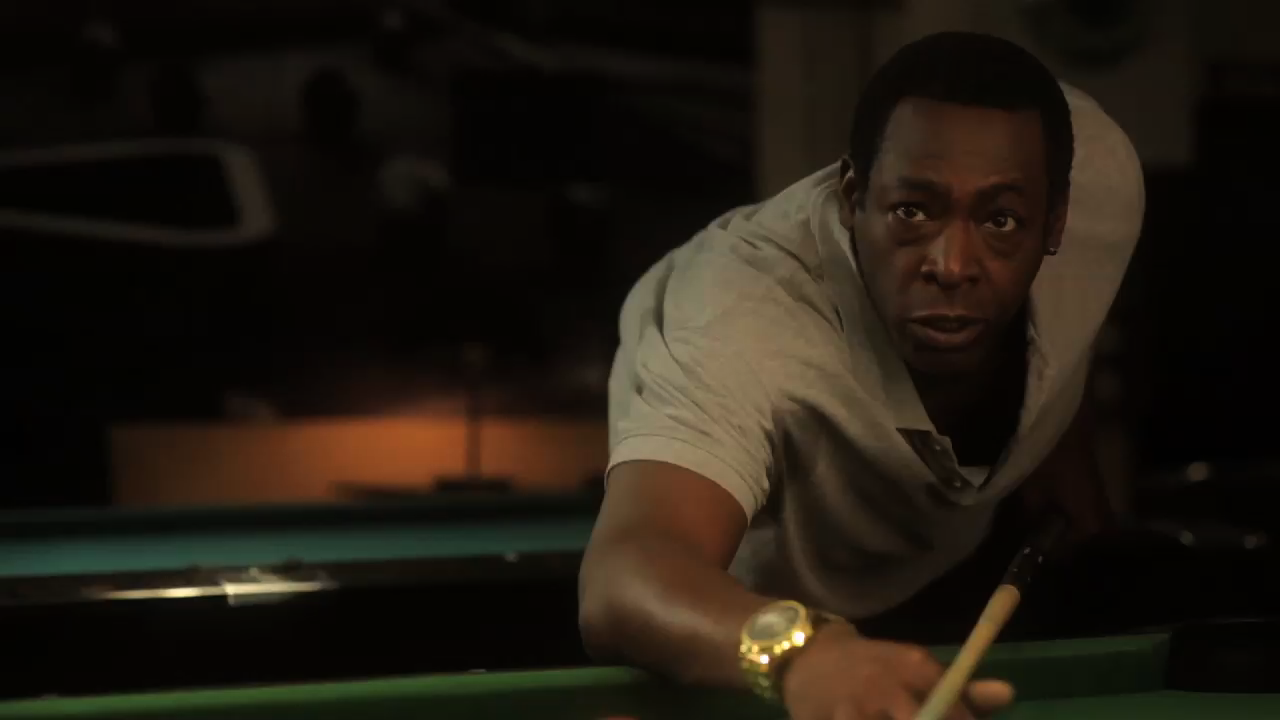
"Hard Time Bus"
Still of Anthony Warren as Longas in “Hard Time Bus”


In a reflection of how he skillfully portrays people far different from himself, Anthony speaks of Langas like he would an old college friend. “He is so horrible to people around him but lovable to the audience in the way he is horrible – if he was one of your friends you’d keep a distance or want to punch him in the mouth.”

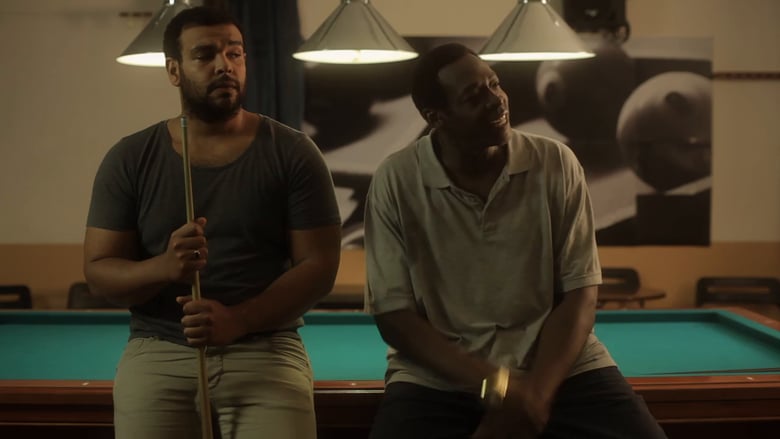
The film’s iconic pool hall scene, where the characters fight after Langas trash talks the girlfriend of one of the pool players, was a particular highlight for Anthony. “The scene had actors that I had worked with before and [am] still good friends with.” 


Michael Ellis Anthony Warren
Still of Michael Ellis (left) and Anthony Warren (right) in “Hard Time Bus”


It’s no surprise that Anthony’s maintained friendships with his fellow actors – those in the entertainment world are fully aware of his commitment and significant contributions to the industry. Besides his work of course, he has mentored numerous young actors and actresses and developed a reputation for being a friendly collaborator with everyone on set.

He admits, “It is a really different dynamic when you work with your friends. I feel a lot more at ease due to the experience and history we have together.”

With a cast that includes Aren Devlin (from Brad Pitt’s “World War Z”), Roger Griffiths (“Holby City,” “Doctors,” “Doctor Who”) and Naomi Ryan (“Guardians of the Galaxy,” “Mr Selfridge”), “Hard Time Bus” puts Warren in a position to call some illustrious company his friends.

The added benefit of being everyone’s favorite guy on set? People want to work with you even more, so it will come as no surprise that Anthony is slated to be involved in future productions produced with the production company 2HotFilms.

Megan Waters to produce upcoming sequel of hit film Ditch Day Massacre

waters_0077
Megan Waters is a producer from Toronto, Ontario.

Megan Waters is many things. She is a Canadian, born and raised in Toronto. She is a pinball enthusiast who loves retro games. She is a world traveller and describes the world is her playground. She is a salsa dancer, believing it to be an amazing dance and community. And above all else, she is an extraordinary film producer, using her skill and creativity to entertain audiences.

Waters passion for producing is evident. She has been producing for over twelve years, and has received praise and recognition for her talent. In 2012, the “Soul of a Ninja” Kawasaki USA commercial she produced won the Bronze ADDY Award at the American Advertising Awards. The first feature film she produced, Ditch Day Massacre, won the 2014 Best Feature Length Horror Film at the Burbank International Film Festival. Waters is one of those people who knows she is doing what she was meant to do.

“Why be the puppet when you can be the puppet master?” said Waters. “I got into producing because I love the business just as much as the creative process. As producer, I get to wear both hats and interact with all aspects of production.”

Now, Waters is set to continue her success of Ditch Day Massacre by producing the sequel Ditch Day Massacre II. The film will follow the character of Jenny, who is placed into a mental institution after suffering from a mental breakdown as a result of a brutal attack. Little do Jenny and her mom know that what’s inside the walls of the mental institution is far more deadly than the world outside. There will also be a documentary about behind-the-scenes look into the making of the film, which Waters will be producing.

“Working on Ditch Day Massacre has been the highlight of my career. It taught and tested me so much. It was an incredible experience as the crew all had the same level of passion and commitment to making this project go,” she said.

Waters had help on Ditch Day Massacre, with producer Michael J. Zampino as a consultant for the film. Zampino has lots of experience working on horror films, including distributing the award-winning film The Slaughter. Despite this, he was still impressed with Waters’ commitment and knowledge of the genre.

“What sets Megan apart from many producers is that she has confidence but very little ego. That’s extraordinary in our business itself. Megan moved mountains and motivated everyone to bring their A-game to complete Ditch Day Massacre in 17 days,” said Zampino. “Megan is a tireless worker who strives to carve out not one film but a career worth of films. Ultimately, the film would never have been completed, and never would have received the attention and sales that is has, if it weren’t for Megan’s drive and leadership. Megan’s successes in the international film and television industry marks her as one of the most successful and skilled producers to come out of Canada in some time.”

Waters’ success is not just limited to film. She produced the Emmy-nominated series Chop Cut Rebuild and the Speed Channel series Street Tuner Challenge. It is not the accolades that motivate her. She says every project is a creative and logistical puzzle that needs to be completed.

“I create and execute. I get an idea, script, project, client need and make it happen. I usually start from where I wish to finish and then work backwards. I think mostly in visual stories and then align the team and resources to execute,” said Waters. “When I produce I like the challenge of figuring out the puzzle pieces and then putting them together. Plus, all the hurdles that make it a one of a kind experience on each project. I love that producing offers a different road every time. I fear a career that becomes repetitive. I love the randomness and goal of planning for the unpredictable. It’s organized chaos and when you build the team that communicates, respects and share the same passion for the project amazing things happen.”

Part of this passion also comes from using film as a tool to send a meaningful and powerful message. Waters has seen. a lot of success while making PSAs, especially producing the PSA “Over Watering Is Out” about water saving gardening. Part of what makes her PSAs captivating is that she refuses to create what she would consider “boring content.”

“When I am considering film or documentary projects I look at the story. It must hold my interest and I must feel passionate it about it. I say this because it takes everything in you to complete a long format project. If you don’t have a connection to it then you will be pulled away from it and it will never get done,” she said.

There is no doubt that with the innate skillset Waters possesses alongside her passion for the industry, her name will continue to roll past the eyes of audiences in the credits for years to come. She is determined to produce quality, and she never lets anything stand in her way.

“I expect and accept challenges. It’s part of producing. I actually joke with my teams that my title may be ‘producer’ but it should be changed to ‘head problem-solver.’ I am proactive and focused on the solution when challenges arise. It’s better to work toward the solution and communicate, communicate, communicate. Some of the best creative ideas have been derived and developed because of a challenge,” she concluded.

You can look out for Waters’ work on the upcoming Accio Cine feature film From Dust to Diamonds, and of course, the anticipated Ditch Day Massacre II.


Film Director Claudio DiFede’s Date with Cinema Fate

The movie business is fraught with ambition, cynicism and expedience—qualities diametrically opposed to producer-director Claudio DiFede’s gentle, artistic nature. The Canadian-born DiFede, who is equally at home working in television and motion pictures, betrays a gentle, individualistic aesthetic that is a refreshing divergence from hard driving commercially-fixated attitude which so frequently saps the creativity from mainstream Hollywood projects.

Claudio’s aesthetic, part vulnerable hesitancy, part determined auteur, part pop culture guerilla is showcased in his unusual, career defining documentary film “Calling Spielberg.” The story is one of fateful twists and human foibles that reflects the film maker’s distinct, creative philosophy.

The origins of “Calling Spielberg” goes back to the early 1990’s, when the 22 year old Claudio was barnstorming through Tinsel Town, tuxed up and cheeky enough to finagle his way into the People’ Choice Awards ceremony at Sony Studios. This was a star-studded, formal affair with tight security which the charming film maker easily bypassed. Backstage following the presentations, Claudio came to face to face with his greatest idol, the legendary director Steven Spielberg.

“It was a once in a lifetime thing—by chance if you will!” Claudio said. Like my whole life had lead up to that moment in time. It was crazy! Spielberg had just accepted the People’s Choice Special Tribute award and I found myself, backstage, just walking right beside him. It was one of those things I’d always thought of, ‘what would you say to Spielberg if you met him?’ Well, it happened, it took a lot of chutzpha but I introduced myself and I told the biggest Director in Hollywood: ‘Take it to the bank,’ I told him. ‘You and I are going to work together one day. For a split second I thought ‘WTF did I just say to him?’ He smiled, asked my name again and replied ‘Sure kid, why not?’”

Emboldened, Claudio repeated the feat weeks later, but at even higher profile affair: the post-Academy Awards Governor’s Ball at Shrine Auditorium, a big night for Spielberg whose “Schindler’s List” had just won seven Oscars, including Best Picture and Best Director.

“It happened again a few weeks later, after the Oscars,” Claudio said.  This time I found my chance, I hugged him and face to face I told him that I can only imagine what it must be like to create such an incredible, moving film as Schindler’s List. He replied ‘Thank you,’ and told me it had taken a lot out of him. I then asked, ‘So, when can I call you?'”

DiFede today would not elaborate much more on the conversation or on his reply “I don’t want to give out too much on the film,” he said. “But let’s just say; it was encouraging.”

“I drove home that evening, roof down and I remember I couldn’t contain my emotions any longer. So I let out the loudest scream!” Claudio said. ‘The fact he remembered my name from our first meeting—it was a feeling I cannot describe. We all have dreams and this was mine. It was nothing short of a crazy euphoria.”

Was it just a lark, a childhood fantasy that had unexpectedly played out? Time passed. Claudio moved along with his life, fell in love, married, and started a family.

“I never called the man,” he said. “I had the chance, and I never did. I was asking myself that question. Then It occurred to me, I must be the only human being that never called Steven Spielberg when he asked someone to. What if? What if I did call? I was thinking there must be a lot of people in my situation that have left behind many of opportunities maybe even regrets and dreams left behind. We all once had aspirations, dreams – did I miss my opportunity?  there was one way to find out.20 years later, and that was to make ‘Calling Spielberg.’”

“When I first started working with Claudio I didn’t really have any formal training in filmmaking,” Mike T. King, editor at Big Coat Productions, said. “I jumped at the opportunity. Claudio’s attitude was infectious, which got me excited to hop onboard. The amount of time and effort he has poured into ‘Calling Spielberg’ is incredible, inspiring even. It is his passion project.”

Still in post-production, Calling Spielberg promises to be a fascinating examination of the human condition. Unorthodox and compelling, equal parts documentary, philosophical seeking, self-examination and show business truth-telling, it’s a rich, multifaceted achievement.

“Things happen for a reason, and we simply cannot give up on our dreams,” Claudio said. “I have matured and what my goals were in my 20’s compared to what they are now are very different. My goal now is to truly be who I am, living out my life doing what makes me happy. Honestly, I consider being a dad, fatherhood, as my greatest achievement.“

But Claudio’s romance with film remains profound. “Professionally, I was involved in Canada’s first reality TV show, and that was a great experience,” he said. “And being part of the American Film Institute, just being immersed with such talents from all walks of life was wonderful. To collaborate with my AFI fellows was a cherished experience. I am passionate about storytelling, through television or the big screen, either way its storytelling.”

Claudio’s commitment and emotional involvement with storytelling is a compelling, legitimate creative force, one that is certain to soon reach a wide international audience.

“Claudio is a talented director and pays a great attention to detail,” composer Mark Dunnet said. “He never gives up until he gets that perfect shot or performance”.

Actor Philip Moran Totally Recalls his big break

total-recall
Philip Moran as the immigration sergeant in 2012’s Total Recall.

For many actors, their breakout comes from a gruelling audition process, waiting in a room with hundreds of others, hoping to be the one left standing. There are call backs, and screen tests and waiting games, creating a stressful situation that eventually turns into something. After the process is over and everyone is cast, the rest is history. For actor Philip Moran, his career-changing role came quite differently, when he played the immigration sergeant in the 2012 blockbuster Total Recall.

Some people attribute luck or chance to their success, but Moran is not one of them. His unwavering belief that he will do something and achieve something ends up becoming a manifested truth. This is what happened with 2012’s Total Recall, starring Colin Farrell, Kate Beckinsale, and Jessica Biel.

“It is quite extraordinary how it all happened. I felt assured that I was going to get an actor role in this blockbuster movie. I didn’t know how it was all going to happen, but I sensed it would. I posted all these positive-notes around my house to help create a strong inspiring expectation. I started making phone calls and tracking information to make things happen. For the first time, I joined the Actra union,” said Moran. “I got onto the set in a less significant role, and gradually caught the attention of Len Wisemen, the director of the movie.”

Wisemen, married to the film’s co-star Kate Beckinsale, had seen Moran on camera, and handpicked him to take on a more challenging acting role, telling Moran he could be a bigger asset to the film. The next day when Moran walked on set, he felt like the star he would soon become.

“At one point, I actually remember there were three cameras on me, and Colin Farrell, a great actor, was standing in my scene, but there weren’t any cameras on him. I felt like a star,” Moran said, almost still in disbelief. “And it felt really special. You have to get up and make it happen for yourself. You can’t wait for people or things to come to you.”

Now, Moran is the star of the upcoming feature film Adams Testament, filmed in late 2015, working alongside an all-star cast. The role has already been official selections at film festivals and brought Moran himself an award nomination at the 2017 INFAME awards. This success, he says, can all be contributed to that one fateful day in 2012 on the set of Total Recall, and the strong desire to want to be something more.

“For some reason, I was expecting it, like it was part of my universal plan. During filming, I was walking on the set as if I was one of the main actors. When Len Wisemen asked to talk to me, I was definitely very excited and felt my plan was working. Even though I believed it would happen, I was still a bit shocked, but I knew it was happening,” he said.

philip-1
Philip Moran is from Toronto, Ontario.

The role was Moran’s bread and butter. Having attended school years before to train as a police officer, he had training on firing a gun, which was one of the requirements of the role. Everything was working out for him. He was prepared, excited, ready, and expected the perfect opportunity.

“I brought my mother and my sisters to see the film at a Cineplex theatre, and they saw me on the screen in a big feature film. People were paying to be there. It was great,” said Moran. “My mom thought it was wonderful. I brought her to things before, like small film festivals and short film premieres, but nothing as special as seeing a big blockbuster movie and seeing your son on the big screen and his name scrolling in the cast list.”

The role provided Moran with the breakthrough he needed. From there, he became sought after and recognized in the industry. He started creating some acting workshops, and shared excitement with other people through those classes. Director Rafael Kalamat was inspired after seeing Moran’s acting scene, and offered his services as Moran’s personal publicist. Kalamat was then motivated to open his own production company and in 2015, he cast Moran as the starring role in his film Adams Testament.

“Philip is a flexible actor who can be a lead in an independent feature like Adams Testament or a day player on a Hollywood blockbuster like 2012’s Total Recall,” said Kalamat.

Moran said the scene came with a price, as it was a very popular scene in the original 1990 Total Recall film starring Arnold Schwarzenegger. In Moran’s scene, Colin Farrell, disguised as someone else, is sneaking through immigration at the airport. When the officers realize it is him, a fight erupts. Wanting to make the scene not only as memorable, but better than the original film was important to the director.

“There were a lot of stunts, and a lot of bullets shells flying. That whole scene, it’s one cut. There were 450 background people on set, and approximately another 50 were stunt performers. It was so exciting,” said Moran. “I remember in one take I got hit with one of the machine gun shells and when it hit me on the cheek, it burnt. I saw the red mark, I got some gun powder in my eye when I held the gun up in the air. But being a professional I flinched and continued filming. It was a sacrifice, because that’s what good actors do.”

Working on the film was Moran’s first career-changing role acting with an ensemble cast, which he says gave him an amazing opportunity to learn from some of Hollywood’s best. After previously working as a warrior on the 1995 film Johnny Mneamonic with Keanu Reeves, this was his first opportunity since then to combine stunt work with his acting skills in a major film. For Moran, it was kind of a déjà vu.

“It’s funny, because my first film I worked on was Johnny Mneamonic back in 1995. The movie was about a man who had something in his brain that bad people wanted. When you think of 2012’s Total Recall, it’s a lot like Johnny Mneamonic and the 1990 Total Recall combined. There I am almost 20 years later, working on a film combining the two. It was magical. I came full circle to realize my career was made,” he said.

There is no doubt that Moran’s experience on 2012’s Total Recall ignited his career, and being singled out by a top Hollywood director justified any struggles he would have or had already experienced. Since that time, he maintains that having belief in yourself and the right attitude, combined with skill and opportunity, will get anyone wanting success to where they need to be. And it looks like that plan is working out pretty well for him so far.

“I felt like I was on my way to something but I didn’t know what. People are always saying you can’t see what’s ahead, and I tell them it’s based on what’s happening to you now, your interpretation of it, planning your work, and working your plan” he concluded.