As a child, choosing your path in life often comes from a film or television program. It is the greatest exposure to different jobs we have in the modern world. However, many are inspired by the characters in the film, not what is going on behind the scenes. This was not the case for Guillermo Garza.
As a child growing up in Monterrey Mexico, Garza had an obsession with his mother’s video camera. He loved holding it, looking through it, and eventually filming scenes with his brother and sister. Many children’s interests change as they grow, but not for Garza. Now, he is a successful cinematographer, living his childhood dream.
Garza’s inspiration came from many classic films. As a child, he would stay up late recreating scenes from Monty Python and the Holy Grail with his GI-Joe figurines. In his teens, he watched a behind-the-scenes look at the making of the Star Wars original films.
“That’s where I figured out that making movies was an actual job you could have,” he said. “Ever since I was a teenager all I could think of ever being was a cinematographer. That is what I have always said when people asked what I wanted to do.”
His instincts have proven to be right, and Garza has achieved a lot in his career. Flores Para el Soldado, his first film out of film school, went on to win the Mexican Academy Award for Best Documentary Feature.
“An important moment in my career was straight of school. I was invited to shoot the documentary Flores Para el Soldado,” said Garza. “It was a very personal and difficult project with a very low budget. We were quite inexperienced, but we gave it our best and focused on the story.”
Later on, he was the cinematographer for the commercial campaign Native/Time Out MagazineMexico, which won the Cannes Bronze Lion award.
“The job of the cinematographer is a very complex one, because no two jobs are alike,” described Garza. “I have to take what is on the director’s mind and the screenplay’s pages, and then use the camera, lights, time and space to create the visual experience of the film,”
Success continued for Garza with the films Caminoa Marte and Paraiso Perdido. Andres Almeida is an actor, composer, and production designer who worked with Garza on both projects. Almeida describes both experiences as amazing.
“Guillermo’s unique sensibility and understanding of light, as well as his construction of the scene through image, make him one of the best cinematographers working in Mexican cinema right now. The easiness with which he moves through the set with the camera and with actors themselves make him a great partner and enjoyable person to work with. He is both dedicated and passionate in his work and a true professional in all senses,” said Almeida.
Garza’s Mexican heritage is important to him, and he is an admirer of his fellow Mexican cinematographers that, as he says, continue to raise the standards of what is expected of a cinematographer and the cinematic experience.
By chance, Garza had the opportunity to connect with Oscar-winning director Guillermo del Toro. He was buying some books at a bookstore in Madrid where Garza was buying textbooks for film school. Garza says the experience changed his life.
“I approached him and told him how much I admired his work as a director, and that I was in film school hoping to one day be a cinematographer. I told him how one day I wanted to be able to work and create films as good as his,” said Garza. “He was really nice and said that we could have a coffee after he paid for his books. We sat down for thirty minutes and he gave me some great advice and a point of reference of what to expect from a career in film. He gave me his email and told me that I was welcome to come by his set for the film he was going to shoot in Madrid. Six months later he started shooting and I went to the set. He introduced me to his cinematographer Guillermo Navarro, who let me stick around the set for a few weeks. That was the first time in my life that I was on a real film set.”
The film was Pan´s Labyrinth, and Guillermo Navarro went on to win an Oscar for his achievement in cinematography for his work on the film. For Garza, having this opportunity is a highlight in both his career and his life. He took the most of a chance meeting, and it allowed him to learn from one of the pros. Now, he is considered a pro himself.
“The way I approach challenges in my job is to be adaptable and flexible and to really be able to trust in my experience, my taste, and my crew,” he said.
Garza will be shooting the film Bayoneta in the new year. It is a project he is very excited for. It´s about a Mexican boxer during a dark time in his life, he is coaching a new Finnish boxer while running away from his past.
“I love that every job has its unique set of challenges and puzzles to solve. I love that even though we try very hard to plan and control outcomes in this job there is also room for unpredictability, and that those unpredictable or unplanned moments sometimes are the best, the most real, and beautiful,” he concluded.
We recently caught up with actress Tatiana Romao for an interview about what drives her to perform and how she got started in the industry. Romao, who is known internationally for her performances in the films Lips, Disruption, Corinne, The Red House, Abberation and many more, recently wrapped production on the upcoming film The Process. Set to hit the festival circuit in 2017, The Process is a powerful drama written and directed by Chinese director Apple Ng, whose film 1 Corinthians 13 screened at the Nevada Women’s Film Fest earlier this year. Taking on the starring role of Lindsey in the film, Romao acts alongside Kathy Wu from Chris Nahon’s (Kiss of the Dragon) 2016 film Lady Bloodfight and the secen-time Hong Kong Film Award winning film Port of Call, Yisrael Dubov from the films The Petulant, Scapegoat and the series Z Fever, and Jasmine Hill from the film Highland and the series Princess in Di-Stress.
Romao also recently wrapped production on the upcoming horror film Valentine DayZ from director Mark Allen Michaels, the director of the horror film The Fiance with Carrie Keagan from the films Dead 7, Sharknado 4D: The Fourth Awakens and Father Vs. Son, and Douglas Tait from the films Star Trek, Land of the Lost and the hit Primetime Emmy nominated series Grimm. Romao takes on the lead role of Diana in Valentine DayZ, which also stars Carrie Keagan, FANtastic Award nominee Robert Allen Mukes from the film House of 1000 Corpses and the series Westworld and Weeds, and Dallaz Valdez from The Fiance. An apocalyptic zombie horror film Valentine DayZ, which is due for release in 2017, follows a group of unsavory characters who get a rude awakening when a zombie outbreak plagues earth. In the film Romao’s character Diana, and Max played by Valdez, join forces to battle the undead.
To find out more about actress Tatiana Romao, make sure to check out our interview below!
Where are you from?
I’m from Sao Paulo, Brazil
When and how did you get into acting?
I started acting when I was 12 years old. I come from a family of all doctors. That includes both my parents, my siblings, my cousins, uncles, aunts and even one of my grandfathers used to be one. Acting has been my passion and a need in my life since I’ve come to know myself as a person. It all started as an after school, extracurricular activity and as time went by it became my goal in life. I went through all my years of school taking acting classes, first amateur and eventually a full professional acting program at one of the most respected schools in Brazil, Escola Celia-Helena. After finishing school I went to college for marketing. In Brazil it is almost something you HAVE to do if you want to get somewhere and coming from a family of doctors there wasn’t much discussion on that. During college I kept on working in small plays and small projects, worked with Fatima Toledo, one of the most respected acting coaches in Brazil (she worked on City of God, Elite Squad I and II, Alice and so many other very big movies and tv series in Brazil), went through her film program, organized myself and my life and moved to LA 2 years after graduation, in 2009.
What is it about acting that drives you to perform?
Acting is a need in my life, it’s not an option of whether or not I will do it, it is what I have to do, it is what I do and a great part of who am. Acting has shaped my life. The feeling, the emotion, hearing from the audience how you moved them, how you touched them, it is indescribable.
Can you tell us about the upcoming film “Valentine DayZ”?
“Valentine DayZ” was likely one of the most fun sets I’ve ever been to. I played Diana, a girl that, with Max (Dallas Valdez), has to defend the world and everything they hold dear from a zombie apocalypse that recently burst. We also had Carrie Keagan as part of our cast playing Sara. It was my second time on a horror/ thriller film (the first was ‘The Red House’) and besides what people may believe the energy on set is just so light and everyone just becomes this one big family. When I was at the beginning of my acting career I used to believe that even the filming of a horror film had to be somewhat scary, I remember reading stories of things that some people said happened on their sets and so I had in my mind that I was never going to be in one, well…that has changed a lot. Of course we have our very tense moments depending on the scene that we are filming but we had so much fun, we were always trying to scare each other and would burst into laughter right after. It was so much fun, I miss it a lot honestly. The film is still yet to be released and we are all very anxious and excited to watch the final version.
How about the film “The Process”?
“The Process” is a comedy about the day to day life in an office space and how frustrated people get in the normal 9-5 jobs. It’s centered on Lindsey (myself), Carter (Jasmine Hill) and Dwayne (Matt Pena). They are best friends and Carter’s life is falling apart. She just got divorced, after catching her husband cheating on her with an older woman, she can’t stand her boss anymore and she wants to sell all her things and move to Hawaii. Lindsey has a kid and almost lost her job twice for being so tired of it she just doesn’t deliver almost anything anymore, she is always stalling and was caught sleeping at a meeting. Dwayne is the nerd one, always afraid to lose his job as he lives from paycheck to paycheck and even though he is miserable and is always being relocated from different areas in the office as his boss doesn’t want him there anymore but don’t want to have to fire him and pay all the fees. The three decide to then find reasons to blackmail their boss Colton Ellis (Yisrael Dubov).
“The Process” was a fun light movie to be a part of. It barely felt like we were working. It was a thrill to play Lindsey. It’s so good to feel like we can let loose of everything that holds us back in life and just do exactly what we want, and that’s what Lindsey does in the end. I related a lot to Julia Roberts role in “Eat Pray Love.” When you hit that point in your life that you have to rediscover yourself, when you see yourself living a routine that was never what you planned or even though it was, you discover that money and stability don’t necessarily fulfill you in the way that you need. It was a most delightful role to play.
You get approached all the time to work on projects with people, what makes you pick one role over another?
It varies but sometimes it’s a director I’ve always wanted to work with like Mark Michaels and Giulio Poidomani, or the role is a challenge for me, it can be something so different than what I normally play that I am always dying to try, but one way or another the story has to move me in some way. I have to either relate to the role or the story and if it has a deeper message to the world or is a subject that we all have to start talking about, I’m all in straight away.
Do you feel that you get cast to play a certain type of character more than others?
I do. I feel like I am emotionally open for deep and dramatic characters and I tend to always be a part of those projects and I always end up getting the more serious, responsible roles. I’ve always wanted to play a comic book villain or some sort of superhero, I feel like it would be perfect for me.
Out of all your productions both in the theatre and on screen, what has been your favorite project, or projects, so far and why?
Oh wow, that’s a hard one. I have to say I have an undeniable passion for theatre. I loved all the plays I was in. The thrill of not being able to mess up your lines or a mark, cut and do it again, having the audience right there, being able to play with the audience and the amazing connection you always end up having with those people that you are rehearsing with 24/7 for God know’s how long is such an amazing feeling that even though I love doing films and I know I can achieve a wider audience with those, plays are always going to be my number one passion. On that note, that are 2 plays I did back in Brazil that were certainly some of the best moments. One is called “The Exception and The Rule” by the german playwright Bertolt Brecht and the other one is “Rosita Letters and Poems” by Federico Garcia Lorca. They were both extremely acclaimed at the time… Our group just worked so so hard on both of them, we became a big close family. We would rehearse all day long at times, we had so many struggles during the process that we didn’t think that we were going to be able to present them in the end. Both stories are absolutely beautiful. “Rosita Letters and Poems” is such a delicate story about a teenage girl and “The Exception and The Rule” is one of my favorites because the role I played was so different from me. I played a tour guide in the desert, had to eat with my hands, was dirty all the time. During this last one we were also a very small group, it was only 4 of us so if was definitely a great great time.
What has been your most challenging role?
My most challenging role I think I’ll have to say was when I played Sarah in “Disruption.” I had never played a mom and that was one of my first bigger roles in the US. That was actually an amazing experience because Giulio, the director, wrote the script and the role for me, so it was an honor to be a part of the project. It was the first time I was dealing with a kid and had to work with him, I’ve learnt that I’m not that good at it hahah. Also I had a lot of experience with roles that are emotionally deep and Sarah was more of a stay at home mom dealing with an unbalanced husband. I never knew that holding back was actually going to be a bit of a struggle for me but Giulio guided me and helped me out in understanding how to approach it. It’s funny, we understand that “being pushed” is only for something somewhat extreme, but that role for me was completely out of my comfort zone. I learned a lot from it.
What is your favorite genre to work in as an actor?
It’s a lot “ lighter” to do comedy, even though it’s super hard, but I have to say that my favorite is drama. I just connect with the stories straight away and I feel like I can give the weight necessary. I am very emotional and I feel like my emotions are very deep so I am able to give the depth needed for more dramatic roles.
There are many avenues to pursue in the modern day music industry. While the opportunities for bands and artists may have decreased in the last decade or two, other vocations in the music world have gained new venues within which to be employed. James McWilliam is a prime example of this. He may have had adolescent dreams of pop/rock stardom as a drummer but after veering towards jazz and classical music in his studies, he has become a noteworthy composer, conductor, and orchestrator in his native UK. Although working primarily in the UK, McWilliam has worked with and led ensembles in Paris and Macedonia as well. As a professional whose credits include the films; The Book of Life, Harry Potter and the Goblet ofFire, Masterminds, Standing Tall, and many others, James is widely sought after by filmmakers looking for music to enhance the emotional impact of their creations. Whether working on big budget feature films, Independent movies, or even video games, McWilliam is known for creating and/or implementing the audio accompaniment to perfectly present the goal of its creator. An overview of James’ work on his many projects gives proof to the idea that this musician/composer is challenged to be creative in a wide array of media presentations.
Don’t Look Down is a documentary which follows urban free climber James Kingston as he travels the world scaling 100m cranes, 200m radio towers, tall buildings and bridges…all without the use of any safety equipment. Composing the music for Don’t Look Down was attractive to James for a number of reasons. He states, “The production company wanted a score that followed and heightened the tension of the subject matter, whilst appealing to an age group of between 18-30 years of age; the show therefore needed a contemporary score. I turned to a more electronic based sound with lots of percussion and heavy synths. This show worked a little differently than other things I’ve worked on previously. Rather than writing to picture, the production company asked me to write longer pieces of music that they could then edit alongside the show. This is quite liberating for a composer but perhaps not as much fun; personally, I’m inspired by what’s happening on screen and prefer to write music specifically to picture.”
Standing Tall is a French feature film directed by Emmanuelle Bercot which deals with France’s treatment of disadvantaged youths. In addition to seven nominations, the film was selected to open the 2015 Cannes Film Festival, won two Cesar Awards, and a Lumiere Award. Eric Neveux sought out McWilliam to serve as Orchestrator & Conductor in Paris. Neveux confirms, “James has been a valuable member of my team for over 4 years now and as an orchestrator has played an integral role in the scores of many of my films. Standing Tall opened the Cannes 2015 film festival and was a very important composing project for me. I knew I could rely on James’ orchestration skills to help me deliver the score for this superb film. As an orchestrator, James brings a great depth of sound to my work, utilizing his extensive skill and knowledge of an orchestra. No matter how complex the project might appear to be, he always works tirelessly to achieve the best result possible.” The score was recorded at the famous Studio Ferber, known for the recording of many iconic pop musicians and film scores since the 1970’s. Concerning his role in Standing Tall’s score, James stipulates, “I think that the real skill in orchestration is being able to interpret a composer’s demo in such a way that what you do is clearly a huge improvement on the demo and yet it still sounds identical to the music signed off by the director. This balance (which is quite a fine art to master) is always changing from score to score and cue to cue; how you decide on this is through a lot of discussion with the composer. I truly enjoyed working with someone else’s music, especially on projects where I feel like I’ve had a significant impact on the end result. Of course, the balance I refer to above can be difficult to find especially when working with a new composer and sometimes a greater period of time is needed at the beginning of the process to understand where each other is coming from.”
Legendary filmmaker Guillermo del Toro is highly stylized in his approach to movie making. For the animated film The Book of Life (which garnered 27 nominations including a Golden Globe, 3 wins, and a Worldwide gross of $94MM) the highly respected and successful del Toro trusted Gustavo Santaolalla to compose the music the he wanted to capture the feel of a past and modern Mexico. Hired by the score’s arranger and conductor Tim Davies, James set to work orchestrating the music of Santaolalla. The rich, colorful themes and rhythms were as entertaining as the animation and action on the screen. The process of bringing the music of The Book of Life to manifestation truly depicts the modern and global means by which artists cooperate. James notes, “It’s not often that I’m hired by another orchestrator/arranger to work on a film but when I do it’s always a pleasure to be part of the team. It’s more common on larger US projects to have multiple orchestrators so when I do find myself in this position it’s often on a big budget production. I love the work of Guillermo del Toro so this was a particularly exciting project and something I was very pleased to do. It’s interesting when you work for another orchestrator because it makes you evaluate your own approach to things and working with US based orchestrators in particular really keeps you on your toes. This was such an enjoyable score to work on; the music Gustavo Santaolalla created for the film is brilliant.”
Projecting a completely different tone and subject matter are two feature films which saw McWilliam seated at the composer’s helm; The Patrol (nominated for a British Independent Film Festival Award and winner of a Raindance Film Festival Award) and Born of War. James defines the difference of these two stipulating, “Born of War isn’t really a war film although, like The Patrol it is set in Afghanistan. The two filmmakers work couldn’t be more different and the scores reflect this. Whist the score for The Patrol deliberately avoided emotive strings and Middle Eastern sounding instruments, Born of War fully embraced these sounds and they became an integral part of the character of the film. The film begins in 1980’s Afghanistan, moves to present day Oxford/London and then back to Afghanistan but in the present day. All these changes had to be reflected in the score and we did this through balancing the use of real orchestra and synths/percussion with influences from the Middle East. The score wasn’t about reinventing the wheel, this was more about fitting into a specific genre of films and playing it for everything it’s worth. The orchestral score was recorded in Macedonia. It was a lot of fun!” Rupert Whitaker (Born of War’s Producer) comments about the film’s score, “Vicky Jewson, our director, had a very specific sound in mind for Born of War; a sound that was going to cost a lot of money, which our budget couldn’t stretch to. As soon as we spoke to James about our vision for the score, we knew we were in safe hands. The size of the task ahead of him meant that James decided to assemble an eclectic team of highly skilled people, all of whom added a huge amount of value to the project. Not only did he strive to make Vicky’s ambition a reality but he supplied us with numerous creative possibilities that enhanced the picture, aiding the drama and bringing a whole new life to the film. James is not simply a powerful creative force; he is also a highly skilled technician in his field. I was very fortunate to have him contribute to the success of the picture.”
Rather than touring the world in a van or a bus as a drummer who plays to crowds at clubs or theaters, James has become a respected and valued member of a global music and filmmaking tapestry performing to peers who are among the most talented artists in the world. From a young boy thrashing about on the drumkit to leading the world’s most gifted orchestras, James McWilliam seems incredibly grounded…so much so that one wonders if he actually realizes that he has exceeded his own youthful goals.
Cindy Takehara was born and raised in Japan. Her father is Japanese and her mother from Colombia. She did not always know growing up and going between both countries that she would be an internationally successful sound designer, but now she can’t imagine anything else.
Takehara holds a bachelor degree in Music and Sound Engineering. She first got involved in the audio industry through music while in university. As a student, she had the opportunity to learn and do sound for motion pictures.
“Since then, I’ve never looked back and continued to pursue a career in audio post production for Film and other visual media,” she said.
Her first work as a Sound Designer was Suciedad Ltda, which received attention from film festivals all over the world. It also went to the AES (Audio Engineering Society) student recording competition in San Francisco. The judges were the Academy winners Shawn Murphy and Lora Hirschberg.
“I still remember hearing them acknowledging and praising my hard work. It was inspiring meeting them but also, it encouraged me to keep doing what I love doing the most,” she said.
Since that time, Takehara has had many achievements throughout her sound design career. One of these achievements is the film Once, which premiered at the world-renowned TCL Chinese Theater in Los Angeles, during the HollyShorts Festival.
Once is about an old man in a wheelchair, who lives in loneliness and numbness, desperately trying to reach a blackbird pin which carries his memories. On the way to getting the pin back, the audience sees his happiest moments in his life.
“I liked the minimalistic storytelling and its astonishing cinematography. This project required us to tell a story through sound and music without any dialogue between characters, so it was a great opportunity for me to experiment with sound. At the same time, the sound also represented the psyche of the main character and his memory,” said Takehara.
The director opted to shot the film without having any boom operator on set to record the sound, so when Takehara received the picture, there was absolutely no sound in it.
“There were no footsteps, no movement or breathing sound, nothing. I had to create every sound from the scratch,” she said. “I learned not to over design while creating a soundscape for a certain type of film. On this one, because of its minimalistic character, detailed Foley sound was important but overall design had to be executed tenderly with subtle changes.”
Takehara also worked with the music on the film, which was pre-existing music, meaning that it wasn’t composed specifically for this film. Therefore, it required a delicate editing to fit the music to the scene, and the transition had to be smooth.
“During the music editing process, it was crucial to pick the right time to start the music, and to pick the right note to start the cue and blend together,” she described. “In the beginning of this film, where the old man starts to bring up his memory, the music starts very subtle, almost unrecognizable. By using audio processing such as the equalization, and the use of the right amount of reverberation in the music, it was able to represent the scene sonically, as if he were searching his memory that it gradually appears.”
After finish editing all the necessary sound and music, they had to be “mixed together” not only in terms of volume or levels for each sound, but also, to create the adequate mood during a specific scene or event, and keep the transition of the story engaging for the audience. Takehara’s job in the last part of re-recording mixing process was to enhance this audiovisual experience by determining how these each sound element was put together.
The film allowed for Takehara to be reunited with director Xuexue Pan, who she had worked with previously on the music video The Mariner’s Revenge. Pan reached out to Takehara to work with her once again for Once.
“It’s always a pleasure working with Cindy. She can deliver sonically what a director sees in the image. She has a great artistic sensibility and she is also highly skilled in Sound Design techniques,” said Pan. “I worked with her previously and she was able to create this immersive underwater experience by carefully using the surround mixing techniques. I was amazed.”
Takehara says it is important to work with someone when you share the same vision for a project, which she and Pan did.
“We both agreed that the role of sound and music will be important in this project, since they are the key element that can evoke emotion to the audience,” said Takehara.
Despite all of her technical knowledge, what makes Takehara truly successful is her passion for the art of sound designer. To her, it is not just playing with a computer to get what you want, but something entirely more profound.
“To be a sound designer means that you are at the intersection of where art, emotion, and technology meets. You’ll need technical skills, tools and knowledge to manipulate sound, but also, it requires artistic sensitivity, good taste and creativity. I’m always aware of sound around me in daily experience and it fascinates me all the time. I believe that sound itself can move people emotionally, and I can use this as a tool when working with the visual media, and provide a meaning, an emotion, and an immersive auditory experience complementing the visual,” she said. “There’s something magical about this job, and that’s why I love doing what I do.”
During her childhood years in Jakarta, Indonesia, Michaela Angelique always was taking pictures. She was known amongst her friends as the one with the camera. As a teenager, she knew the camera inside out. She adjusted to the conversion of film to digital. And now she is still the one with the camera, but there is a new meaning to it.
Angelique is a camera department specialist, working for various films and television shows and with some of Hollywood’s biggest stars. In 2015, she worked on the film Rated, which has lighting up various film festivals since its world premiere and won a Best Comedy Short at the Sonoma Film Festival in April this year.
“Working on Rated was really fun. The producers were really awesome and director knows what he was doing,” said Angelique. “And the kids are super cute and adorable.”
Rated follows Maggie, played by Christie Lynn Smith. Maggie must find the courage to own up to her behavior when she wakes to find every adult has received a YELP-like star rating floating over their head. While most every adult has a shining 4 and 5 stars, Maggie’s got just 2.5. The director of the film, John Forston, plays Maggie’s husband.
“It is just such a cute story,” said Angelique. “And John was such an awesome person to work with. He is very talented and knows what he is doing. He is a very humble person and treats everybody respectfully.”
Fortson was the director, lead actor, and executive producer for Rated. He was so impressed with Angelique’s professionalism and adaptability on set that he says he wants her to work on his next project.
“It was a pleasure to work with Michaela because not only is she a consummate professional about her camera work but she is a kind and lovely person to be around. Working on a film set can be stressful, but Michaela brought her smile and professional work ethic,” he said. “Our film Rated has gone on to much success, winning many awards and being accepted to many of the top festivals in the United States and this is in part because of having Michaela there working with us. She worked amazingly well with the other crew, always courteous and with an attitude of teamwork. Her qualities are invaluable.”
“Michaela’s attention to detail was invaluable,” he continued. “She constantly made sure that our camera lenses were properly handled and protected, as well that every shot was perfectly in focus. Time was of the essence on our shoot and Michaela pulled through with excellence every day.”
Angelique had to overcome many challenges on set and as a camera assistant. It isn’t always easy being in charge of carrying a forty-sixty-pound piece of equipment all day.
“It was not always easy when shooting on location and trying to locate where to stage the camera gears. We also had a handheld shot which went from the bedroom through the house hallway and then to the living room which has a mirror, and the shot was looking everywhere. We had to hide our gears and I had to pull focus manually from the camera. It was close to impossible pulling focus on that specific shot,” she described.
The important thing for Angelique, however, is what the film represents and what she took away from working on such a dynamic project.
“After working on this movie, I have more belief in humanity, I know it’s a movie, but movies help people to realize there are good things in the world, and to not judge people too harshly and quickly. Everybody has their own struggle that we don’t always know, and we would never to come through it like they do if we were in their shoes,” she concluded.
Witnessing Kenji Usui perform is like nothing you have ever experienced. That is not the usual hype and dribble that music business executives use in their speech to get someone to “drink the Kool-Aid.” Kenji is unique and fearless. He could not be further from safe or controllable if that was his intention, which it is not. There are artists who set the parameters for what those who are later lauded as mold breakers, Usui is the former. Names like Morrison, Cobain, Hendrix, come to mind…more for the fact that they were individuals who found their unique voice and style than because they were musicians. Every generation has someone who breaks through the status quo and inspires artists to do things their own way; Kenji is performing and living like no others at this time. Though he is still underground internationally, he is something of an icon in the Japanese music community. In a culture known for their intense work ethic and devotion, Usui takes his love of music and creativity to an even more intense level. As a member of many bands and a multi-instrumentalist, this artist has singlehandedly pushed his countrymen in a new direction as well as contributed to the careers of US bands touring Japan.
For many individuals, playing music and being in a band is a rite of passage. Making music might be a way to investigate your artistic abilities in school or a way to rebel against the establishment, before you become part of it. For the true-believers, it becomes a lifestyle. Honestly, the true believers are in the vast minority. Even more rare are those who lead that minority. Kenji Usui is at the apex of the underground music scene in Japan. Embodying the Japanese work ethic, Usui works a 72 hour work week to enable him to spend every other minute pursuing his music career. That’s the kind of lifestyle that society calls crazy until you “make it” and then it is praised as “visionary.” When asked why he perseveres, Kenji professes his love of making music gives his life meaning and also confirms, “It’s difficult, but it’s also rewarding. The best bands are the bands you never hear about, and in the DIY scene you get to find these bands. But this means having a music “career” without making much money, which is very challenging sometimes.” Foregoing the goal of making money for the pursuit of realizing one’s own artistic voice is admirable, and taxing. Since 1999, Usui has been making music with many different bands and in a variety of roles.
Since 1999, Usui has been a mainstay of the diversified Japanese music scene. Content to let others pursue the pop music format, Kenji has been a leader in pushing the envelope of music, experimenting with effects, a combination of singing and spoken word/prayer-like vocals, and shifting his instrument of choice in different band configurations. As a member of groups like; Shoot, Blackjack, The Spoon, Allies and Aces, An Atomic Whirl, Pororocks, and Poronely, Usui constantly presented an evolving artistic style to his fans and other artists alike. Eri Zarigani (member of renowned Tokyo girl-punk band Zarigani) confirms, “There is a big festival in Taiwan called “Spring Scream”, and both my band and Kenji’s band had the chance to perform there. When we saw Kenji play, we were blown away. His level of performance had increased drastically since we had last seen him; we all felt that we were part of his performance. Fans and bands alike were in awe of his band’s performance. As a fellow Japanese citizen, this meant a lot to us, as he is helping take Japanese bands to another level. Kenji is a great inspiration. Many people look up to his creativity, his patience, and his ability to relate to people and make connections with other artists. People respect him due to not only his music but also his sincere personality.”
Kenji’s admirers and exposure is not limited to his homeland. He inspires audiences wherever he goes. His performances transcend language and cultural ideals. C Leung, Show Organizer, Founder of CCCC Productions & Organizer of NoiseNoiseNoise Festival in Hong Kong. He states, “I first saw Kenji in 2012, performing with the band Pororocks. He sat at the back of the stage with a spotlight on his face. He was mumbling, singing and playing drums, and I could immediately tell that there was something very special…almost otherworldly, about his stage presence. After the show, I invited Kenji’s band An Atomic Whirl to play in Hong Kong at a show presented by CCCC. In Hong Kong, I got to see him performing as a bassist and vocalist. I was again impressed by his musical capability and the possibilities and creativity he brought to the stage. I was so glad that I had brought his band to Hong Kong. In a single night, he earned numerous fans in Hong Kong. His fans were adamant that I bring him back again, so I brought Kenji to perform with both An Atomic Whirl and Pororocks. To date, I have had the chance to see Kenji perform on many occasions in Hong Kong, Taiwan, Japan, and South Korea. He is a born performer who belongs on the stage. He can make every show different, even with the same set list.” Kenji Usui is an original voice, existing to channel the artistic message and ideals through the vehicle of experimental modern music.
Actor Vishal Arora’s career is a fascinating study in multi-culturally informed artistic disciplines. An accomplished stage, film and television player, his professional background as a full time Bollywood actor and subsequent training in Los Angeles at the famed Lee Strasberg Theater & Film Institute provide him a world class foundation of technique and experience. Arora’s broad international palette of skill and training also includes youthful participation in the rich Indian tradition of street plays, a sort of guerilla theater, performed in public, which often examine pointedly topical themes.
Ambitious, enthusiastic and always upbeat, Arora, now based in Los Angeles, spent his life working to reach this point. “From childhood I have been very active on stage and in street plays,” Arora said. “It’s a form of theater all about society, an activity that creates an awareness among people about ongoing problems—things that, with the help of street plays, we can change.”
“I love to live different lives, and acting is the best way to do that,” he said. “And, doing television, I get the chance to play a different character every week, it’s like having another person’s experience, an entirely new life span, one different from your own.”
The handsome young actor’s resume includes appearances in the Fox Star Studio’s hit feature “Neerja,” a tense thriller centered on an airline hijacking, parts in numerous television crime, comedy and soap opera series, short films and pop music videos. Arora’s soul deep passion and drive him allows him to not just seek out, but spontaneously discover unexpected roles. This was exactly the case with Kis Din Mera Vyah Howega, a popular Indian TV comedy series.
“I went in to give an audition for a particular role on the show,” Arora said. “But, on the spot, the casting director gave me another script, I wasn’t expecting this, because I’d been called for a different character but, of course, I read for them. After a few days I got the call saying that I have been finalized for this particular role, so I accepted the challenge of playing Gay character.”
The Indian LGBTQ community routinely faces significant opposition; homosexuality is largely considered taboo and is illegal, but Arora, with his grounding in topical street plays, didn’t hesitate to take this opportunity.
“I have to do my work and make sure I put 100% of my efforts while on set” Arora said. “So, I spent some time with one of my gay friends, to observe how, as a person, he was different from straight guys. I just see things internally and then apply that to myself—‘if I were gay, what would my feelings and reactions will be?’ That’s how I did my homework for this role.”
“This particular character is the one who really brings comedy to the show,” Arora said. “I was doing a scene with a guy in drag, who I turned into a girl with makeup, saying Now, if you stay at my place, people will talk!’ Because in Asian countries, without a marriage, guys just don’t stay with girls, and so, having a gay character saying that was really a different, funny twist.”
“Working on the show was a really fun experience,” Arora said. “I took the challenge, learned new things, l and made some good friends while we were working together. This was a good character for me and it did very well in towns all over India, people liked the comedy and my character.”
Kis Din Mera Vyah Howega represented another upshift for the talented, restless Arora. It was a significant achievement that underscores his natural ability to inhabit any role with a truthful. instinctive skill, and this natural talent has steadily heightened his professional profile. A success in Bollywood, Arora’s now poised to storm Hollywood with his same measured combination of hard work and priceless intuition.
“The part was a challenge in the beginning, but then I let it go, and got over that pressure,” Arora said. “And I was very natural with it. These challenges are one of the factors which led me to pursue acting in the first place, and when you have the whole country watching you, when you are a part of big successful project, it provides a good platform to make a name for yourself and your family.”
Childhood, for most of us, is a wonderful time when we are provided for and loved unconditionally; we have the feeling that anything is possible. This is the spring from which the ideas that make up fairytales flows. The world seems to be such a welcoming and magical place that almost anything is possible…even the magically impossible. Adulthood is quite a different place. The real-world practicality and day to day of surviving and providing is the experience of most adults. Still, children often give the adults the motivation and joy to accept a sense of selflessness. There is a space between these two worlds and this is the inspiration for Mark Pedlow’s film The Gap. This film is comprised of three different tales about the curveballs life can sometimes throw us which begins to pull our life experience from this comforting fairytale world into the realities (and dangers) of the real world. The Gap has a lofty goal in its attempt to link the world we aspire to with the one we are forced to accept. The unique approach of The Gap is what first interested actor Caleb Chernysh to the film. Chernysh has played a heroin addict (in Mule), a serial killer (Fractured), even a father of twin sons…one whom “sees” his dead brother everywhere (James in Sea Change), but never before has he been a young father.
As a student of the Actor’s Centre (the same Australian school which has produced actors such as Hugh Jackman), Caleb continually searches out varied and challenging roles by which to challenge himself and increase his palette of experience. Chernysh recalls how he came to the film, “Mark Pedlow, creator and director of The Gap, was holding auditions for John, the father in one of the three stories contained in The Gap. I was attracted by the script, as I’ve never played a young father and it would involve fight training. When I got the script, I fell in love with it and begged Mark to let me audition. I wasn’t aware of this fact but Mark already knew that he wanted me for the part. I’m thankful that he was aware of my work and abilities but he didn’t want me to know that. He wanted me to audition, not to see if I would be good enough, but to confirm that I seriously wanted to do whatever it took to get the role of John. After the audition, I was thrilled when he said I would be John in The Gap.” Pedlow states, “I had a lot of applicants, but Caleb’s resume stood out the most. I decided to meet him and asked him what he thought of John. When Caleb described his version of John, it felt like he brought more layers to the character then I even thought of.
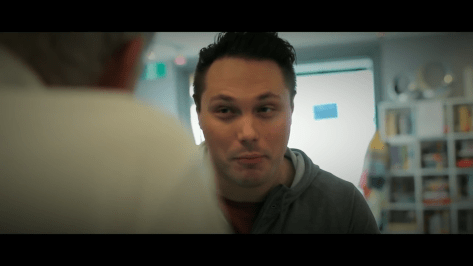
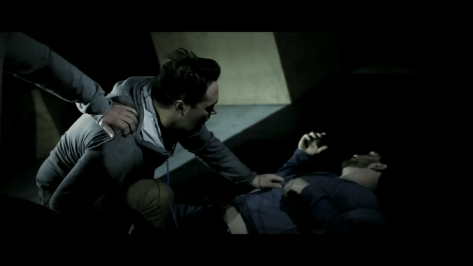
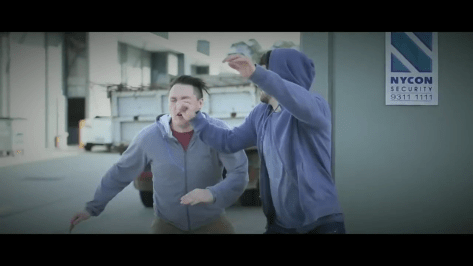
Getting the part may have been the easiest facet of his involvement as Caleb had to venture into a completely unknown area for him, fight training. Chernysh was excited to train but admits that it had its uncomfortable moments. He notes, “The Gap was the first movie which I was in that had fight choreography. I was so excited! There were nights where we had to train leading up to production and I would come home bruised and sore…but with a smile on my face. When it came to the shoot, we added some more fight sequences. I still remember getting an uppercut from one of the thugs and I literally picked myself up and threw my body backwards onto a box. It must have been impressive, because I remember people gasping when I crashed into the box. When I got up, people were saying ‘Geez, you’ll do anything for your performance!’ It looked like the uppercut was real and had a powerful force behind it.”
That uppercut comes courtesy of one of the attempted kidnappers of John’s daughter. In one of the tensest parts of the film, Caleb’s character John (one of the lead character’s in this film) has gone to a café with his young daughter and, while she wanders downstairs, two men attempt to kidnap her. This particular scene which so clearly states the film’s theme of the difference between the fantasy life’s abrupt collision with reality, was highly motivating to Caleb. Though not a father himself, Chernysh believes that in each man resides the protective fatherly instinct towards his children. It was that character trait that he unearthed for John commenting, “I’ve never played a young father before. So I really needed to put myself into the role and imagine that I have created this beautiful life and have raised it for 8 years. This beautiful life is the most treasured being in my world and I would not let anyone or anything harm it. That was my mindset in the performance, which also helped the fight scene.”
Caleb Chernysh is currently working on a webseries in which he plays Boris Djerkich, a man who want to be the next Eurovision star. One character is Bosnian born Boris Djerkich who has moved to Australia and wants to be the next Eurovision star. Caleb also plays Cameron Tomes, a flamboyant ex-dancer who goes to a job interview and it bombs! Caleb is working on extending his series with more characters.You can subscribe and view on YouTube.
Xiao Sun in an accomplished actress with numerous TV and Film credits to her name but she began her career achieving fame in Canada as a model. Miss Universe Canada was a springboard for her to work with Vogue Italia and Cosmo TV, which would eventually lead to acting roles in films such as Les 3 P’tits Cochons 2, Anna, TidalWaves, and even work on X-Men: Days of Future Past,. Trained as a dancer in China, and the emigrating to Canada in 2009, Xiao has followed suit with Cameron Diaz, Milla Jovovich, Halle Berry, Charlize Theron, Angelina Jolie, and so many other models turned actress. Proving that you can’t contain natural charisma and talent, Sun has crossed from print and runway into TV and silver screen at a swift pace. While excited about her current success as an actress, she looks back toward those early days, what she learned, and how to apply it to her current status.
It is difficult to imagine that just seven years ago, Xiao Sun was living in China with great aspirations inside her head and heart. In just those few years she has moved across the planet, began a highly successful global modeling career, and is now a celebrated actress. Iconic names like Vogue and Cosmo are part of her resume which now includes monikers like “leading actress.” To those of us on the outside, viewing her career, it all seems fast. Xiao will tell you that it is all a product of focus and hard work, but also notes that she had early indicators of inclinations. Sun states, “I was obsessed with clothes and style at very young age. I used to often dream about the clothes I would wear for different moments in my life. I love how creative you can get on a piece of cloth; you can transform a person into a totally different look, feeling and energy with different styles of clothes.”
Xiao moved to Canada in 2009 with her parents and entered into Ms. Universe Canada where she placed in the Top 10 national finalist and won Best Model Award (Sun was the first Asian Canadian to ever win the Best Model Award). While she learned more about interacting with the press and public presentation, she especially enjoyed the interaction with youth (in the form of motivational speaking) and interacting with charities as an ambassador of Canada. Denis Martin Davila is the President of Beauties of Canada which runs the Miss Canada Universe organization and pageant. Speaking of Sun’s win for Best Model, Davila comments, “This achievement of Ms. Sun’s is no small feat, and truly signifies her extraordinary talents as one of Canada’s top models. To win such an award, let alone place so highly in the national pageant, is only a possible achievement for the most capable and experienced of models, and Ms. Sun proved her talent with this. Miss Universe Canada is the biggest national beauty pageant in Canada, and its only 60 contestants are selected from thousands of applications across Canada after rounds of regional competition each year. Ms. Sun shined among these thousands of other beautiful and talented models and proved her high stature in her field. To win such an award from the biggest pageant in Canada is one of the biggest national honors for a model in this country.”
Xiao was approached immediately following the competition to start her modeling career. The crowning achievement for any model on the planet is working with Vogue and Cosmo; something which Xiao achieved almost immediately. She recalls that being in Italy to work on Vogue Italia was the complete experience for her. She comments, “Vogue magazine is my favorite fashion magazine to read. I have visited Italy a few times, and loved each time. Needless to say, the street fashion, shops, and the food are amazing too!! I also love people dress up for different events, like they wear gowns to go to a concert. Makeup artist Paul Venoit’s simple but bold style was really inspiring. The first look Venoit created for me, was only foundation, with black rectangular eyebrows…super edgy, I never knew that I could rock that kind of look. I was shocked how amazing I looked like in the final pictures. It has brought my modelling career and the way I look at myself as a model into a new different level. Paul Venoit is a legendary beauty expert that I had heard a lot about before I worked with him. He has worked with many celebrities including Scarlett Johansson, Lady Gaga, etc. I was very excited to work with him on this project, he is very fun and relaxed. He can effortlessly create stunning fashionable looks for everyone with his magic brushes. He could easily crack a joke and make anyone laugh on set. We had a great time working for Vogue Italia, and we’ve worked together numerous times after this project.”
Natalie Dean (producer/writer of the award-winning Entertainment Tonight Canada as well as director/producer of Cosmopolitan TV’s Oh, So Cosmo) saw Sun on Ms. Universe Canada and recalls, “I cast Ms. Sun on the heels of her winning the prestigious Best Model award from Miss Universe Canada and placing as a top 10 finalist in the nationwide competition, which is truly an accomplishment that only a very gifted and uniquely beautiful model can achieve. The Oh, SoCosmo production was very well received and achieved great ratings, reviews, and buzz. Ms. Sun’s modeling was highly effective and truly leading and critical to the production itself, and I am glad to have cast her.” This began Sun’s transition into being a personality on TV and would peak her interest in acting. Although she loved the talented professionals she worked with and the creative approach to style in her modeling career, there were certain aspects that did not suit her temperaments. Sun confirms, “What bothers me about modelling is that a lot of it is about your look, what you were born with…unlike acting. That’s not something that you can work on. The length of your legs, your body proportion, your face shape…these aren’t things that you can improve upon. Obviously everyone who is a model is very beautiful and has a nice body, but nobody is perfect. People have different tastes and preferences. As models, we get judged by on our look first. and the idea of that stressed me out.
The progression of Xiao’s career path seems to be that each is more successful than the previous choice; dancer to model, model to television personality and actress, and now film actress. Being a part of the X-Men franchise and Les 3 P’tits Cochons 2 (one of this summer’s most popular films in Canada) bears the fruit of this driven actress’s hard work and desire to continually improve on her talents.
Canadian actress Tara Yelland will be gracing small screens in the fall.
Yelland has been cast in CTV’s hit medical drama Saving Hope. Yelland will play Summer, the nanny, a role that allows Yelland to show off her comedic side.
“She gets into trouble constantly! She’s inappropriate, wild, and generally just a total mess” said Yelland.
Initially brought in to audition for a smaller role, Yelland impressed right away. During the casting session the director suggested she read for another character. They sent her out into the hall with the sides where she had to quickly familiarize herself with the script.
“I came back in and just had fun with it, and I guess it worked,” she recalled. “They liked what I did with the character, so they kept her around.”
The role required Yelland work primarily with Erica Durance (Smallville) and Michael Shanks (Stargate).
“They’re total pros and the fact that they’re genuinely nice people and giving scene partners is definitely a bonus,” said Yelland.
The two play a recently divorced couple trying to co-parent, and Summer, the nanny, is there to help. However, it turns out she’s not very helpful.
“I don’t think I’ve had this much fun with a role in a long time. She’s so over the top that it really gives me a kind of freedom to be big and outrageous. Summer lives in a world where consequences aren’t a real thing, so she doesn’t really have any fear. I kind of admire that,” she said. “Summer is a bit out of control, and there are plenty of opportunities for comedy, and physical comedy, in particular.”
Yelland also worked alongside actor Greg Bryk for the role, who describes her as a “special actor.”
“Tara is beautiful, charming and sensitive. She is also gifted with a fierce intelligence. She is very serious about her craft and has grown immensely as a performer in the time that I have known her,” said Greg Bryk. “She brings together a whimsical sense of humor with the emotional depth to fully realize more dramatic roles. That combination is incredibly rare and makes Tara one of the most unique people I have ever met. It would not surprise me if she became a star.”
The role allowed Yelland to experiment with challenges she had not frequently encountered in her acting career.
“I don’t have a lot of experience with children, so working with a set of twin babies was definitely a challenge! But an exciting one. I was so nervous about holding a baby, but it was actually kind of great, I was so focused on carrying this baby and not dropping him and trying to stop him from crying that it kept me very present during the scenes. You never knew how they were going to react during a take, whether it will be laughter or tears,” she said. “It kept things fresh.”
Playing Summer gave Yelland the opportunity to play around with a character that was extremely different than what she was used to.
“The fun thing about acting is that you get to keep a part of all the people you become with you, and I guess what I took away from Summer, and my time on Saving Hope, is her sense of risk and freedom. I mean, imagine being a person who just follows their impulses and does whatever they want, whenever they want…I kind of liked it. Summer is irresponsible. I am way too much of a control-freak to ever even show up late for work, let alone the kind of shenanigans Summer gets herself into.”
However, they have their similarities.
“We can both be a bit impulsive, but luckily, I’m far less self-destructive than she is,” Yelland concluded. “We’re also both very fond of big floppy hats.”
Saving Hope returns for its fifth season this fall.
Everything you ever wanted to know about Hollywood's who's-who.

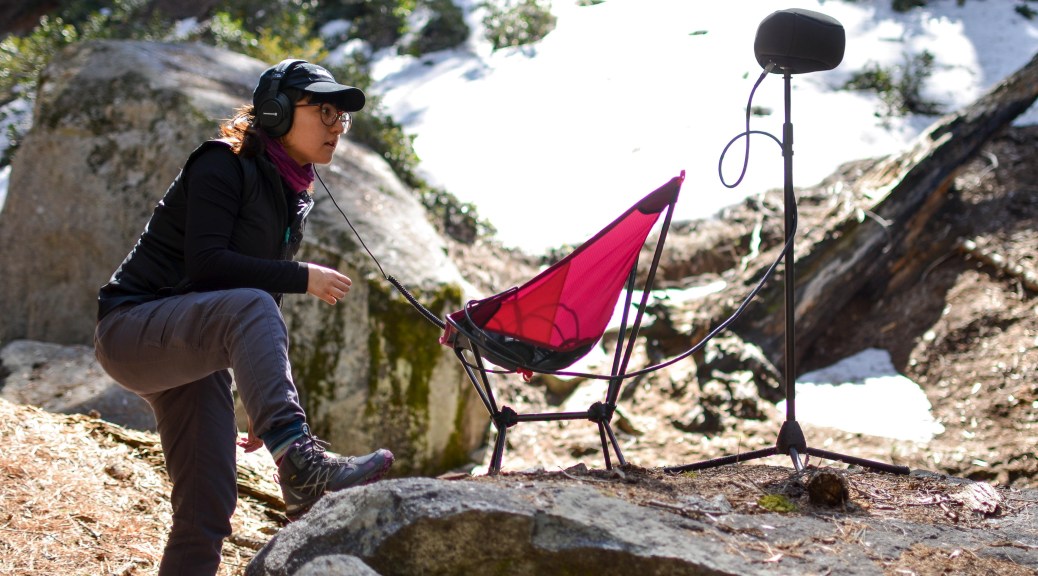
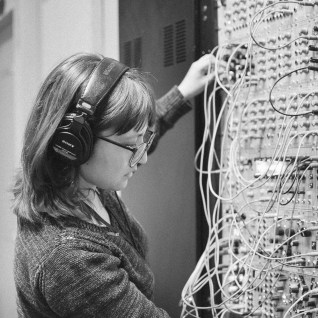 Cindy Takehara was born and raised in Japan. Her father is Japanese and her mother from Colombia. She did not always know growing up and going between both countries that she would be an internationally successful sound designer, but now she can’t imagine anything else.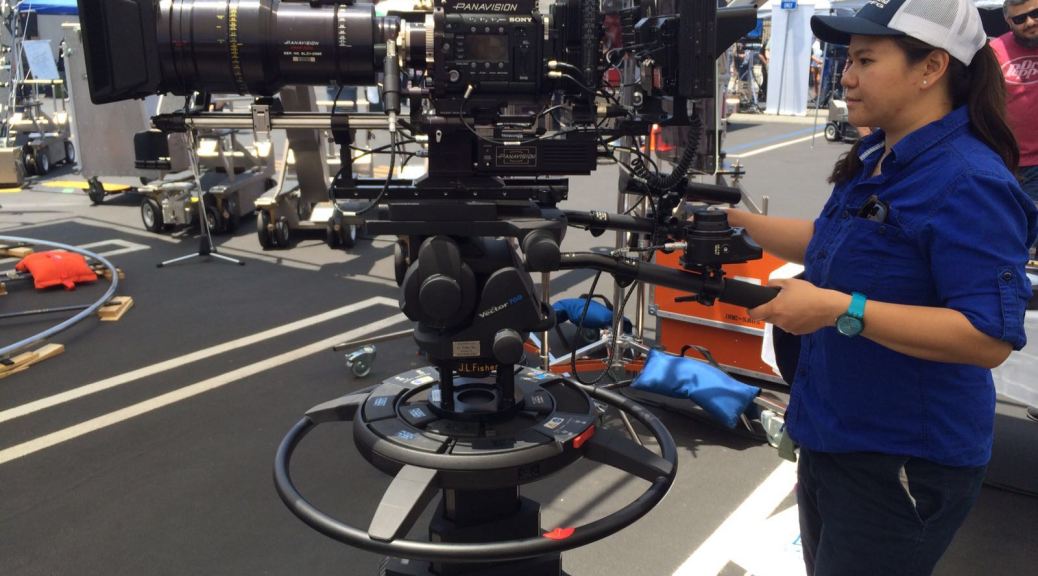




 Tinsel Town News Now