Category Archives: Film

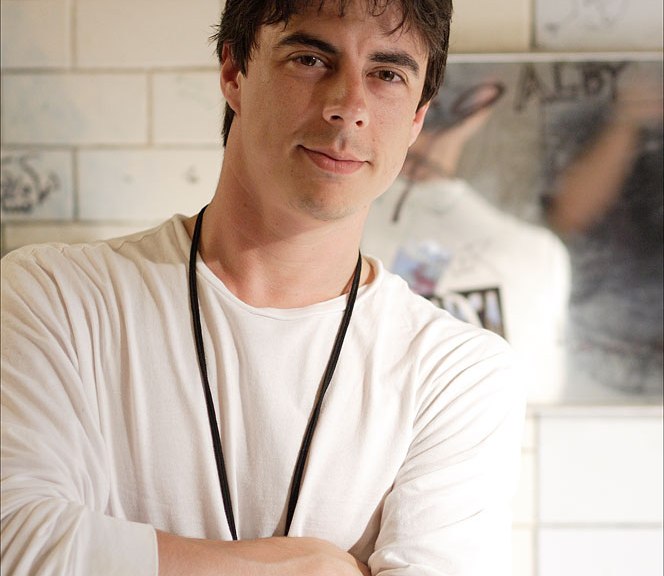
BIG STUDIO OR INDIE, THEY’RE ALL IMPORTANT TO DIRECTOR/PRODUCER JOHN ALBANIS

Education is a good thing but, consider that education alone is not indicative of the ability to master something; it’s a springboard to jump into the race. Specifically, when it comes to artistic endeavors, vision and mastery of skills easily defeats the knowledge base of how something “should” work. One can understand painting but it doesn’t make you a painter. A knowledge of the complexities of music theory does not make one a songwriter. Film school does not make you an accomplished cinematographer. While scholarly endeavors may get you in the ballpark, they won’t insure that you will make the team. Of all the aforementioned art forms, film is the newest and thus the idea of attending film school was not available until recently. The pioneers who crafted this art form and by whose hands it evolved were the men and women who learned “on the job.” Considering the fact that film has permeated almost every culture and region of the planet, they did their jobs quite well. Following in the footsteps of these giants is John Albanis. This producer/director had not planned on entering the film industry (moving from Calgary to the UK to pursue rock stardom) but made an artistic switch when he discovered he had a natural skill set that lent itself to this medium. With no formal academic film training, John learned from those he worked with; those who recognized his ability for accelerated learning. Years later, he has cultivated quite an impressive career which rests on both huge blockbuster productions as well as carefully and emotionally crafter indie art films. Feature Films, TV movies, music videos, even recording studios make up the eclectic life of this immensely talented Canadian filmmaker.

John Albanis’s work on major studio films is instantly recognizable and is not confined to simply one genre…unless that genre is “successful.” Some films perform well at the box office and also have a second life on downloads and streaming services, as is the case the Hector and the Search for Happiness. As Co-Producer on this 2014 film starring Simon Pegg, John had the herculean task of taking the production across the planet to locations which included: Canada, the UK, South Africa, China, USA, India, and Germany. The Story and its locations are entertaining and seamless, something which Albanis is quite proud of achieving.

Contributing his full range of abilities to the film Psychic Driving, John was director, producer, and writer of this Film Noir. Inspired by the great political thrillers from the 1970s films like Three Days of the Condor, The Parallax View, All the Presidents Men and based around the CIA mind control program in the 1950’s called Project MK-Ultra (a secret program that ran experiments on human subjects, often without their knowledge), Psychic Driving’s theme was perfectly suited for the Film Noir genre. It also allowed Albanis to indulge his creative side to great length, exhibiting his multiple talents. Utilizing his connections in the film industry allowed for a quick and impressive production schedule. John relates, “When I work on studio films, I build such great relationships with the crews whom I work with. One thing I quickly learned is that there are so many talented artists who are on the verge of breaking. In the case of Psychic Driving, I had recently completed working on Miramax Films’ Shall We Dance. This was pretty early in my career; I was a director’s assistant at that point. But the director, Peter Chelsom, had me very involved creatively so I worked closely with all department heads. I forged relationships with (main Camera Operator) Peter Rosenfeld and (Art Director) Sue Chan. I had written Psychic Driving shortly after the studio film wrapped and I gave the script to both of them. They immediately signed on as Director of Photography and Production Designer respectively. Since we all have contacts in the studio system, we were each able to bring those resources to this small, indie film. That’s why it has such ambitious production values.”

Not content with Feature Films or Indie Films, John also lent his production talents to a series of highly successful made for TV films (for CBS) starring Tom Selleck. Jesse Stone: Stone Cold, Jesse Stone: Thin Ice, and Jesse Stone: No Remorse were all presented in a period of five years.

As he prepares for the next obvious progression in his career, Albanis confirms, “Los Angeles is still the heart and soul of the film and television industry; it’s where all the main players are and where all the deals are being struck. I’m transitioning from being a hired gun producer/director into developing my own projects from the ground up and Los Angeles is the best place to do that. Last year, I purchased the TV rights to a book called The Mirror Thief, which I’m developing with Peter Chelsom to direct into an 8-hr series. It’s a mind-bending thriller that follows interweaving narratives of three driven men all connected by the alchemical possibility of a mysterious book, and shifts from 16th century Venice, Italy— where famed glassmakers perfected one of the world’s most wondrous inventions, the mirror (an object of fearful fascination)— to the seedy Venice Beach waterfront of the 1950’s, to the glitzy trappings of the Venetian casino in 2003 Las Vegas.”

IMG_3526

Editor/Colorist Liang Xia Expertly Combines Technical Precision and Nuanced Emotion

The film industry is home to an army of specialty craftspeople and technicians, each working in distinct specialized niche disciplines. These widely varying duties abound in the post-production field and while many seem almost esoteric in their limited scope, some actually have a critical impact on the finished films emotional appeal and ability to directly reach an audience.

Chinese born Editor/Colorist Liang Xia is a prime example of this. His is a uniquely demanding position, one that requires a masterful sense of nuance and subtlety, balancing the aesthetics’ which a production’s setting and style requires while subtly enhancing the film’s overall mood and emotional appeal. Xia achieves this with a both comprehensive attention to minute detail and an overarching perspective on the sweep of the entire film.

“There are three different things that a colorist does,” Xia said. “First, I adjust the exposures of the footage. A lot of things, such as lighting issues, weather, location and cause the cinematographer to get incorrect exposures. In most films, there will be several shots under or over exposed and colorists fix those issues in post-production, making sure each shot is the correct exposure and matches other shots.”

“Second, Colorists need to correct unnatural colors or unwanted colors. Sometimes, color temperature of the lighting is not accurate, or if the camera setting isn’t right, the color in footage will not be correct. Even when every setting is right, the camera sensor will receive more light and colors than we can see, and there will be some unwanted colors, or the contrast will change. Colorists fix all these problems during the process of color correction. And after this process, the color will become very accurate and satisfying to audience.”

The third aspect of the colorist’s job is the most important, and also where Xia excels.

“Color can also express emotion,” he said. “As we know, red means passion or blood, blue means cold or peace. Colorists can also use color theories to emphasize emotions in scenes, chapters or even whole films. A subtle change of color tone is not very obvious to audiences, but when they watch the film and see the color, they will have a natural, almost subconscious reaction to the color tone. In this way, a colorist enhances the film, allows it to further express subtexts and emotions.”

His work on the recent feature film Strawman exemplifies Xia’s perfected mix of vision and expression. A gritty look at a youth forced into a life of petty crime to support his siblings after their parents abandon them, Xia’s atmospheric approach and attention to detail further burnished director Tian Xie’s impactful drama.

Xia is driven by a fascination with the human condition and the inescapable drama of common life. It’s a combination of sensitivity, aesthetics and technique striking an unusual balance between meticulous technical precision and broad emotional strokes. For Xia it’s almost therapeutic and this unusual artistic perspective enhances every project undertaken and has, in a few short years distinguished him as a professional force to be reckoned with.

Strawman was the first time I worked with Liang,” director Tian Xie said. “Besides his editing concepts and skill, Liang has very good vision and a feeling for color, so his color correction is excellent. Liang had a five-year experience in studying paintings, including traditional Chinese painting and watercolor. I think that’s an important reason for his excellent sense on color. When we worked on Strawman, I told him the story takes place in summer, a hot summer. Liang did some adjustments on his color panel and created an ideal overall look, immediately. That color tone was what exactly I want, and I said, ‘that is the one.’”

Xia’s lifelong affinity for both art and film created the perfect combination for his profession. “I’ve loved film since my childhood,” he said. ”After high school, I studied TV and film directing in college. After I came to U.S. to study film, I found my logic and patience gave me a strong advantage and decided to work on editing. Then, during my post-production study, I found I am sensitive to color, so I started to study color theories on my own and also took some class about film color grading.”

And it’s working. Strawman took Best Foreign Feature at 2016 Los Angeles Independent Film Festival and Best Feature Film Diamond for director and editor at the 2017 NYC Indie Film Awards, and led to an on-going collaboration with he and director Tian Xie, most recently on the short Promise. In fact, Strawman and Promise each won a Gold Remi Award at 50th WorldFest-Houston International Film Festival. Additionally Strawman officially selected in the 19th San Francisco Indie Film Festival, the 6th Richmond International Film Festival and 23rd New Jersey Film Festival.

“I love editing and doing color,” Xia said. “My goal is to keep working on indie films. In my opinion, indie films more focus on humanities and society. I want to have more chances to edit more indie films. It not only provides me editing or color jobs, but also makes me connect to the real world.”

*I like dramas that focus on people who are often ignored or marginalized by society, and these give me the chance to using my post-production skills to build complete characters—and to build a complete me.”

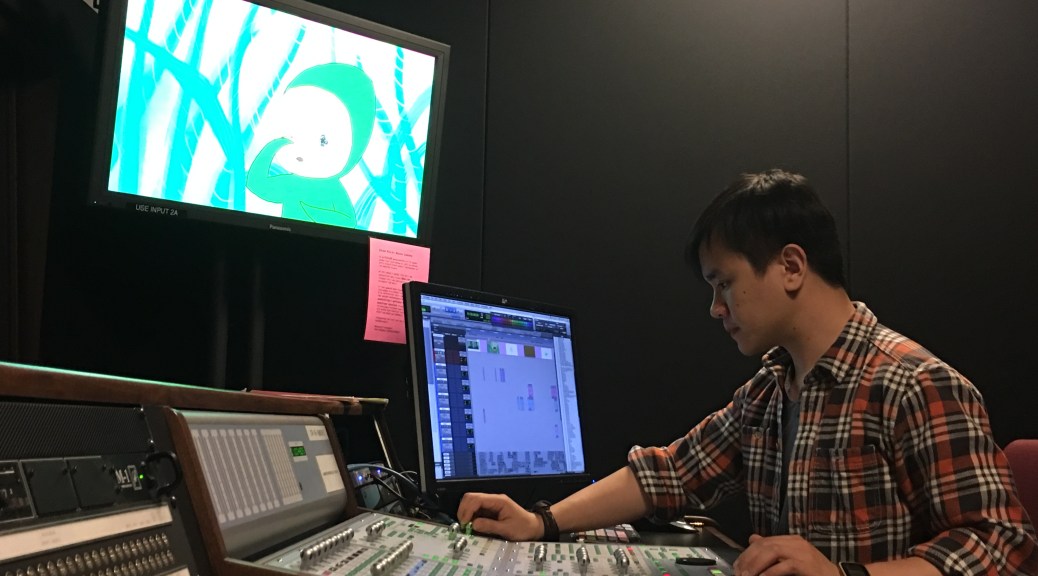
Sound designer Randolph Zaini says film “Mosquito: The Bite of Passage” is highlight of his esteemed career

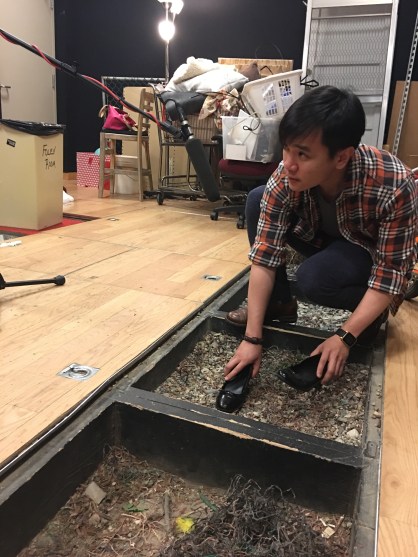
Randolph Performing Foley Footsteps
Randolph Zaini working on “Mosquito: The Bite of Passage”

Randolph Zaini is more than a sound designer. He is an artist; the video is his canvas and audio clips are his paint. He is a storyteller, and sound is both the setting and the characters. He sees sound as one of the most important aspects of a film, and those that have seen his work can hear this immediately. There is no doubt as to why he is so sought-after in his industry.

Of all the films he has worked on, with many esteemed awards and praise, the highlight of Zaini’s career he says is working on the film Mosquito: The Bite of Passage, which was just shortlisted for the British Academy of Film and Television Arts (BAFTA). The film tells the story of a young mosquito brought out by her mother on her first hunt for blood. The issue, however, is that she doesn’t like blood, and but fears disappointing her mother. Though the main story is simple and clear, there is a complex message underneath. It has much to do with being accepted for who you are. It exemplifies the best form of storytelling, where it can both entertain and illuminate.

“It was a great screenplay filled with heartwarming and funny moments,” said Zaini.

Since the story deals with opposing perspectives, it is imperative to give the appropriate sound design treatment on each subject matter. The mother has set her eyes on a single human: a slob who lives alone in his dingy apartment. When there is a switch back and forth between the perspectives of said human and the mosquitoes, audiences should hear the differences in ambiance. Everything feels gigantic in the perspective of the mosquitoes, even the air feels heavier; they are in the land of giant beings. Although Mosquito: The Bite of Passage is a hybrid live-action/animation, there was no production sound provided to Zaini, even on the live-action part of the film. This meant on top of creating every bit of audio clips for the mosquitoes, he also had to recreate the sounds of the human character, played by a live actor, from scratch as well.

“Every bit of sound that the animated character made, from the mosquitoes’ helmets, suits, boots and blood-bag was created by me in the foley recording studios. As for the human character, I also performed all his movement sounds, which then got a frequency manipulation treatment to make him feel gigantic when seen through the eyes of the mosquitoes,” Zaini described.

The film ended up becoming a large success after premiering at the prestigious Telly Awards, where it won Best Animated Short. In addition to BAFTA, it was an Official Selection at the Chinese International New Media Short Film Festival, Edmonton International Film Festival, New Orleans Film Festival, Haryana International Film Festival, African International Film Festival, 9th CMS International Children’s Film Festival, Newport Beach Film Festival, New Voices in Black Cinema, and more. It has gained offers for representation by CAA, WME, Paradigm and Verve. None of this could have been possible without Zaini’s work as sound designer, and he was recognized for it with the Outstanding Sound Award nomination at the 2017 First Look Film Festival.

“It was incredible. We make these movies to connect with audiences, to tell a story worth telling, with a hidden message worth sharing. Winning awards is always secondary. But I’d be lying if I say winning Telly Award for the second time did not give any affirmation that I was doing something right, that my passion was not misguided, and that people do appreciate the result of hard work and the vast amount of passion being put into it,” said Zaini.

Randolph Performing Foley
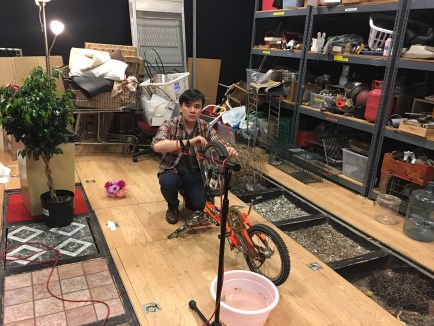
Randolph Zaini recording foley for “Mosquito: The Bite of Passage”

The detail Zaini put in to each and every sound in the film is outstanding. To create the sound of the mosquito wings, he used a combination of hummingbird wings flapping, plastic cards being run through bicycle spokes, and small airplane engines flying in the air, among other sounds that helped sell the integrity of the wings that carry these mosquitoes. Every single sound file was designed with the storytelling effectiveness in mind.

“Randolph is the best sound editor, ADR editor, foley artist, and re-recording mixer I have encountered. To cite a specific example, for Mosquito: The Bite of Passage, Randolph created the sound of the entire film from scratch. There was no production sound going in. He was notably innovative in his approach to creating a new world of sound for the macro world of the mosquitos in the film. Using devices like leather jackets, his own voice for various flight sounds, and other unique concepts, he made a deeply immersive experience. This film relied heavily on the sound design given its heavy science fiction component. I was very happy with the results,” said Brian Rhodes, the director of the film. “Randolph is extremely hard working, dependable, diligent and a wonderful human being to be around. I greatly look forward to working with Randolph the rest of my career. He pushes the boundaries of what is possible and is a visionary.”

Rhodes, who previously worked with Zaini on the award-winning film Harold’s Fish Sticks, refused to have another sound designer work with him on the project. He even pushed back the timeline to work with the sound designer, knowing he needed the best. Although it was a long process from start to finish, there was not a moment of it that Zaini did not like.

“It was work that I enjoyed wholeheartedly. Mosquito: The Bite of Passage is an action-filled movie, which means there are a lot of high-paced sequences that were fun to design. I had a blast planning, recording, and editing the sounds I created,” said Zaini.

With every project he takes part in, no matter how successful, Zaini is living his dream. As a child, he told stories, always putting in captivating sound effects. He may not have known at the time it would be his future, but he always knew what his passion was.

“Like most children, I grew up watching animations. Though I wasn’t always aware of the sound design aspects of those cartoons, it had always sold the believability of these drawn and sculpted worlds and characters, being brought to live with sound. To think that what I do now is breathing life into these lovable characters, it is like having an important role behind a magician’s performance,” he said.

Working on Mosquito: The Bite of Passage was just another chance for Zaini to live out his dream.

Writer Sarah Stunt tells inspiring and impactful story in award-winning film ‘Girl Unbound’

IMG_9236
Actress/writer Sarah Stunt, photos by Alexis Dickey

Growing up, Sarah Stunt always loved stories. The Toronto native was always a big reader, reading her first novel, Little Women, at just nine years old. She loved the history and romantic setting, drawing her to the visual, and she was immediately taken by the characters, seeing herself in the passionate and independent writer Jo March. At the time, the only way she could describe the feelings the book gave her was on paper. It was something that changed her life. Now, her talent communicating through the written word, and that passion that started at just nine-years-old, has propelled Stunt’s career, and she is recognized around the world as an outstanding writer.


Stunt’s work has impressed international audiences for many years, but it was writing the impactful documentary Girl Unbound that she considers the highlight of her career. The film is about an exceptionally brave girl living in Waziristan, Pakistan, “one of the most dangerous places on earth.” Maria Toorpakai defies the Taliban, disguising herself as a boy, so she can play sports freely, something the Taliban strictly prohibits girls from doing. However, when she becomes a rising squash star, her true identity is revealed.

“I love working on documentaries as a writer. It’s always a long-term, nurturing relationship that changes and grows as time goes on. The lives of the characters are real. You don’t have to envision the conflicts, the inciting incidents or arcs, they evolve naturally on their own. Being able to capture it on the page is where the magic before the magic takes place, because in a matter of pages, your essence of the film presents itself and sets the stage moving forward. Being able to create some sort of affect, as the subject matter is usually from a human-interest point-of-view, is always the greatest outcome. You learn to champion your characters and unlike fiction, their stories continue to evolve after production is complete. It has a long-lasting affect,” said Stunt.

As the film’s writer, Sarah worked closely with the Producer, Cassandra Sanford-Rosenthal, to develop the film’s basic concept, and from those initial ideas, she wrote the film’s script. Rosenthal says without Stunt, the film could never have been possible.

“Sarah is an exquisite writer whose skill and talent for her craft is obvious. Girl Unbound could not have been made without her guidance and her amazing abilities. The fantastic record of success the film had could not have been achieved if not for Sarah’s prodigious talents,” said Sanford-Rosenthal.

After being asked to premiere at the world-renowned Toronto International Film Festival last year, Girl Unbound received rave reviews from such top industry publications as The Hollywood Reporter and screened at more major international film festivals such as the DOC NYC (where the film was nominated for the festival’s Grand Jury Prize), Cleveland International Film Festival (where the film was nominated for Best Documentary), Athena Film Festival, and the Human Rights Watch Film Festival.

“I am so proud that the film has done so well. So much work, dedication and time went into the making of this film. With all the ups and down, everything from capturing the characters and their lives to the struggles of filmmaking in general, the final film is beautiful and powerful and executed in a way that will continue to generate a conversation after the film has been screened. This, in my opinion, is the true purpose of documentary film,” said Stunt.

With experience in writing for documentary, which for obvious reasons does not have scripted lines but requires a strict outline, Stunt was asked to join the film. The filmmakers knew they needed an experienced and skilled writer to properly tell such an important and captivating story. Originally, Stunt came to work on the film for a short time, but ended up as the lead writer, watching over the process from start to finish.

“The messaging is inspiring. The themes are varied with a focus on human rights, girls in sport, the right to education, and identity, but the courage of this one girl and the support of her family to use their platforms to inspire and make change is why it’s so important. Our main subject Maria is a force to be reckoned with, and if she can win and continue to do so, then it spreads the message of hope for others to do the same,” said Stunt. “The story was so strong and ever evolving. It took a lot of risk, courage and strength for all involved to actualize the final product and it inspired me to do my part as a writer, even though I wasn’t on the ‘frontlines’ of it all.”

In a world with a growing stereotype towards the Middle East, the story of Girl Unbound is of increasing importance. For Stunt, working on the film was not about the many awards and recognition both she and the film received, but about educating the viewers and inspiring audiences through Maria’s story.

“I loved working on this project. It took on many lives but the story that is out is the one that needs to be told. It has so much heart and invites viewers into a world that is both complicated and beautiful. It expels Western notions of Pakistan, sheds light on the lives of many but especially women and children and challenges old world notions that this generation of youths are trying to identify with and evolve from,” she concluded.

Actress Shauna Bonaduce takes audiences back in time in “Embrasse-moi comme tu m’aimes”

Shauna 2
Canadian actress Shauna Bonaduce, photo by Andréanne Gauthier.

Acting has always been a part of Shauna Bonaduce’s life. As a child growing up around Montreal, performing was a favorite past time, and the stage was a second home. As a teen, she was shy and thought maybe she should consider a different field, but acting kept coming back to her, as true loves do, and audiences both in Canada and around the world are thankful, as she is a truly unique actress.

Bonaduce’s versatility in her craft is evident with every role she takes. Whether it be comedic in the hit teen show Comment devenir une legende, or serious in the popular Quebec series 30 vies, Bonaduce knows how to captivate audiences. Her work last year in the period drama Embrasse-moi comme tu m’aimes did just that.

“Era movies are great. I love getting to explore an era that I would otherwise never have the chance to get acquainted with. I love researching and having the chance to travel back in time, and getting to explore how the women of these different periods lived.  And love the dresses and hairstyles of these periods. What a chance to be able to play dress up and be paid for it,” Bonaduce joked. “Also, the cast and crews of that movie as well as the director himself were just perfect. I consider this project as one of my most memorable ones.”

The story follows twenty-two year old Pierre Sauvageau , in the year 1940. Pierre wants to join the army, but he must take care of his twin sister Berthe who is paraplegic from birth. This closeness awakens Berthe’s sensuality, who then tries to seduce her brother. Pierre rejects her advances, but when he falls in love, he is haunted by the fantasy of his sister. He would like to get rid of it, but the fantasy of Berthe is very persistent.

“The movie takes place in the 1940’s, Second World War, so research on that time was mandatory for the process. In my creative processes though, mostly when the rest has settled down (learning the lines, researches, reading the script, etc.), the costume also has some importance in helping find the character. It really helps me become the person I’m portraying. How she walks, moves, talks, holds herself, her hair, it’s very stimulating. Is she the ‘good girl’ type or more frivolous? Trendy or conservative? Feminine or more one of the boys? The costume chosen by the production always influences my performances and I’m always exited when it’s fitting day to discover what they will bring along,” said Bonaduce.

Bonaduce plays Madeleine, a pivotal character to the story, as she is Pierre’s first serious date in a long time. He takes her out to dance that night at Café Bleu. When he gets in the car with her to drive her back home, the attraction is palpable and they start kissing. But as always, his sister is there to haunt him and, confused, he decides to pretend Madeleine has bad breath and that he will just take her back home.

“Shauna truly brought the role to life, with simplicity and genuineness while still keeping it firmly rooted in the period in which the film took place. This is a valuable feat, and not one that I have seen many actors attempt successfully. Shauna’s authentic portrayal brought us back to that time. She was engaging yet had the more reserved, prim decorum that women of that time so often had. She kept enough of her personal, modern flair to remain relatable to contemporary audiences, while still offering them a genuine, organic glimpse into their nation’s past. Without a doubt, we were delighted to have Shauna amongst our actors and she definitely contributed to the success of the film, which was greatly appreciated by the audience and rewarded by two awards at the Montreal International Film Festival last September. I would work with her again anytime,” said the director Andre Forcier.

In fact, he was so impressed with Bonaduce’s portrayal of Madeleine that another collaboration between the two is already being worked on for his next feature film, though the project remains secret at this time and can’t be elaborated on. He thinks Bonaduce was able to bring the perfect balance that Madeleine needed, the poetic and theatrical yet realistic and authentic approach that characterises most of the director’s work. Bonaduce is very eager to collaborate with Forcier again.

“Andre is a great director and quite unique too. There’s only one like him and I had the chance to work on what lots of us consider like one of his bests movies. I feel extremely privileged” said Bonaduce.

Going back in time and portraying characters from other eras is one of Bonaduce’s favorite things to do as an actress. In the film La passion d’Augustine, she had to play a trendy young woman in Catholic Quebec during the 1960s.

“I definitely did some research about that era and how things where done in that time; the role of women, the convent, the importance of religion in people’s lives at that time, etc,” said Bonaduce.

In the film, Mother Augustine provides a musical education to young women no matter their socio-economic background in a small convent school in rural Quebec. She helps Alice, a young music prodigy; realize her aspirations. However, with the looming changes brought by Vatican II and Quebec’s Quiet Revolution, the school’s future is at peril. Bonaduce plays Françoise, a trendy young woman who believes in modernity and evolution. She finds this convent completely passé and is quite happy that it is under serious threat of being shot down. When leaving the Church where a meeting was organized by the nuns in a desperate attempt to save the convent, she is requested by two students of the convent to sign their petition to save it. Françoise refuses immediately, since she is very much against that idea. 

“Historical movies are my favorites and I had the chance to take part in this great movie, with a very talented director. There are too little female directors in our industry. Lea Pool in one of our great ones and she truly inspires me. She is bold, outspoken and determined. There were also lots of great Quebec actresses on the cast, from whom I admire the work a lot, Celine Bonnier is one of them, and just felt blessed to be able to see them work and learn from them. It was just such a great experience,” she concluded.

Costume designer Angela Trivino talks award-winning horror flick “Fear, INC”

For Angela Trivino, a character in any film is born in the fitting room. Yes, the writer creates a character in their mind and a director creates a vision, but the character is not fully realized until they put on their costume. That is why she is an artist and a storyteller. She takes an idea and turns it into something visual. Her talent has earned her a reputation as one of the best, but her passion for what she does as a costume designer is what drives her into work each day.

Trivino completes the transition for audiences from a theatre chair into the film. Her period piece costume design for the film Tragiometry and the commercial for Environmental Working Group Setting the Bar Low, took viewers to a different time, and her work on the film The Fog encapsulated the struggles of a war veteran, even visible in what he was wearing. With this, it was her work in the feature film Fear, Inc. starring Academy Award-nominated actress Abigail Breslin, where she created a horrifying spectacle for audiences, and was pivotal to the film’s success.

“The script was really fun, and I thought it was such a clever story. I knew right from the beginning that I was going to have fun,” said Trivino.

Fear, Inc. follows a company of degenerates who can be hired for a premium to bring your greatest fears to life. But when horror junkie Joe Foster’s customized scare seemingly begins, he and his friends must decide if this company is there to scare them, or make them pawns in their own sick game. The film has 5 bloody scenes, more than 3 dramatic days in the story, 24 characters with different costume changes, and an all-star cast.  As the head of the Costume Design department, Trivino not only designed every look, but also lead her department in different office endeavors like managing finances, scheduling fittings, doing alterations, and executing breakdowns of the script in order to keep track of continuity.

“Just as the story, the characters were young, fresh, and hip, so my inspiration was mainly contemporary trends. However, the film had a dark side to it, as it was also a celebration to horror American classics such as Scream, A Nightmare on Elm Street, The Shinning, and The Game. Therefore, keeping the aesthetic references from these films was key to creative process of the project,” Trivino described.

As a designer, Trivino wanted to make sure every character’s costume reflected who they were. She had multiple meetings with the principle cast to discuss their character, and the physiological layers to come up with the right look for the story. While filming, she was on set to give final approval on the looks, and assisted with any last-minute costume changes.

From the moment we met Angela, we knew that she was going to be the one ready for the challenge. Angela is a hard-working designer with the absolute best energy on set to work around actors and help them find their characters through their costume. She truly helped us tell our story using wardrobe. She really understands contemporary trends, and was able to achieve an overall hip fresh look for the cast. Angela is incredibly intuitive. We never had to manage her or worry that our cast wouldn’t be in the right wardrobe. She was consistently on top of her job. Angela went above and beyond what we asked of her and that truly shows with the success of the film,” said Luke Barnett, the writer and producer of the film.

After premiering at the Tribeca Film Festival last year, Fear, Inc. went on to be an Official Selection at the Sitges Film Festival and the San Diego Film Festival. It was then released on Amazon Video, YouTube, ITunes, Vudu, Google play, and Hulu.

 “It is so gratifying, and a total surprise that the film has done so well. I knew the film was going to do great, but I think the results totally exceeded my expectations,” said Trivino. “The film was Luke’s baby and you could feel the passion around set.”

That energy on set made all the challenges that came from shooting a horror film worth it. They shot in a short amount of time, and Trivino’s department overcame any obstacles that would ordinarily arise with a tight timeline. The experience made her want to work on even more films in the horror genre in the future.

“It was a film about horror films, so the impact of these films was huge. However, we wanted to visually quote these movies in a way that they would fit in the contemporary hip, young world that we wanted the story to have,” Trivino concluded.

Viewers wanting to see Trivino’s bloody work can watch the full-length film here.

Art Director-Motion Graphics Designer Ilya Tselyutin Thriving in Hollywood

Art Director-Motion Graphics Designer Ilya Tselyutin works in one of the most fascinating, fast moving and over looked fields in modern media. Motion Graphics is a constantly evolving, creatively fertile niche that entails creating everything from eye-popping feature film title sequences to innovative television commercial applications. It’s a complex mix of graphic design, animation and cutting edge technology that requires innate resourcefulness, meticulous attention to detail and the ability to bring life to  a very broad spectrum of images—qualities which the Russian-born Tselyutin has no shortage of.


“While studying computer science at university, I developed interest in 3D graphics,” Tselyutin said. “I was always curious how this technology worked. At the same time I started looking at works by some famous graphic designers and learned about typography. I wanted to bring all of this together – 3D graphics, animation and design. Also, I drew my inspiration from title sequences from Hollywood movies, as well as the special effects in sci-fi movies.”


A painstaking, gifted craftsman whose outstanding work has been recognized with international awards—Silver winner for Art Direction at Cannes Corporate Media & TV Awards, and a Silver Win for Graphic Design/Animation at PromaxBDA, both in 2013—Tselyutin has distinguished himself with an impressive roster of career achievements. All this has led him to the field’s epicenter, Hollywood, where he enjoys a position at the prestigious Troika Design Group, a top branding and marketing agency that specializes in working with entertainment and media companies

Troika_Office_2

“Troika is one of the most notable companies in the industry,” Tselyutin said. “I had learned about it a while ago and they were looking for a lead motion graphics designer to bring the quality of 3D graphics to the next level. Paul Brodie, the Managing Director, was closely following my work and invited me to join the company in 2016, where I am currently working as Art Director/Motion Graphics Designer.


At Troika’s Design Department, Tselyutin has successfully undertaken jobs for a disparate series of high profile clients. “We have a very busy schedule with plenty of projects coming my way every day,” Tselyutin said  “The most interesting projects so far have been for AT&T Sports Network and ESPN College Basketball. The video for AT&T included working with the client’s static footage. As a lead designer on this project I suggested using a special technology in Cinema 4D software to cut the static footage into several pieces an then project them onto 3D models, and the result made both the team and the client happy.”


Tselyutin’s gift for surpassing expectations is a result of his widely varied cultural background and educational experience. With a Bachelors of Arts in Information Technologies and New Media from the Kuban State University, Krasnodar, Russia and a resume of jobs all over Europe, Tselyutin brings a refreshing international perspective to any project assigned him.


“While I was studying computer science, I started working at the local TV channel as a designer discovering the world of 3D graphics,” Tselyutin said. “I developed interest in design, typography and animation and after graduation, I moved to Moscow to work at the national largest TV network Channel One Russia, where I had the privilege to learn from the best and most experienced broadcast designers in the country.”
 

“My work brought me around the world,” Tselyutin said. “For example, I produced a 3D mapping show in at the Technology University of Mangalore, India. In 2013 I moved to work at VUCX creative agency in Cologne, Germany. Working and living in Europe with its variety of art museums, exhibitions and strong school of design was a great experience that helped me expand my portfolio and explore motion graphics even further.”

Troika_Office_1

For the driven, ambitious Tselyutin, whose formidable resume is already packed with enough accomplishments to stand as the full measure of a professional career, it is only the beginning. “I am eager to continue my personal development as an artist, 3D professional and art director while growing professionally within the company,” he said. “I see myself working on large-scale commercially successful projects.”

“My motto is: be curious, be professional, never give up.”

Actress Ariel Zhang captures split personalities in award-winning performance

International film festival
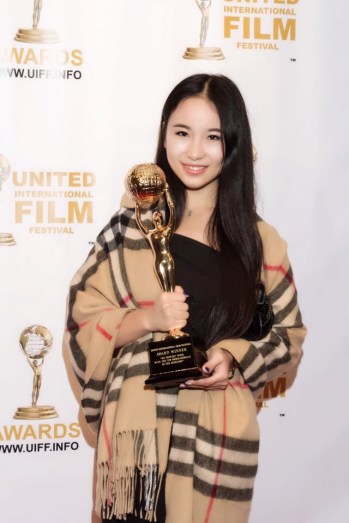
Ariel Zhang 

Despite being an award-winning actress, Ariel Zhang remains humble. For the Chinese native, she is just thankful to be doing what she loves each day. Audiences around the world have had the opportunity to appreciate her talents, and with each project she takes on, it shows how versatile she truly is. This was never more evident than when she shot her film Consumemate.

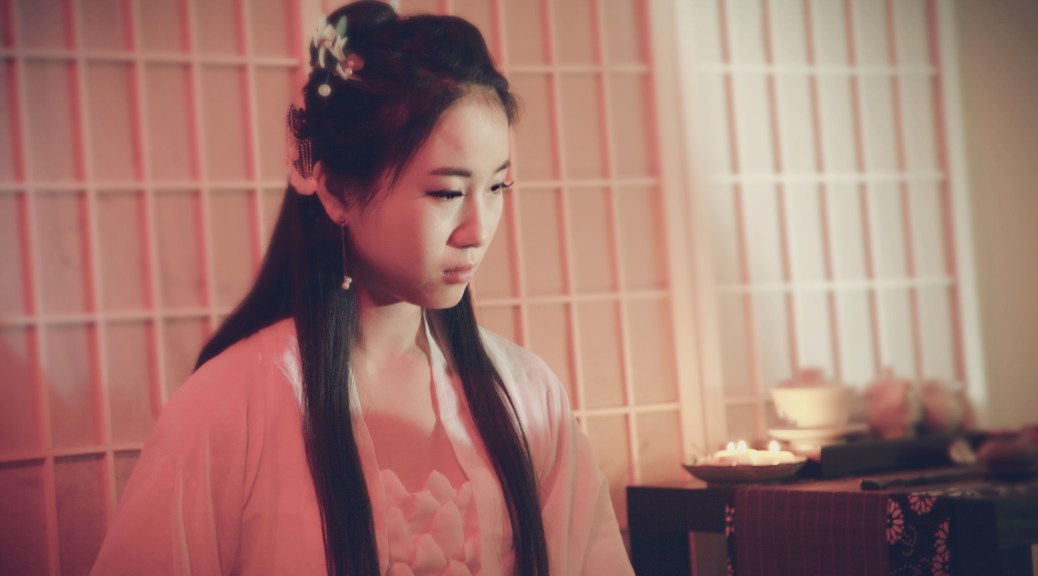
Consumemate tells the story of Amalthea, a writer who wants to write a perfect story, but has her own internal struggles. It shows the consequences of Amalthea losing herself in her art. She sinks into madness as she immerses herself in her drive for perfection to live in the character of Piner, the protagonist of her story. She develops a split personality and cannot distinguish between reality and fantasy. Zhang played both Amalthea and Piner in the film.

“I like the theme of the project that is about success and ruin. The acme of desire is ruin, it’s difficult and important to make a balance. I believe the aim of every artist is to achieve perfection of execution. As an actress and artist, I always hope to find roles that are challenging and have perfect performances. Setting a goal is the whole life. In order to achieve that goal, I have to eliminate all the obstacles. Sometimes the obstacle is ourselves, so I start to fight with myself and seek a breakthrough,” said Zhang. “As an actress, I have to put myself into some imaginary circumstances and feel my characters. I have to have my heart open and be vulnerable. Sometimes, if I go deeply and stay in that imaginary circumstances for a long time, it can feel hard to get out. I also have a negative side in my body and feel self-denial and self-doubt. The feeling of failure is like an evil power, just like the writer Amalthea. The harder part was the ghost, Piner. She represents the dark side of people, she is like a powerful evil. I had to overcome my fears. I had to find out the dark side beyond myself.”

Although Consumemate just started its film festival run, it has already seen a lot of success, and was the winner of the Festigious International Film Competition 2017. Zhang has been recognized internationally for her outstanding performance. She won the Award of Merit – Leading Actress at the Best Shorts Competition 2017, the Festival Award – Best Actress at the Festigious International Film Festival 2017, the Bronze Award – Best Actress at the NYC Indie Film Awards, and was an Honorable Mention – Best Actress at the Los Angeles Film Awards.

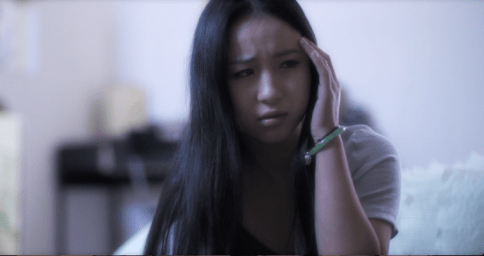
still of Consumemate
Ariel Zhang as Amalthea in Consumemate

“When we were working on the first steps of rehearsals of this film, I thought this could be a great movie, so I gave my best, as everyone did. The fact that this film is doing so well on an international level is something that makes me feel really proud, and inspires me to keep working hard, because every victory means more and more work,” said Zhang. “It was fun and challenging having two different characters in the same movie. They were so opposite that I really needed my space and to work with each of them, and the director and the rest of the crew were really helpful about that.”

The success of the film truly came down to Zhang, as she had to fully capture both of the characters she had created. The director, Jun Xia, says he cannot imagine any other actress for Consumemate other than Zhang, and her acting in the film was complete perfection.

“Ariel nailed every single scene. Her understanding of the character and her journey was 110 per cent accurate, and even more important, believable. And for sure, she can make a project awesome just by having her as part of it. She has such a high level of professionalism as an actress. Also, the fact that she can deliver any emotion on screen completely real, makes the product basically perfect. She understands and works the character of the film as much as the director, so they end up giving life to any single detail of the film,” said Jun Xia, the director of the film.

In addition to being the lead actress, Zhang also wrote the film. Her idea to create the two characters were to create contrasts between them. She says the challenge is not only that the two characters have totally different personality characteristics, but they also live in different times. She was seeking to find different characteristics for each character. To do this, she explored the symptoms in schizophrenic patients, ensuring the feel was believable and raw. To set up the tone of ancient people, she also read a lot of ancient literature and watched many ancient themed movies. She truly wanted to explore more details to create a believable and truthful performance.

“After I created the two characters and the story, I also learned a lot of things from my characters. In a personal aspect, I learned that I need to appreciate the imperfect self, imperfect art and imperfect life. In a professional aspect, I found deeper areas of both myself and my role. I learned how to use acting skills and techniques to create characters, and not just playing myself. I knew more about my capability which will help me with developing different types of characters and different genres of films,” Zhang described.

Consumemate has been officially selected for the Los Angeles CineFest and Digital Griffix Online Film Festival, and there is no doubt that Zhang’s performance will once again be appreciated by those audiences, and many more.

Film Producer Kseniya Yorsh’s Creative, Kinetic Approach to Movie Making

Film producer Kseniya Yorsh’s approach to cinematic excellence is a high-powered mixture of meticulous attention to detail and an impressive grasp of comprehensive overall scope of any project. Although a relatively recent arrival to Hollywood, Yorsh’s brief yet fruitful career trajectory encompasses a broad spectrum, including music videos, feature films, documentary and shorts—four of which were screened at the Cannes Short Film Corner. Most recently, Yorsh produced Visitors, an engrossing Science Fiction short drama that’s been getting a lot of attention and is set to be showcased in half a dozen prestigious film festivals across the country in 2017.

The Belarus-born Yorsh always gravitated towards the creative, a pursuit which inevitably led her to film. “As a kid and teenager I received all sorts of artistic training,” Yorsh said. “Classical piano, theater classes, film school, literary practice, and I learned 3 foreign languages. As a young adult I worked extensively in business, and all these disciplines have helped build my film producing career. Once I decided to devote myself fully to filmmaking, I came to the US, got a degree in Documentary Filmmaking at New York Film Academy and in Entertainment Business and Management at UCLA.”

Ambitious and focused, Yorsh perfected her craft with experience in almost every aspect of filmmaking. She has written, directed, acted, edited, and worked as an art director, make-up artist, production designer, even in the sound department. It’s an impressive background that’s created her near encyclopedic grasp of what a film producer must both anticipate and turn to the project’s advantage—locations, crew, casting, supervising daily operations on set—and her roster of achievements currently stands at 13 shorts and 3 feature films.

The intense, idiosyncratic Visitors, which combines themes of family dysfunction and chilling otherworldly suspense, offered Yorsh some unique opportunities for trouble shooting.

“Alon Juwal, the director, came to me with the script and the budget he had for the film and I transferred his ideas into a feasible reality,” Yorsh said. “We had some shots that were difficult from a technical standpoint. For example, we had a shot where we see the main character in a beam of light as if from a landing spaceship. We were filming at night so it had to be bright light coming from the sky, with a lot of wind, and us moving in closer and closer to his face. We had aerial shots; we had night shoots in a forest; we had a dog that we needed to film at night; we had guns, special effects.”

“When producing a short film, budget and logistical limitations make you become creative in solving technical challenges and making sure the shoot like this is done in comfortable and safe conditions for the actors and the crew. Figuring these things out was an exciting challenge for me as a producer.”

Characteristically, Yorsh met every concern head on and turned in a flawless finished product. Her vision and drive not only set Yorsh apart but also unfailingly impress her colleagues. “I first met Kseniya a few years ago and was immediately impressed by her clear vision, discipline, imagination and passion,” Sergei Stern, the film’s musical composer, said. “When I was recommended as a composer for Visitors, I was pleasantly surprised to find out that Kseniya was the producer. She and Alon built a great team around this wonderful project and I think we did a solid, beautiful film that combines visual beauty with an emotional, dramatic story.”

Released in late 2016, the film—like just about every project Yorsh takes on—has been well received by audiences and recognized with awards at the Boston Science Fiction Film Festival and New York City International Film Festival. And since then, she has already produced an feature film and 2 shorts and has another currently in pre-production.

“I love producing because it’s about seizing an opportunity where one doesn’t exist before,” Yorsh said. “It’s about bringing people together and being able to recognize unique skills in a person and link it to someone else’s skills or written material. I love seeing people shine professionally and I love bringing good material to life.”

Cinematographer Ernesto Pletsch is True Storyteller for Award-Winning Film “Akirah”

AKIRAH, 2015. Dhruv Lapsia (1stAC), Derrick Cruz (director), me and Andrés Hernandez (gaffer)
Ernesto Pletsch with Dhruv Lapsia, Derrick Cruz, and Andres Hernandez

Despite always having a deep passion for art, photography, and film, Ernesto Pletsch was hesitant to follow his dream. Growing up in Porto Alegre, Brazil, there is no film industry, and not many people believe filmmaking is a sustainable career choice. However, Pletsch was determined, and refused to give up on what would make him truly happy. Audiences are thankful for this perseverance, as now he is an internationally successful cinematographer.

Pletsch sees cinematography for what it is, a true and important form of art. He is a visual storyteller, giving a voice to people that may not have had one without him. While working on the film Akirah, the voice was more metaphoric, as there was no dialogue or speaking parts. The storytelling was completely dependent on the lens of Pletsch’s camera, and he was completely up for the task.

“I liked shooting this project because I put all I had into it. Derrick, the director, trusted me and gave me freedom to try something unusual. As the film is purely visual, we had a lot to experiment with. There was lots of camera movements and dramatic lighting. I think Akirah is a cinematography guided film, so that’s why I was intrigued to work on it,” said Pletsch.

Pletsch was extremely vital to the success of the film as the director of photography, and after premiering at Warner Brothers Studios in Burbank in September of 2015, it went on to have success at international film festivals. It was an Official Selection for the Hollywood International Moving Pictures Film Festival in February 2016, where it won Best Student Short Drama, as well as the Gold Award Student Film at the International Independent Film Festival.

“It feels gratifying to have the film be so successful and recognized at these festivals. When directors, producers, actors or any other people who watched Akirah come up to me to congratulate, you feel gratified because you played an important piece in the success of it. And it’s only when each piece gets together that we can make something great,” said Pletsch.

Akirah shows the struggle of young gangs in a disturbed environment. It is a film about violence, an exploration of the psychological motivations of violence and the consequences that come with growing up in a culture of it. The film deals with our society structure and the people without a chance.

“Whoever is grown in this scenario is faded to the consequences of this culture. The culture of violence. My work was to take in consideration of this environment and try to translate this idea to spread this subject to a broader public,” said Pletsch.

To try to tell this story, Pletsch chose a specific style of cinematography, similar to that of David Fincher and Fight Club for look, colors and framing, and Akira Kurosawa in terms of the blocking of the actors and movement of camera. This approach was appreciated by director Derrick Cruz.

“Working with Ernesto has been one of the most seamless and easygoing partnerships of my career. His outstanding work lighting and composing shots speaks for itself. And I contribute his excellent craftsmanship and skill as the key factor in creating the quality and professional aesthetics of my films and TV show. But above all, what has kept me going back to Ernesto with my projects and films is his excellent on set demeanor, fearlessness and professionalism,” said Cruz. “Ernesto is great at what he does because of his passion and commitment to it. Watching him grow throughout our time together at school and now in our professional careers has been terrific. He is great at what he does because it is clear to me that every day he strives to get better and be better. And because of his dedication and love for photography and film he has continued to do so. I look forward to our continued partnership.”

It was Cruz who initially invited Pletsch to work on his film. He saw a bit of Pletsch’s work and knew he had the talent and skill to take the project to the level it needed to be. After discussing the project in detail, Pletsch was won over, and was eager to start working. Arriving to set, he knew no one, and now, two years later, the crew have made many films together with no plans of stopping.

“At first, filming Akirah was challenging. Being a film without any words, it was a big step to me in the pursuit of being a cinematographer. I was anxious. At the end of the shoot I was very pleased with the results. My crew was great, composed by talented people. Overall, it was a good stress. I was a little nervous by the responsibility put upon me, but it’s a natural process. We all have to pass through that at some point, and I did it,” Pletsch concluded.