Tag Archives: Writing

Filmmaker Hollis Sherman-Pepe on Craft, Creativity, and Her Feature Debut

Though she has become known for dreaming up fantastical worlds and elaborate stories through her work as a filmmaker, Hollis Sherman-Pepe insists she’s not a dreamer, she is a doer. And after looking at all that she has accomplished over the course of her more than two-decade career in the industry, it is a statement one can only agree with.

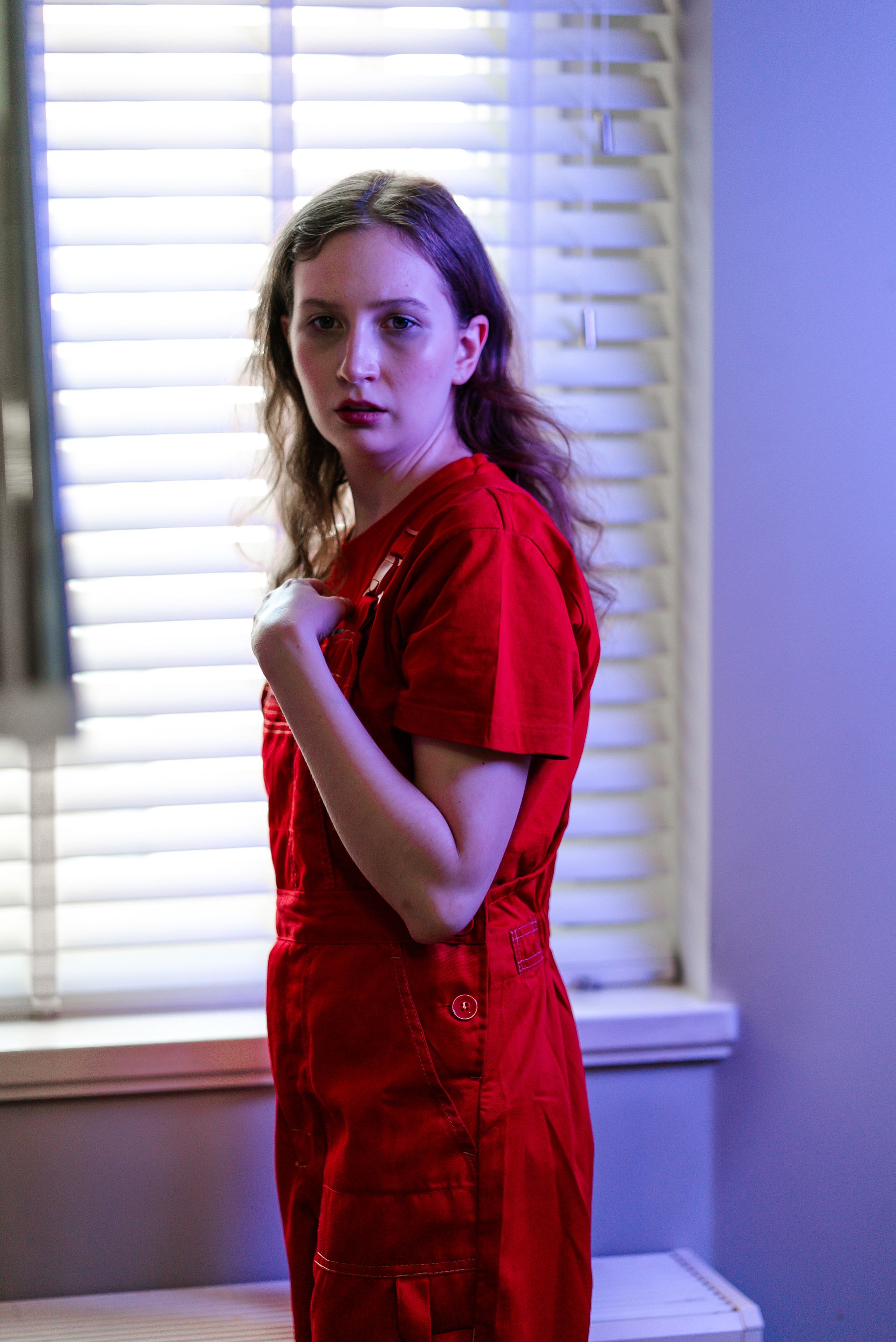
Writer-Director-Producer Hollis Sherman-Pepe

Hollis began her industry journey as an actress. Over the years she has played a wide range of roles in films such as Between Wars starring Primetime Emmy Award winner Michael Imperioli (The Sopranos), Twenty-Minute Exotic Getaway, Adrenochrome, Green Piece, and series such as NCIS and 1000 Ways to Die.

She wrote, directed and starred in the short film To Quiet My Mind, her directorial debut, which was the Festival Award winner for Best Experimental Film at the California Women’s Film Festival, as well as Valediction, for which she received Best Actress Awards from the Los Angeles Cinema Festival of Hollywood and the Los Angeles International Underground Film Festival, along with the Women Filmmakers Award of Merit from the Best Shorts Competition. In 2021 she also wrote, directed and starred in the sci-fi fantasy film Twenty Minute Exotic Getaway, which took home two Best Sci-fi Awards from the Jim Thorpe Independent Film Festival and Pasadena International Film Festival. Additionally it was the winner of Best Cinematography and Best Set Design at NewArk Independent Film Festival.

One of the aspects that makes Hollis such a unique talent is her curiosity; and it is something that has led her to step outside the path of acting, and explore the myriad of other production roles that bring a film to life. Early on in her career she worked as a production assistant, using the opportunity to learn as much as she could from every department willing to take her under their wing. She says, “I still approach filmmaking this way: ask questions, stay curious, work hard and be proactive.”

In 2015 she started Farmer’s Daughter Productions, a women-helmed production company dedicated to bringing powerful cinematic experiences to the screen. Over the years she has produced numerous award-winning films through Farmer’s Daughter Productions, including YES, the winner of Planet Female’s Best Festival Short Award and Noci Film Fest’s Audience Award and Young Jury Award, A Couple of Secrets, which won the awards for Best Film Trailer at Mindfield Film Festival, the screenplays Foxes, a Semi-Finalist at Richmond International Film Festival and Cordillera International Film Fest, and Right Hand Man, which took home the Bronze Medal Award at LGBTQ Unbordered International Film Festival.

Now, as she prepares to release her first feature film, Tenants of Carver Hill, we were lucky enough to catch up with Hollis for an interview about her creative inspirations, her evolution as a filmmaker, and the deeply personal experiences that helped shape her latest project.

For Hollis, the impulse to tell stories has always been rooted in curiosity. She is fascinated by the space between what we know and what remains unexplained, and that fascination has become a recurring thread throughout her work. “There is far more unknown than known to humankind,” she explains, describing the questions that arise from that uncertainty as a source of endless inspiration.

That curiosity doesn’t stop at the page. Hollis approaches filmmaking as an exploratory process, researching everything from philosophy and science to poetry and the ideas of thinkers who have grappled with the mysteries of human existence. She then looks for ways to weave those discoveries into her stories, often using fantastical beings and supernatural spaces to give physical form to thoughts and emotions that might otherwise remain invisible.

It is perhaps fitting, then, that her first feature would be a supernatural thriller — and even more fitting that it would draw on experiences that are very close to home.

“I grew up in a haunted house,” Hollis says. “I think it was perhaps my destiny to make a cinematic ghost story.”
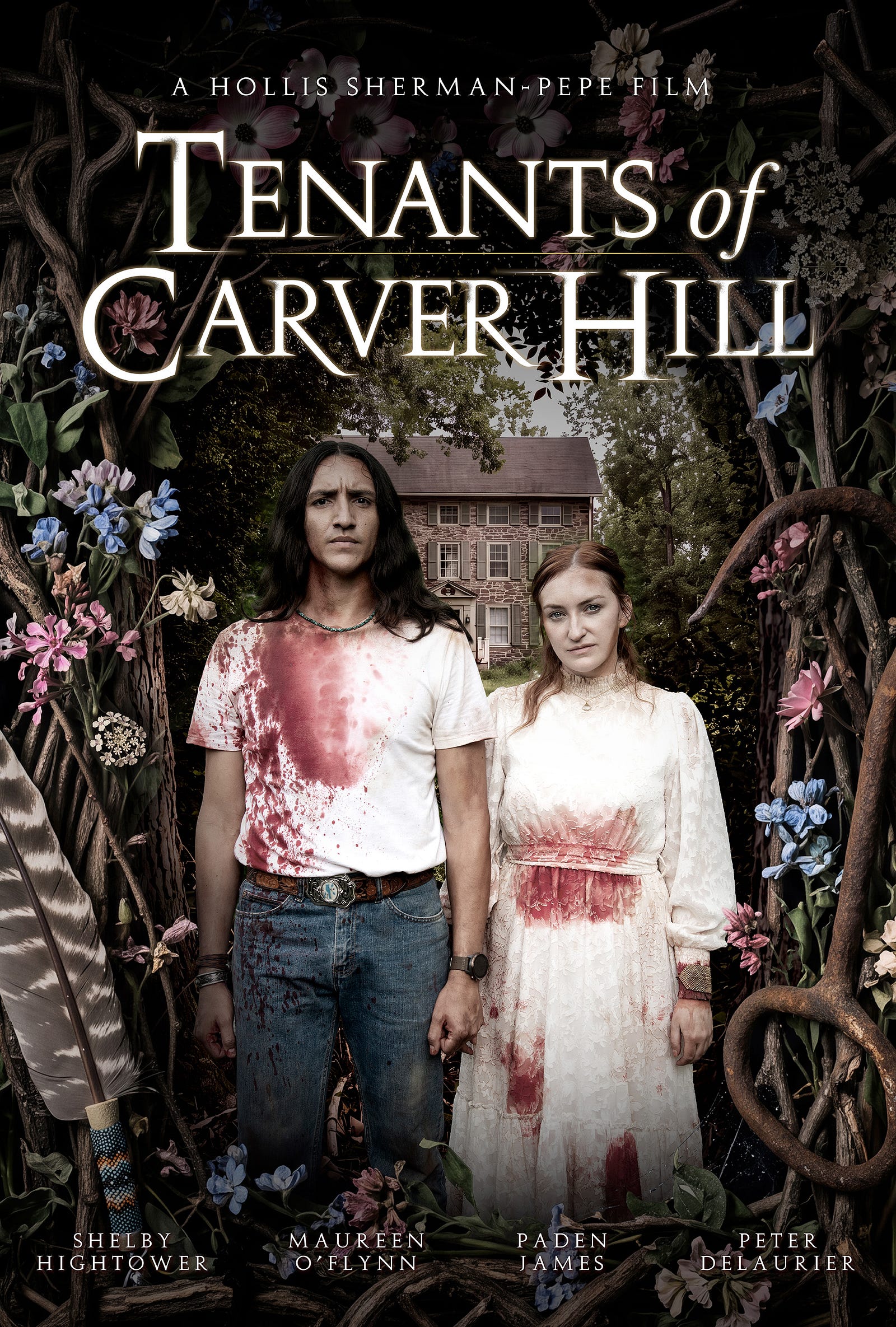
Film Poster for “Tenants of Carver Hill”

With Tenants of Carver Hill, Hollis has taken those real-life experiences and transformed them into a story that explores the mysterious and unseen while remaining deeply connected to its characters, its setting, and the history embedded within it.

A supernatural thriller, Tenants of Carver Hill follows a stranded young couple who spend the night at Carver Hill, only to awaken the spirits haunting the house — transforming one fateful night into an inescapable nightmare. The film features standout performances by Shelby Hightower (HBO’s Task, Netflix’s Tires), Searra Sawka (Hell House LLC: Lineage), Paden James (Prime’s No Rest For The Wicked) and features legendary opera diva, Maureen O’Flynn and theater luminary, Peter DeLaurier.

Welcome Hollis, such an honor to catch up with you. Can you start by telling us where you’re from originally and when you started getting into film?

I am so grateful to be speaking with you. I grew up in rural Southeastern Pennsylvania, outside of Philadelphia. I was always a very creative child and began writing at a very young age. I wrote my first novella by age ten. By my teens, my first camcorder changed how I saw and interacted in the world. I was obsessed with turning our games of playing dress-up into real stories. I made movies all the time: live action, stop motion, documentary. I simply just loved to shoot what I saw.

I was able to save most of my childhood tapes, digitizing them some years back. One of my favorite early films documented an architectural preservation event on our family farm. I set the whole event to Moby’s album Play, and dragged around a boom box on a 100-foot extension cord as I shot beautiful images of construction against a backdrop of blue sky, puffy clouds, and all these wonderful people who came to celebrate the event. I recently dug out the footage and recut it, using the same music and presented it to my family as a special screening. This absolute nostalgia gem meant as much to them as it meant to me.

How did you know that film would be a part of your life for the long haul? And how has it influenced your life?

I was an actor. As young as preschool, I was determined that acting would be my life’s pursuit. I chased that dream, earning my BFA degree at University of the Arts in Philadelphia and making a move to Los Angeles where I continued the work and the training. I loved being on set and wanted to learn as much as I could about production. I started as a hardworking and eager production assistant, garnering as much knowledge as I could from every department that was willing to take me under their wing. I still approach filmmaking this way: ask questions, stay curious, work hard and be proactive.

The first time I wrote and starred in my own short film was in 2012. In that, I found what I was really searching for, creative fulfillment and control of the narrative. It snowballed from there. In 2015 I started my production company, Farmer’s Daughter Productions. I have been producing, directing and shepherding other filmmakers ever since.

My passion for storytelling and art is in consistent bloom. I find my inspiration in nature, art, books, and in folklore. I go to the movie theater often and watch films across all genres and time periods, finding inspiration and studying — how did they shoot that? The language of film is my vernacular, my orbit. I love talking about both the art and the business of film and I feel incredibly fortunate to be surrounded by an ever-growing circle of filmmakers who support, challenge, and celebrate one another.

Making movies is difficult, expensive and time-consuming. These truths are ever present, but they also make the community around filmmaking all the more meaningful. I believe there is room at the top for everyone. Every artist has a voice that can only belong to them. Cinema speaks on such a deep level, providing hope, catharsis and offering windows into experiences we may never otherwise know. I feel incredibly lucky to spend my life creating within that sphere.
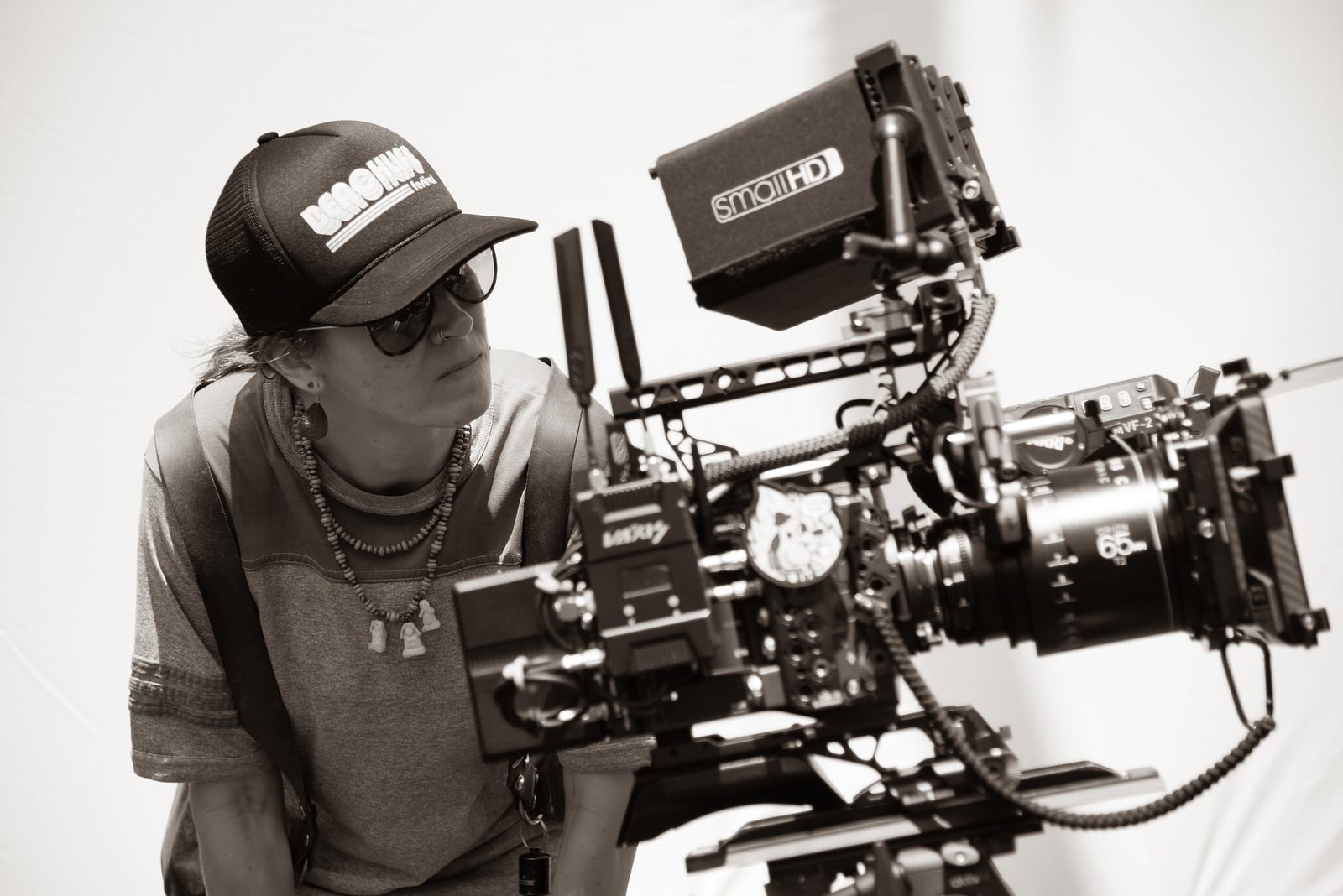
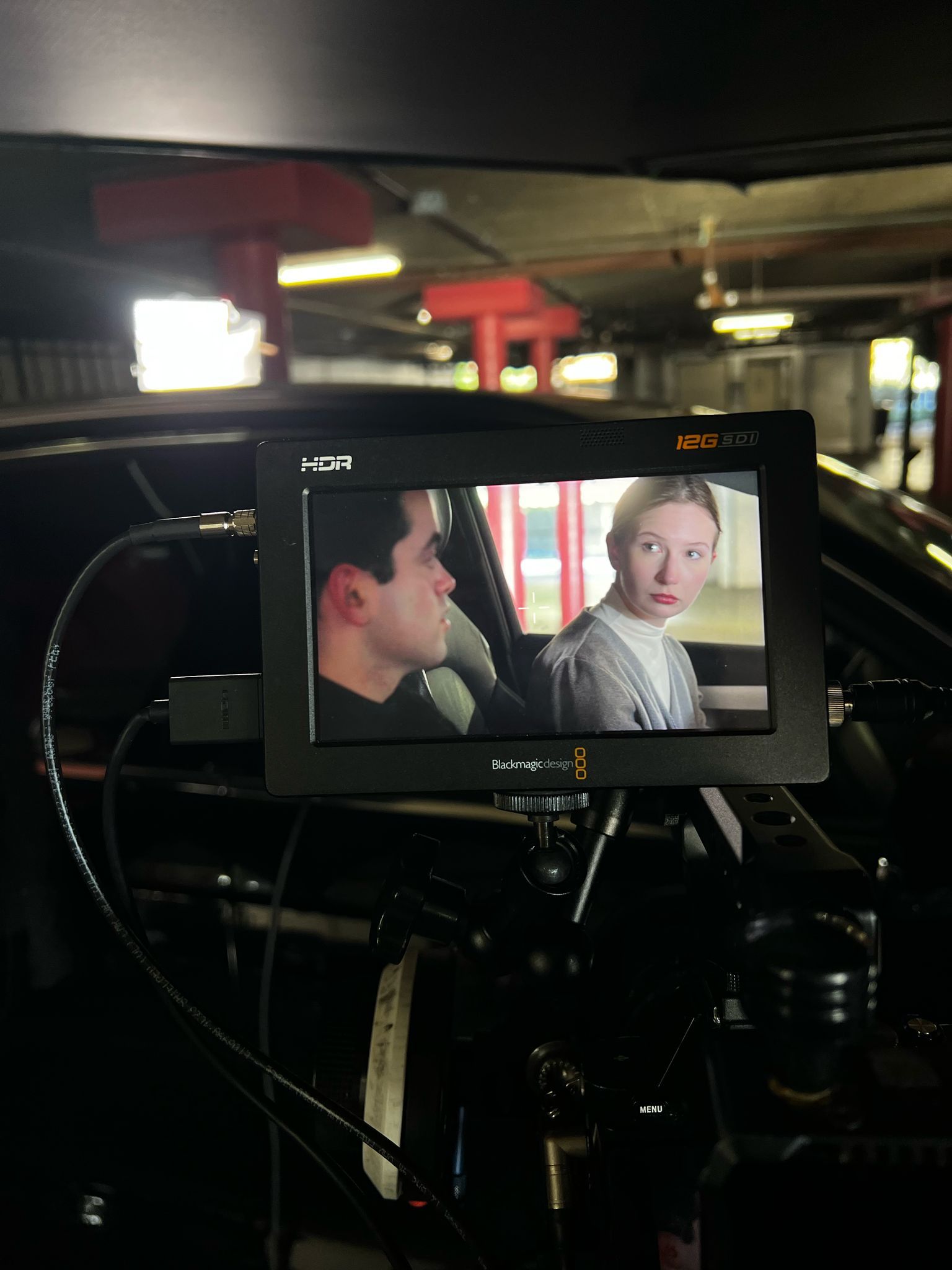
Director Hollis Sherman-Pepe checking the shot

“Tenants of Carver Hill” marks your feature directorial debut. Looking back, what does reaching this milestone mean to you personally and creatively?

I am proud of the work it has taken to get here. I am not a dreamer; I am a doer. My gosh, I have learned so much as a filmmaker over my two-plus decade career and have profoundly grown as an artist. Cultivating my vision and translating it clearly with my team so we can work toward a common goal feels really satisfying. I have never been afraid to ask questions and push my abilities beyond my comfort zone.

Completing a first feature film, particularly one with financial limitations and visual effects demands, feels like an awesome launching pad into the next film and the one after that, and so forth. I intend to keep learning and pushing myself to expand upon what I believe I can create.

Over the past 20 years You’ve worked as an actor, writer, producer, and director. How has your experience in front of the camera influenced the way you direct actors?

Acting is such a vulnerable and beautiful art form. My job as the director is to provide the incubator for the actor to thrive in. As a screenwriter, I love the exploratory aspect. As a director, I like to share the pearls I found along the way with the actors. The pearls include reading material, inspirational art, poetry, music, anything I can offer for their character development. That said, ultimately, I trust them to make unique and honest choices. Often actors will find their own inspiration that they share with me and I then find ways to incorporate their ideas into the story.

As an actor for most of my life, one with a BFA degree and endless training, I have a good eye for what is working and honest within a performance. Sometimes a spark needs a bit of coaxing to become real fireworks and that is when my own training comes out. I love that I can sometimes share the perfect tool from my own toolbox to help an actor realize their fullest potential. I have some absolute favorite acting exercises that I employ behind the scenes. I’ve used them during casting, in rehearsals, and on set to help guide an actor’s sensitivity, connection to co-stars, or even to break a repetitive performance. I would encourage all directors to dive into some acting classes, not scene study, but rather classes that focus on the more subtle aspects of the art.

Sometimes the acting exercises can be physical and I will get right in there with the actor and engage them. The crew on Tenants Of Carver Hill got a real hoot out of watching me jumping and shouting alongside one of the actors. I needed intense frustration and anger from a particular moment, so I got down and dirty with my roots. We jumped up and down to a point of exhaustion. I had him shout the line in my face. I told him to scare me. I would shout it back. We got there. He got there and it paid off tenfold in the cut.
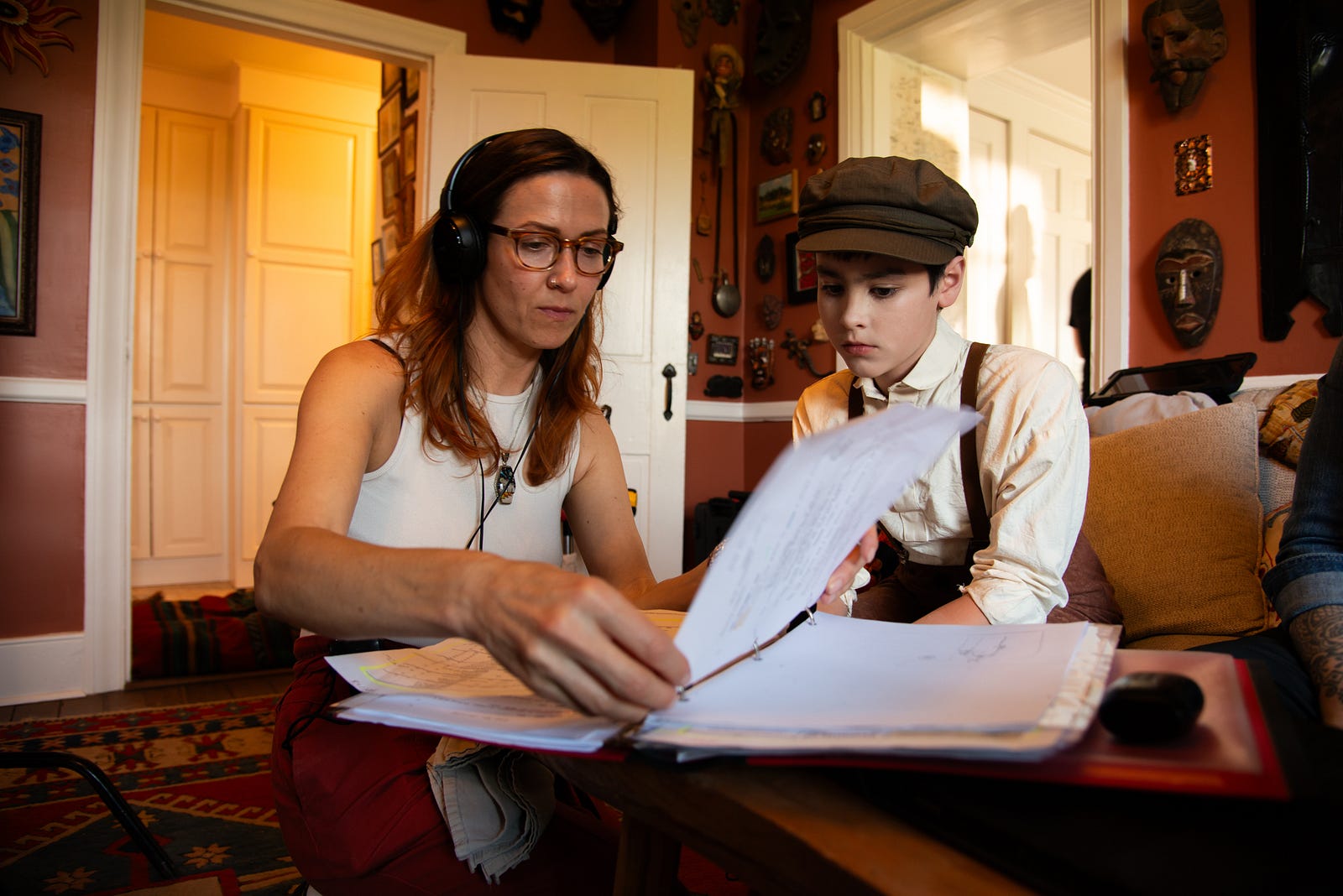
Director Hollis Sherman-Pepe looking through script notes with actor Adam Provo

You often describe your work as exploring the unseen forces that shape our lives. What draws you to stories where mystery, folklore, or the supernatural become a lens for examining human nature?

Unseen forces shaping our lives have been a through line in my work thus far. As human beings, our life cycle is short, and our place in the universe is a marvelous mystery. We are all story tellers; functionally recounting events, replacing lost facts with emotional impressions, as well as inventing explanations for the unknown. From prehistoric cave painters to the legends of the Qing Dynasty, and the traditions of the modern American ghost story, as a species we love to share, imagine and invent. Here on Earth, we are but a pin prick in the vast and ever-expanding Universe. There is far more unknown than known to humankind.

I love the questions that arise from that uncertainty. They give me a reason to research, to read books, papers, and studies written by philosophers, scientists, poets and thinkers. My private holiday is to lose myself in it all, then find clever ways to hide the gems within the stories I build.

Characters interacting with fantastical beings and supernatural spaces gives me an avenue to materialize thoughts and feelings that would otherwise be difficult to see. It opens the door to humanizing concepts and questions. People are marvelously complex. Behavior for most of us is multifaceted. The choices we make are based on morals, emotions and culture. When you introduce spirit realms like magic, faith, consciousness, and new dimensions the possibilities are endless. The supernatural isn’t an escape from human nature, it is a way of looking at it from a different angle.

Although “Tenants of Carver Hill” includes supernatural elements, it feels rooted in history, place, and character. What inspired the story, and what were you most interested in exploring beneath the mystery?

I grew up in a haunted house, so I think it was perhaps my destiny to make a cinematic ghost story. This film became my opportunity to share some of my real-life haunting experiences as well as honor my appreciation for the past.

Tenants of Carver Hill was written specifically for our filming location. Setting the story on a property dating back to the 1700s allowed me to intertwine the real-life history of the house and the Pennsylvania Dutch culture into my story. These early American settlers had their own language, faith, and traditions, and their simple farming lifestyle helped lay the groundwork for the Mennonite communities that followed. I loved the idea that one house could carry all of those eras, lives, and people’s stories vibrating within the walls.

I am fascinated by the idea of destiny versus free will. As modern Americans, we are constantly driven toward success. Our culture is always evolving toward better, bigger, newer, and more efficient. We celebrate the idea that we are free to command our own destiny, but what if we aren’t? What if our position in life was actually predetermined? Like, what if we are part of a much older cycle, a cog in a never-ending wheel, destined to repeat the history of those who came before us?

Our culture prizes youth and beauty. I wanted to play with these roles and expectations, so I set my hopeful heroes in a world that forces them to experience the past, confront duty and preservation. I gave them this challenge but funneled it through a supernatural lens, letting it be enchanting and simultaneously unsettling.
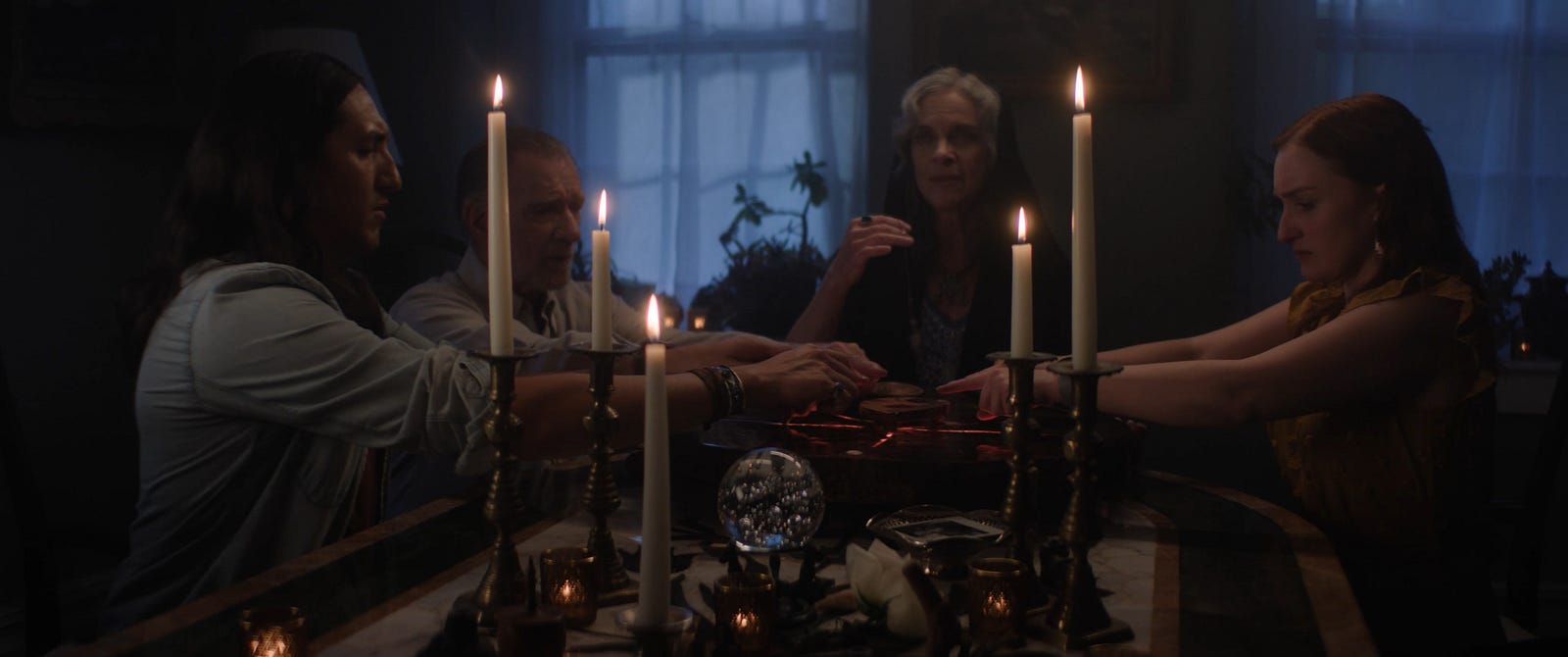
(L-R) Stil of Paden James, Peter DeLaurier, Maureen O’Flynn, and Shelby Hightower conjuring the spirits in “Tenants of Carver Hill”

Your films are known for layered storytelling and richly imagined worlds. What makes “Tenants of Carver Hill” different from other supernatural thrillers audiences may have seen?

I love creating worlds that invite you in, only to later reveal something much darker underneath. Spooky but charming. Warm but secretive. Beauty that fills you with unease. The world of Carver Hill is dreamy. Springtime blooms are as welcoming as the tenants that live there. The perfect misdirection.

I wanted to try something fresh with the look of our ghosts and chose to make them photosensitive. Developing this look with the artist was a lot of fun. The mysterious house was to feel mazelike at times, filled with a collocation of museum-like antiquities and preternatural relics, alive and watching, offering clues to the decades encapsulated within the walls.

I don’t think genre films have to be simple or formulaic. Of course, some formulas work for a reason and Tenants of Carver Hill includes some of those familiar beats and the inevitable “don’t go in there” moments. But ultimately, I love to find ways to break the mold. I’m not a fan of stereotypical characters. I would rather build characters with layers and contradictions. When a character fights with their own belief system or moral code, we as an audience become more invested in the cause and consequence. Watching a complex character make choices is far more intriguing to me.

World building is certainly a specialty for me as a filmmaker. My previous Sci-Fi film, Twenty Minute Exotic Getaway explored a wild variety of environments, from dead planets with suns on the verge of burning out to creatures and ghosts that walked through dimensions that would feel familiar and yet foreign. My unproduced folklore horror scripts also push the envelope of imagination with worlds and creatures. I can’t wait to bring them to life next.

The film incorporates both early American settler history and Native American perspectives, including tailoring your lead character’s background to reflect your lead actor’s Navajo heritage. Why was authenticity so important, and how did those cultural influences enrich the story?

At its core, this ghost story is one about history repeating itself, and memories being alive within the walls. Because the story was site specific, it was important to be authentic with the historical storyline. I wanted the multi-cultural aspects to be organic, not just a flavor enhancer. The male lead is Native American. This felt right for the story because I wanted his connection to the land to be old, an inheritance bestowed for the Settlers arrived, and before the House itself. I left some of the integral parts of his scripted dialogue and action open-ended until we completed our casting. That way my actor could inform some of these choices with their own tribal heritage.

The character is played by a Navajo actor, Paden James. I worked with him directly as well as with a Navajo consultant so I could approach the language and tradition authentically and respectfully. I learned a lot and found meaningful ways to include what I had learned into the story. I learned that a specific prayer is said aloud when a Navajo person enters and exits a graveyard. I included this into one of the earlier scenes of the film. I also included blessings with corn pollen and a prayer song in Navajo asking for protection.

I also wanted the house itself to feel like a character in the story. Using real historical events allowed me to honor the home and memories associated with it. I wove in documented stories, such as how an 1800s patriarch died after being kicked by his horse. The tenants of the estate, characters played by Maureen O’Flynn and Peter DeLaurier, both express their admiration for the home and bestow history of the Pennsylvania Dutch settlers. I sought out consultation for that unique language as well.

Ultimately, by weaving together these various histories allowed me to give the house a truer sense of memory. Not just a haunted-house, but one where generations have left their mark and that is what makes it feel so alive.

Pennsylvania becomes almost another character in the film. What made it the perfect location, and how did filming there shape the atmosphere of “Tenants of Carver Hill”?

Being from Southeastern Pennsylvania, it was personal and meaningful to return and shoot my first feature film here. It was a wild full-circle moment. I knew I wanted my ghost story to feel like a fantasy, harkening back to Ridley Scott’s Legend. We used a variety of filters to create ghostly blooms of light, and we built our shooting schedule around the Springtime blossoms. We planned for scenes around particular trees and flowers as they came into bloom, racing to capture them before the petals fell.

Pennsylvania is incredibly green and lush. This helped our location to feel particularly isolated, making it a little fantastical bubble all on its own. The heroes, played by Shelby Hightower and Paden James arrive at Carver Hill after an ill-fated, cross-country truck breakdown, but soon they are completely enraptured by the beauty surrounding them. The green floral atmosphere feels more like a gift than a warning, a wolf in sheep’s clothing.

And of course, there is the history. Philadelphia was the first capital of the United States. The Northeast is old. If ghosts are the echoes of the past, these walls have a lot to say. There is something inherently uncanny about being alone in a big, old space. It gives you the feeling that you are not really alone. I wanted to capture that feeling in my film.

The production also received Pennsylvania’s film tax incentive. How did that opportunity impact what you were able to accomplish as an independent filmmaker?

We are incredibly grateful for the Pennsylvania film tax incentive. The story takes place in the Keystone State, so shooting there was non-negotiable for us. We took the time to carefully prepare our application and raise the full production capital prior to filming, as required by the Pennsylvania Film Office.

Creating a truly independent film is a monumental undertaking at every step. After completing the project, receiving this incentive feels like a gift. Having fresh funds available to put toward marketing and bringing the film to audiences is an invaluable final piece of the filmmaking process.

Every independent production comes with unexpected challenges. What was the biggest obstacle during production, and what did you learn from overcoming it?

Being ready for anything and willing to adapt and shift gears is essential for independent filmmaking. My show bible is extensive. The script pages are filled with color coded notes and hand drawn diagrams. I keep the pages in plastic sleeves and consult them while shooting. My shot lists are specific and detailed. My cinematographer Nick Pietroniro and I were so incredibly in-tune with one another, creating the shot list, the look books, camera and filter testing well ahead of time. The more you can control and discover in the preparation, the easier it is to change course for the unexpected.

We were shooting in April and May in Pennsylvania, so the potential for rain was a concern. Our 1st Assistant Director, Katrina Gerlach was a wizard juggling our everchanging scheduling needs, child actors that could only work on weekends or after school, talent that needed to fly out mid-shoot for a wedding, talent leaving the country on a set date. There were so many moving parts and sometimes more than 40 camera setups in a day, yet we never once hit overtime and we were able to capture everything I intended to shoot. The vibes were high on this production. I am truly proud of that.

Our principal location was a historical landmark, which brought another set of challenges. The rooms were small, our equipment couldn’t be fastened to the walls or placed on surfaces, and we had to be constantly mindful of protecting the property. Our entire crew took that responsibility incredibly seriously, and we finished without a single incident.

A favorite challenge on set was a shot with my star Shelby Hightower. The camera would spin around her as she was experiencing paranormal contact and sense memories from the past. This type of shot would normally require specialized gear and a larger space. Instead, we were working in a room with a six-foot ceiling and uneven floors. Pietroniro would have to shoot it with a Movi gimbal rather than a crane or circular dolly track. We were shooting anamorphic and had some beautiful lens flares coming in through the windows, but as the camera circled, the operator and equipment began throwing enormous shadows across Shelby. While braving the unexpected rain shower, gaffer, Colin Passman, key grip, Morgan Hartman and team kept adjusting the lights, trying to preserve the flares while eliminating the shadows. We were losing time and falling further behind schedule. Eventually, we had to get scrappy. On each pass of the camera between Shelby and the key light, we verbally cued the gaffer to kill the light. It was whacky but it worked. We captured the quintessential moment using the bare bones, a lot of ingenuity, and a determined crew, and still caught up with our schedule that day.

My takeaways from the experience are to prepare intensely but be ready to adapt, combine and adjust. Always work in service of the film. Stay true to the vision, but ultimately stay true to what the film decides it wants to be. It’s easier to make jazz when the foundation is strong.

On the other hand, was there a moment on set that reminded you, “This is exactly the film I wanted to make”?

That is such an interesting question. From conception through production and post, my expectations evolved with the film. Putting together this stellar ensemble cast really brought it to life uniquely. No other combination of actors would breathe life the same way. Choosing key crew like my cinematographer gave a specific flavor to the film. Working with my editor Brian Ufberg to craft the final picture gave birth to yet another new perspective. Killing my darlings was a powerful benchmark as well, eliminating five scenes from the director’s cut, more tightly crafted the vision. During my pickup days, I added new scenes, and new characters. I also expanded the role played by Searra Sawka, which gifted the final picture in such a paramount way. From the first draft to the final cut, Tenants of Carver Hill developed into something unique. In a funny way, it will never be exactly what I envisioned, but rather it is its own being. The film speaks for itself, a culmination of choices I made along the way with the support of a dedicated team of collaborators.
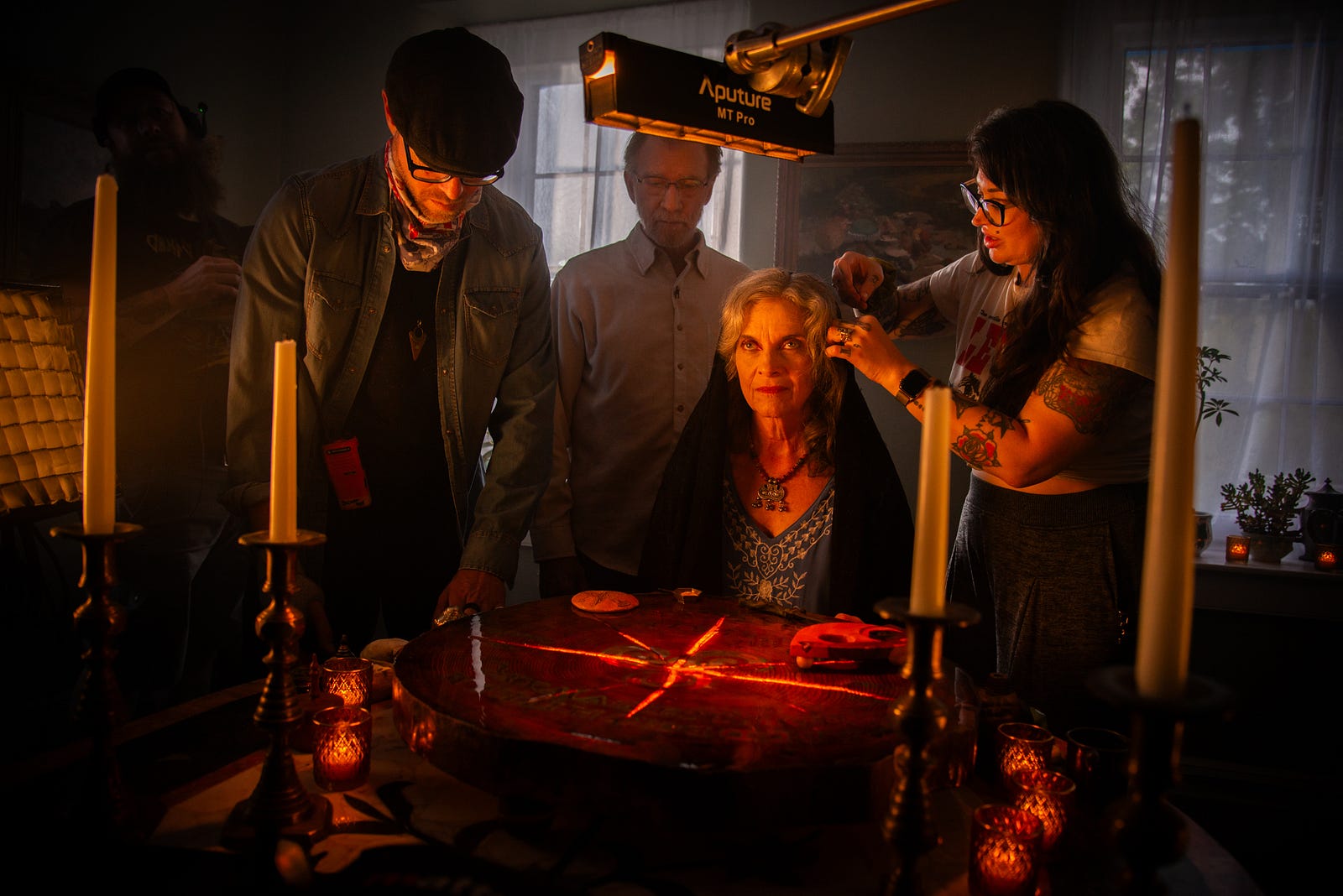
(L-R) Producer Scott Fleisher, actors Peter DeLauier and Maureen O’Flynn, and HMUA Jessica Saint gathered around the custom built spirit board, perform last looks before shooting a “Tenants of Carver Hill” scene

Your bio mentions that you’re a collector of art and antiquities, and that you’re drawn to color, texture, and layered imagery. How do those personal passions find their way into your filmmaking?

I am a more is more person. It’s in the clothes I wear and how I style my home. I’ve always been drawn to color, pattern, art with feeling, fashion with flair. I am drawn to quality craftsmanship and artisan made pieces. I approach my filmmaking this way. Every element is considered and imbued with care. I love to travel, to read, to absorb art and nature. My personality inevitably splashes onto the screen. All of my films have been slightly off-skew from the straight and narrow. Despite what genre I happen to be tinkering in, my voice is clear. I love to fold in layers, ask questions that reveal more questions, explore and invent. Art gives us the ability to expand ourselves in magical ways. Cinema is a particularly limitless medium to do just that.

After completing your first feature, what surprised you most about yourself as a filmmaker?

I might be allergic to keeping it simple.

Every filmmaker grows from one project to the next. What lessons from Tenants of Carver Hill will you carry into your future films?

I have ambitious projects in the queue. A lesson learned from Tenants Of Carver Hill is the value of bringing key collaborators to the table earlier in the game. Having a strong Executive Producer that wants to meet me on that quest will be a game changer.

I would prefer to have my editor on board prior to shooting so that way we can work in tandem as we shoot. With each project, my visual effects needs have expanded. Each time I have had marvelous consultation prior to shooting and exceptional guidance during post. For Carver Hill we created a playbook for how to tackle each shot and we executed accordingly. Going forward I would prefer to have my Visual Effects Supervisor on set, that way we can more easily switch gears, adapt, adjust on the fly, solving problems creatively and professionally as they arise. Ambitious filmmaking requires incredible collaboration. The earlier the right people are in the room, the more possibilities you have when it comes time to make the movie.

Beyond festival recognition or distribution, what do you hope audiences take away after experiencing “Tenants of Carver Hill”?

My hope was to bring a fresh perspective to the genre film world, bridging the gap between the hardcore horror hounds and the introspective indie aficionados. I wanted to celebrate the charm of Pennsylvania with all its history, natural beauty, open spaces, historical landmarks, and hopefully inspire people to appreciate and want to preserve those things.

I’d be tickled if viewers walked away considering that consciousness may be deeper than human thought. That perhaps it is an energy within physical spaces or that conversely, material objects are living within a greater cosmic consciousness. Memories and emotions are alive and transferable, whether we consider them spirits, ghosts, faith or something beyond our current understanding.

My film is chocked full of Easter eggs. If someone picks up on the clues and metaphors, I hope they’ll be moved to watch it a second time and discover something they missed the first time around. Ultimately, I hope audiences appreciate the nuance and craftsmanship behind my picture. If Tenants of Carver Hill leaves you curious and questioning what lies beyond our human experience, I feel as though I did my job.
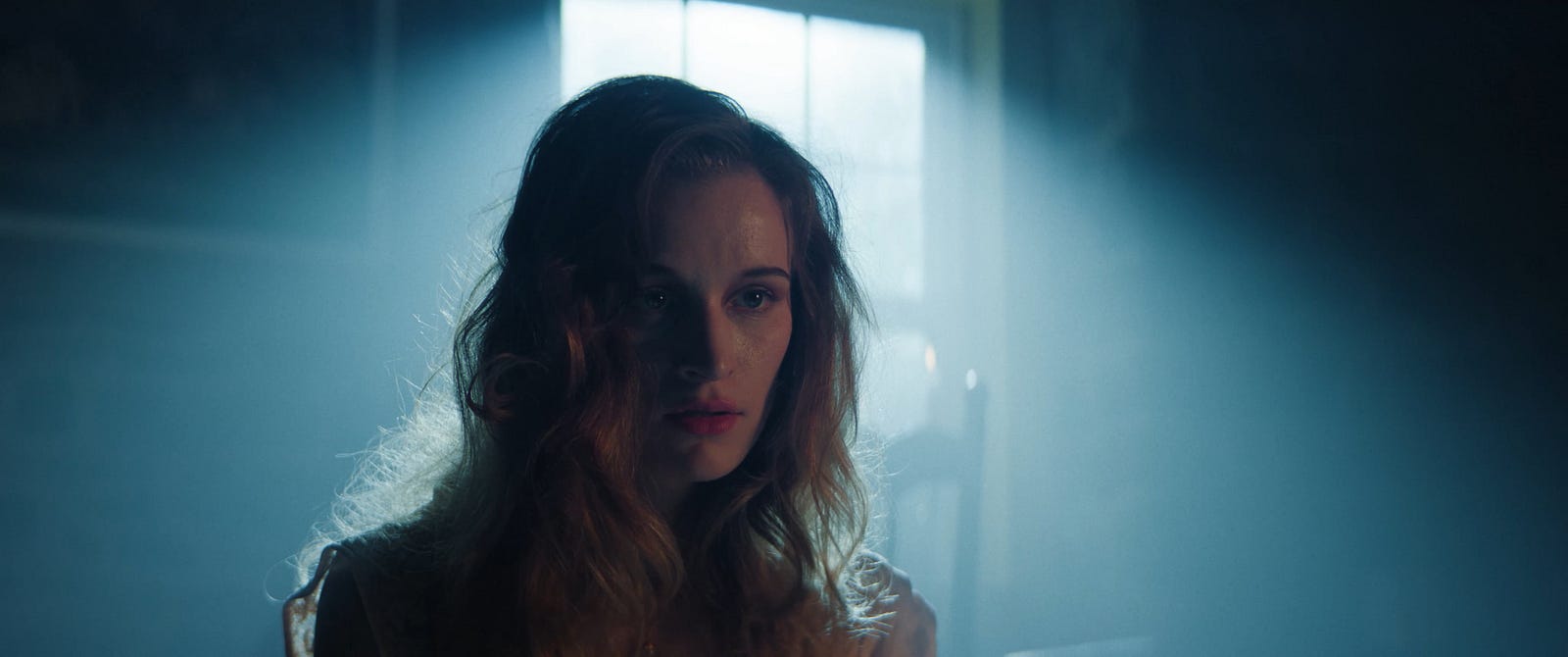
Actress Searra Sawka as Mable Marie, the origin story, in “Tenants of Carver Hill”

Looking ahead, what stories are calling to you next? Are there themes or worlds you’re excited to explore in future projects?

Oh gosh, I have quite a few scripts ready to go and projects in development, so I would hate to let the cat out of the bag. I explore a variety of genres and am eager to dive into new worlds, so I’ll keep the specifics under wraps for now. Interested collaborators can find me through Farmer’s Daughter Productions.

At the end of the day, I believe an artist always needs to be arting. The need to create is as important as the need to breathe. No matter the next picture, I will breathe my life into it and give it my heart.
Between Two Worlds: Editor Brandon Li on “PaperBoy”

When Brandon Li first came to PaperBoy, he was not simply being asked to assemble a fantasy short. The film, directed by Saulius Baradinskas, follows Luke, a dyslexic comic artist who retreats into an imaginative Paper World of his childhood as he confronts the painful memories surrounding his dying mother. The story moves between the physical world and a fantastical universe constructed from paper, but its emotional center remains firmly rooted in Luke. As the film’s editor, that distinction was crucial for Mr. Li. The Paper World could easily have become an opportunity for visual spectacle. Instead, Brandon approached the material from Luke’s subjective experience, using pacing, transitions, shot selection and scene structure to make the fantasy world feel like an extension of the character’s emotional life. His challenge was not simply to make the Paper World convincing, but to make the audience understand why Luke needs it. “PaperBoy is a fantasy story with a highly imaginative world,” Li explains, “but at its core it is also a very personal story about its protagonist.” This approach became the North Star of his edit.

Editor Brandon Li

Finding the Film in the Edit

Brandon joined this project after conversations with Baradinskas, an award-winning European director whose previous work had been selected by the Venice International Film Festival. Baradinskas had already seen three films Li edited during his first year at AFI (Factory Boy, Fisher vs. Hayes and Nosebleed) and had developed an understanding of his approach. What particularly interested the director was Brandon’s ability to make strong creative choices without losing sight of the character. Li did not see editing as an opportunity to display technical virtuosity for its own sake. His approach was to understand what a character was experiencing and allow that emotional logic to guide the edit. That made him a particularly natural collaborator for PaperBoy. The film required an editor who could embrace its fantasy elements without allowing those elements to overwhelm the story. Li was involved from the script and shot-list development through production and post-production. That early involvement gave him something an editor does not always have: an understanding not only of what the director wanted the film to look like, but what he wanted the audience to feel.

Once the footage arrived, the two were willing to question virtually everything. They removed shots. They restructured sequences. They experimented with pacing and transitions. Ideas developed during production were reconsidered in post. Rather than treating the script and shot list as instructions that could no longer be challenged, Li and Baradinskas treated the edit as a place where the film could discover what it actually needed. It’s a philosophy that would prove especially important in the film’s final hospital scene.

The Paper World

The central challenge of PaperBoy was the Paper World itself. Luke enters a fantastical universe created from paper, where the imaginative landscapes of childhood expand into paper cities and fantastical creatures. But the world is not simply an escape into whimsy. As Luke moves through it, memories of his childhood and his complicated relationship with his mother begin to surface. The fantasy gradually reveals the pain underneath it. Li was concerned that the sequence could become a collection of beautiful images rather than an emotional experience. “There was a great deal of material that could potentially be included in this section,” he says. His task was to determine which moments were necessary to communicate Luke’s childhood and emotional relationship with his mother and which could disappear without damaging the audience’s understanding.

The solution was to build the sequence around Luke’s emotional experience rather than chronology. That distinction changes the way the audience experiences the Paper World. Rather than simply moving from one event to another, the edit allows the audience to feel the fluctuations of Luke’s memories. Some moments are given room to register; others move more quickly. The rhythm is continually responding to the character. The fantasy world therefore begins to feel subjective. We are not simply watching Luke walk through a strange environment. We are entering the world as Luke experiences it, with the sometimes erratic cadence that emotions can impose. For Li, this was essential because the Paper World is simultaneously a physical fantasy environment and an external representation of Luke’s inner life. The edit must preserve both realities at once.

Crossing the Boundary

One of the film’s most important transitions occurs when Luke first discovers the Paper World. After returning from the hospital emotionally unsettled, Luke tries to draw but cannot concentrate. He accidentally pushes his pen through the paper, creating a small hole. The pen disappears. When Luke looks through the opening, he sees another world. Eventually, he closes his eyes, takes a breath and crosses through. The scene could have been edited as an abrupt transition: ordinary world, magical hole, fantasy world. Instead, Brandon wanted the audience to experience the discovery alongside Luke. That meant resisting the temptation to rush. The mystery needed time to unfold. Luke’s curiosity and confusion needed to become part of the audience’s experience. The moment when he closes his eyes and breathes before entering the Paper World was especially important because it transforms the transition from a visual effect into an emotional decision. Luke is not merely transported somewhere. He chooses to enter.

That also establishes the Paper World as something more psychologically meaningful than a conventional fantasy setting. Luke has just left the hospital carrying the emotional weight of his relationship with his mother. The world he discovers is connected to his memories, his imagination and the emotional refuge he developed during childhood. The pacing of the edit allows the audience to feel that connection. “We were entering the Paper World together with Luke,” Li says of his goal. The edit therefore becomes a bridge between the real and imagined worlds.

When the Fantasy Becomes Reality

The deeper Luke travels into his Paper World, the less secure the separation between fantasy and reality becomes. This ambiguity is central to the film. The Paper World is fantastical but the emotions Luke experiences there are not. His memories of childhood, his relationship with his mother and the pain he has carried into adulthood remain completely real. Brandon’s editing has to maintain that emotional continuity. The audience needs to be able to enjoy the strange and theatrical qualities of the Paper World while understanding that every movement through it is also movement through Luke’s emotional history. That is why pacing becomes so important. If the fantasy moves too quickly, the audience may admire it without feeling it. If it moves too slowly, the emotional journey risks becoming repetitive. Li describes the challenge as finding enough breathing room for the audience to experience Luke’s emotional fluctuations without allowing the sequence to lose momentum. The resulting rhythm is not simply a rhythm of images. It is a rhythm of memory.

The Final Encounter

Luke’s journey through the Paper World eventually brings him back to the reality he has been avoiding: his dying mother. The original scripted approach to the final hospital encounter changed substantially during editing. Li and Baradinskas recognized that the scene could communicate something more powerful by resisting a conventional confrontation. Instead of relying on dialogue to explain everything that remained unresolved between Luke and his mother, the final encounter became largely silent. They look at one another. What has been left unsaid becomes part of the scene’s emotional meaning. For an editor concerned with character perspective, this is an especially revealing choice. The film does not need to tell the audience precisely what Luke has decided or what his mother feels. The emotional information exists in the space between them. The silence becomes active. Luke has spent much of the film retreating into imagination to avoid the pain of reality. By the end, he no longer needs the Paper World to protect him from that encounter. The fantasy has brought him back to the place he was trying to escape. And the edit allows that return to feel earned.

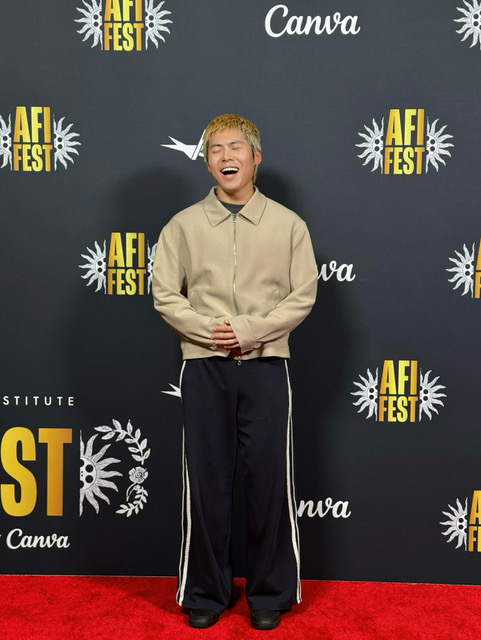
Brandon Li at AFI Fest

Editing as Discovery

Brandon’s work on PaperBoy ultimately reflects a philosophy he has brought to his editing across different kinds of films: the editor’s responsibility is not simply to assemble what was planned. It is to discover what the film wants to become. That meant questioning the script, testing different structures, removing material that no longer served the story and allowing the emotional rhythm of the character to determine the pace. The fantasy elements of PaperBoy made the process particularly demanding because the film had to operate on two levels at once. The Paper World needed to feel imaginative and visually distinctive but it could never become disconnected from Luke’s emotional reality. Li’s editing keeps those two worlds in conversation. The real world gives the Paper World its emotional stakes. The Paper World gives Luke a way to confront what the real world has made difficult to face. The edit is the mechanism that allows the audience to move between them. PaperBoy was completed in 2025 and screened at AFI FEST 2025 as part of the AFI Conservatory Showcase. The film’s fantasy may be made of paper but the emotions are real. Brandon Li’s edit made sure the audience never lost sight of that.

Ewa Sobiczewska: The Polish Actress Bringing Emotional Depth and European Sensibility to Hollywood

Hollywood has always attracted performers willing to cross borders in pursuit of a bigger artistic vision. For Polish-born actress Ewa Sobiczewska, the journey to Los Angeles has been about more than geography. It has meant combining the emotional sensibility she developed in Europe with the rigorous professional training and creative possibilities she discovered in the heart of the American film industry.

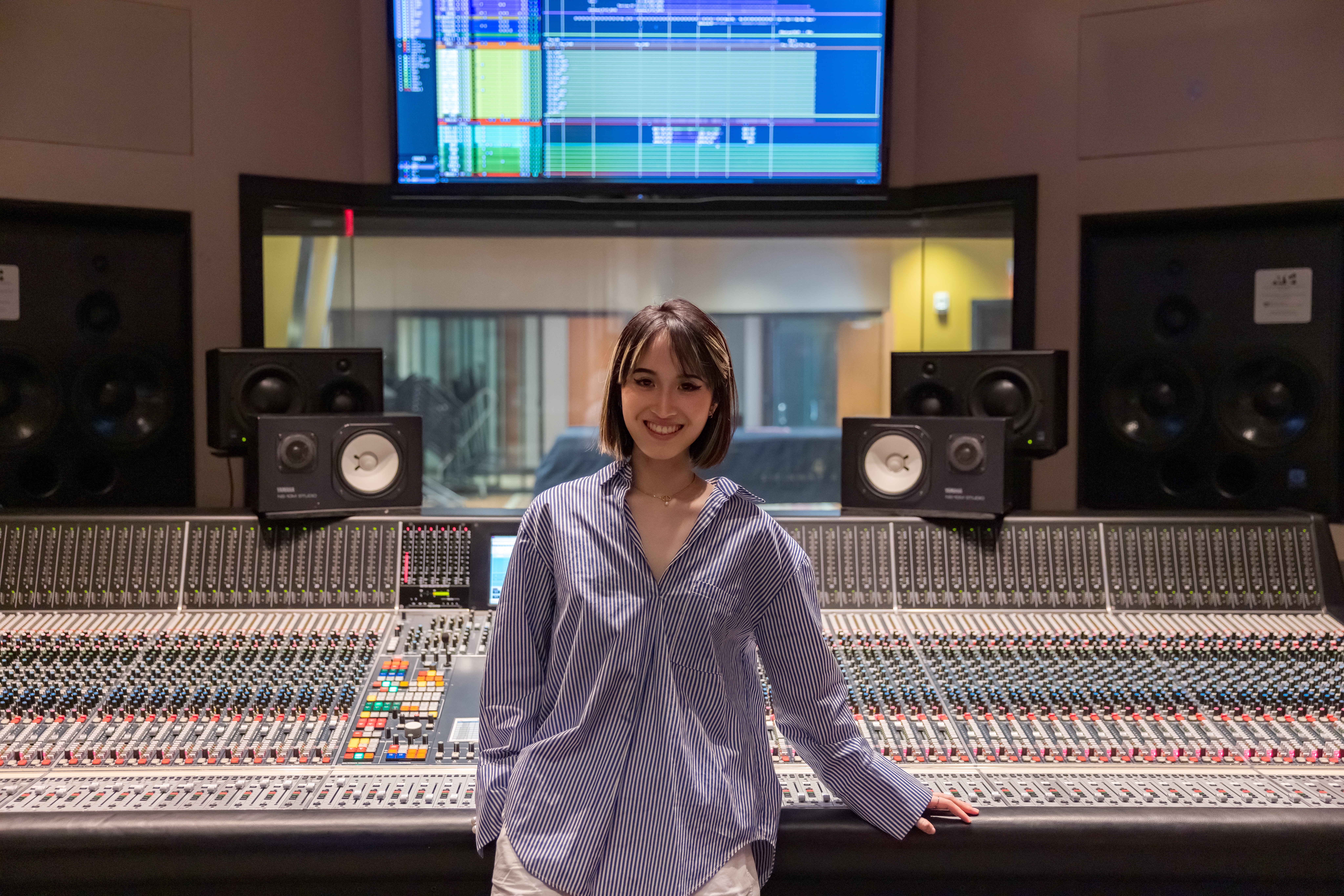
Actress Ewa Sobiczewska

Still early in her career, Sobiczewska has already begun building a diverse body of screen work on both sides of the Atlantic, taking on prominent roles in productions including Family Trust, in which she portrayed the lead female character Naomi, and the Polish film Alastor, in which she played Marika. Rather than gravitating toward one type of character, the young actress has shown a particular interest in roles that demand emotional complexity and allow her to explore the contradictions beneath the surface of a character.

That instinct was further developed during her training at the American Academy of Dramatic Arts in Los Angeles, where Sobiczewska refined her craft and expanded her understanding of acting for the American entertainment industry. For the Polish-born performer, studying in Los Angeles did more than sharpen her technique—it broadened her creative horizons and helped shape the kind of actress she wants to become.

One of the projects that illustrates that direction is Family Trust. Sobiczewska stars as Naomi, one of two siblings attempting to navigate the death of their parents while confronting a painful disagreement over money, personal ambitions, and the futures they envision for themselves. The role required Sobiczewska to balance grief, familial tension, vulnerability, and determination within a character positioned at the center of the film’s emotional conflict.

Her performance in Family Trust also brought her recognition on the independent film-festival circuit, including a Best Actress award from the Alternative Film Festival, marking an important milestone in her developing screen career.

Back in Poland, Sobiczewska appeared in Alastor as Marika, a daughter forced to grapple with a sudden shift in her family’s dynamics after an unexpected event disrupts their seemingly peaceful life. The role provided Sobiczewska with another opportunity to explore the complexities of family relationships and emotional upheaval, while adding to a body of work that now spans both European and American productions.

Actress Ewa Sobiczewska on camera

Yet what may distinguish Sobiczewska most is the perspective she brings to her work. Moving between Poland and the United States has exposed her to different cultures, approaches to storytelling, and ideas about performance. Rather than leaving one artistic identity behind for another, she sees that international background as something she can bring into her characters.

Now, with new professional projects and creative opportunities on the horizon, Sobiczewska is entering the next stage of her career with the opportunity to combine her professional training, international perspective, and growing screen experience. As she continues building her career in Los Angeles, she remains focused on challenging herself through increasingly complex roles and developing a body of work that reflects both her versatility and her commitment to the craft of acting.

For Sobiczewska, Los Angeles represents not simply a destination, but an opportunity to continue evolving as an artist—and to bring something distinctly her own to the characters she takes on next.

Cracking the “Impossible Triangle” of Commercial Video Production: How Axue Wei Rewrites the Underlying Logic of the Industry

Within the film and television advertising industry, a legendary“Impossible Triangle” theorem has long prevailed: one cannot simultaneously attain Cost, Speed, and Quality. However, producer Axue Wei refuses to acquiesce to this dogma. As the co-founder of THG Films, a leading production company in China, and an internationally award-winning producer, she has successfully shattered this curse across numerous projects by introducing an original“End-to-End Agile Production System.” Recently, we conducted an exclusive interview with Axue Wei to delve into how she infuses industrial thinking into emotional creation and compels the market to embrace her vision.

Core Positioning — Not a“Blockbuster Specialist,” but a“Problem Solver”

Tinseltown News (TTN): The outside world, upon learning about the nearly 4-million-yuan production cost of the 3-minute Jade Dynasty Mobile Game Short Film might readily label you as someone associated with “blockbuster-scale productions.” Yet, after witnessing the creation of Spring Rolls, which was made with a mere production budget of 280,000 yuan, they may also conclude that you excel in crafting “small-scale yet exquisitely beautiful” works. How would you define such a wide-ranging disparity in your creative endeavors?

Axue Wei (AW): To me, there is essentially no distinction between these projects; they are all “equations”requiring solutions. The crux of high-budget projects (such as Jade Dynasty Short Film) lies in “entropy”—the intricate art of managing complexity; for low-budget endeavors (like The Spring Roll Episode), the challenge is “precision”—the relentless pursuit of maximizing resource utilization to its absolute limits; whereas in rapid-deployment projects (as exemplified by The Versatile Dalan Is Here), the pivotal difficulty is “velocity”—the audacious reengineering of workflows to achieve breakneck speed. I am not confined to serving merely a single category of projects; instead, I offer clients a universally applicable “systematic filmmaking solution.” My core mission revolves around fine-tuning the parameters within this framework—resources, technological tools, managerial processes, and creative rationale—to seamlessly adapt to any set of boundary conditions specified by clients. Under these constraints, I strive to uncover and deliver the “optimal solution” tailored precisely to their needs.

System Architecture – Dynamically Adapting to Diverse Challenges

TTN: You have consistently emphasized the concept of a “filmmaking system.” How does this system address entirely distinct challenges?

AW: I refer to this system as the “Agile Filmmaking System.” It operates like a finely engineered gearbox, equipped with different gears to navigate varying terrains:

When confronted with complexity (Complexity), we activate the “modular locking mechanism” to uphold industrialized standards; In the face of resource constraints (Constraint), we employ “visual reverse-driving” to ensure the explosive impact of core highlights; Under time pressure(Speed), we adopt “parallel process restructuring” to break free from sequential workflows; When encountering cultural barriers(Culture), we engage in “audiovisual language translation” to guarantee emotional resonance. No matter how demanding the conditions at the input stage may be, the sole objective of this system remains unwavering: to ensure that the output is a resounding success, of high quality, and aligned with commercial objectives.

The Extreme of Complexity – Jade Dynasty Short Film

TTN: Let’s delve into the practical applications of these dimensions. How did your system operate in the case of Jade Dynasty?

AW: The core challenge of this project was “systemic risk.” With a multinational team, the top-tier celebrity, and a substantial volume of CG, coupled with a tight shooting schedule and post-production spanning the Chinese and Japanese Spring Festivals, any disconnection in any link could trigger a domino effect. Here, my system prioritized “standardized control.” Leveraging the 20 years of big-budget production experience from THG Films, we dissected emotional artistic creation into rational production modules. A high budget does not equate to reckless spending; rather, the higher the budget, the greater the demand for precision. Through rigorous process locking, we eliminated friction in collaboration, ensuring that every cent of the budget was tangibly transformed into visual assets on screen. This project ultimately clinched the Silver Award at the 2025 Cannes Corporate Media & TV Awards, generating 2 million APP downloads for the client within just one month of its release. Furthermore, this case was shared within the industry by the China Advertising Association (the largest and most influential organization in China’s advertising sector) in 2025 as a classic example of production process innovation. This stands as a testament to the successful mastery of “high-complexity projects.”

Challenge II: The Extreme of Efficacy — Ele.me: The Spring Roll Episode

TTN: How did your system adapt for a low-budget project like Ele.me: The Spring Roll Episode?

AW: The challenge here shifted entirely to “resource scarcity.” My system swiftly transitioned into “efficiency mode.” Under traditional workflows, a budget of just $39,000 would only support a rather mediocre shoot. However, we adopted a “visual reverse-driving” logic: instead of “shooting whatever we want,” we focused on “leveraging available resources to their absolute fullest.” We eliminated all mediocre intermediate steps and concentrated all efforts on crafting a single, highly memorable visual symbol. Despite the minimal budget, through systematic resource allocation, we produced a highly shareable film. After its launch in February 2025, the project garnered over 630 million views, 3 million+ interactions, and nearly 2.8 million discussions. It was recognized by industry media as one of the most culturally valuable commercial short films of the year, proving that my system not only excels at managing substantial budgets but also delivers exceptional ROI (Return on Investment) even when funds are scarce.

Challenge III: The Revolution of Speed and Process — Ele.me: The Versatile Dalan Is Here

TTN: The Versatile Dalan Is Here has garnered numerous prestigious global awards. What was the primary challenge of this project?

AW: The challenge lay in the paradox between time and quality. With over 30 co-branded partners involved and the brand audit process alone taking 40 days, the standard 60-day production timeline was compressed to just 20 days. Adhering to the traditional animation TVC workflow would have made it impossible to complete the production task before the launch date. Here, we implemented “process-dimensional innovation.” I dismantled the conventional linear animation workflow into a multi-track parallel mode. This was not merely a matter of adding more personnel or working overtime; it required a completely new SOP (Standard Operating Procedure for Aesthetics and Technical Standardization). Ultimately, we not only delivered on time but also won six authoritative advertising awards, including the Grand Prize at the NYX Awards and the Best Animation Award at the US International Awards, due to the exceptional quality of the film. This underscores the system’s adaptive capability in terms of “agility.”

Challenge IV: Cross-Cultural Soft Connection — D-Cal Short Film

TTN: Finally, let’s discuss D-Cal Brand Short Film – The Imperfect Mom, a project focused on localizing an American brand in the Chinese market. What was the challenge here?

AW: The challenge here was subtle yet profound—it was about “resonance.” The client possessed strong brand equity but faced “cultural misalignment” in the Chinese market. This issue could not be resolved through mere financial investment or accelerated speed; it required “meticulous audiovisual translation.” My system fulfilled a “emotional calibration” function in this context. In this project, while the agency had an excellent creative concept, my approach went beyond simply selecting skilled storytellers as screenwriters and directors. Crucially, all core creative personnel were parents themselves—either fathers or mothers. Upon the film’s release, its authentic details instantly sparked intense resonance among new mothers, propelling the marketing campaign to far exceed expectations: targeting only approximately 17 million new mothers, the project generated over 87 million social buzz. The film’s first-week viewership surpassed 32 million, and during the dissemination period, D-Cal’s Weibo index soared to 212,000, surpassing competitors by over a thousandfold. This case became a classic industry benchmark in 2019 and was honored with the IAI Awards – Creativity & Marketing | Video – Silver Award. The exceptional communication effectiveness stemmed from the agency’s sound strategy, while our role was to “materialize” this strategy into a high-quality video. Without this high-caliber vehicle, the strategy would have remained unimplemented.

The System as the Bedrock of Success

TTN: Looking back, each of your cases represents a typical filmmaking challenge.

AW: Precisely. As a commercial production company, we have no control over how much budget, time, or script a client provides. However, my value lies in the fact that, regardless of the “raw materials” and “constraints” given by clients, our filmmaking system can transform them into high-quality finished products through innovative production mechanisms. The success of our clients—whether it be box office hits, viral dissemination, or successful brand localization—is the inevitable outcome of the system’s meticulous operation at the backend. This is precisely why I am committed to continuously constructing a more efficient filmmaking system by integrating AI and other cutting-edge technologies from the industry—to make “success” a replicable industrial standard. Nevertheless, I have consistently emphasized that AI cannot replace aesthetic sensibility; it can only replace repetitive labor. My innovative goal is to build a more efficient “human-machine collaboration” system in the future, enabling technology to truly serve artistic expression.

Exploring Reverse 1999 with Syllous Mai

Photo Credit Craig Dikes

Global storytelling has expanded far beyond traditional mediums, and few projects reflect that shift as clearly as Reverse: 1999, Bluepoch Games’ internationally acclaimed RPG. Designed as a cinematic, narrative-driven experience within an interactive format, the game brings together creative teams across countries and languages to build a richly layered world shaped by history, conflict, and time itself. Its ambitious scope and international collaboration make it a standout example of how modern game production operates on a truly global scale.

Reverse: 1999 is built on a premise rooted in real-world anxiety. As the real world once braced for technological collapse at the turn of the millennium, the world of the game experiences an event called The Storm, which disrupts time itself and fractures different eras of the previous century. Within this chaos unfolds a layered social conflict between the Arcanum and the Manus Vindictae. Like Star Trek or Les Misérables, the narrative prompts reflection on persecution, war, and morality. The story operates on both epic and deeply personal levels, making empathy for its characters central to the player experience.

For players to become fully immersed, emotional investment is essential. The creators pursued a cinematic approach to storytelling, ensuring that character motivations, turning points, and revelations were treated with dramatic weight. This required powerful performances from voice actors as well as meticulous preservation of subtle performance details. At the same time, the game’s intense combat and high-stakes gameplay sequences demand equally strong sonic impact. The emotional spectrum ranges from restrained vulnerability to explosive intensity, and every moment must remain technically flawless to maintain immersion. Even minor audio distractions can weaken narrative impact and pull players out of the experience.

Capturing this range requires careful technical oversight. Quieter lines must retain intimacy without introducing noise, while sudden emotional bursts must remain clean and controlled. The engineering process must track dynamic shifts closely, ensuring that the emotional arc of a performance remains intact. In narrative anchor moments especially, clarity and transparency allow the pacing and emotional intention of the developers to reach players without interference. The goal is always to place the player inside the world of the game.

The creative workflow in gaming differs significantly from that of film and television. In traditional linear storytelling, dialogue unfolds within a fixed sequence. In gaming, voice work must be modular, repeatable, and flexible, functioning across countless potential player paths. Dialogue is no longer simply a performance within a scene; it becomes an adaptable asset that must operate seamlessly in an interactive environment. This shift from linear to interactive storytelling requires a fundamentally different engineering mindset.

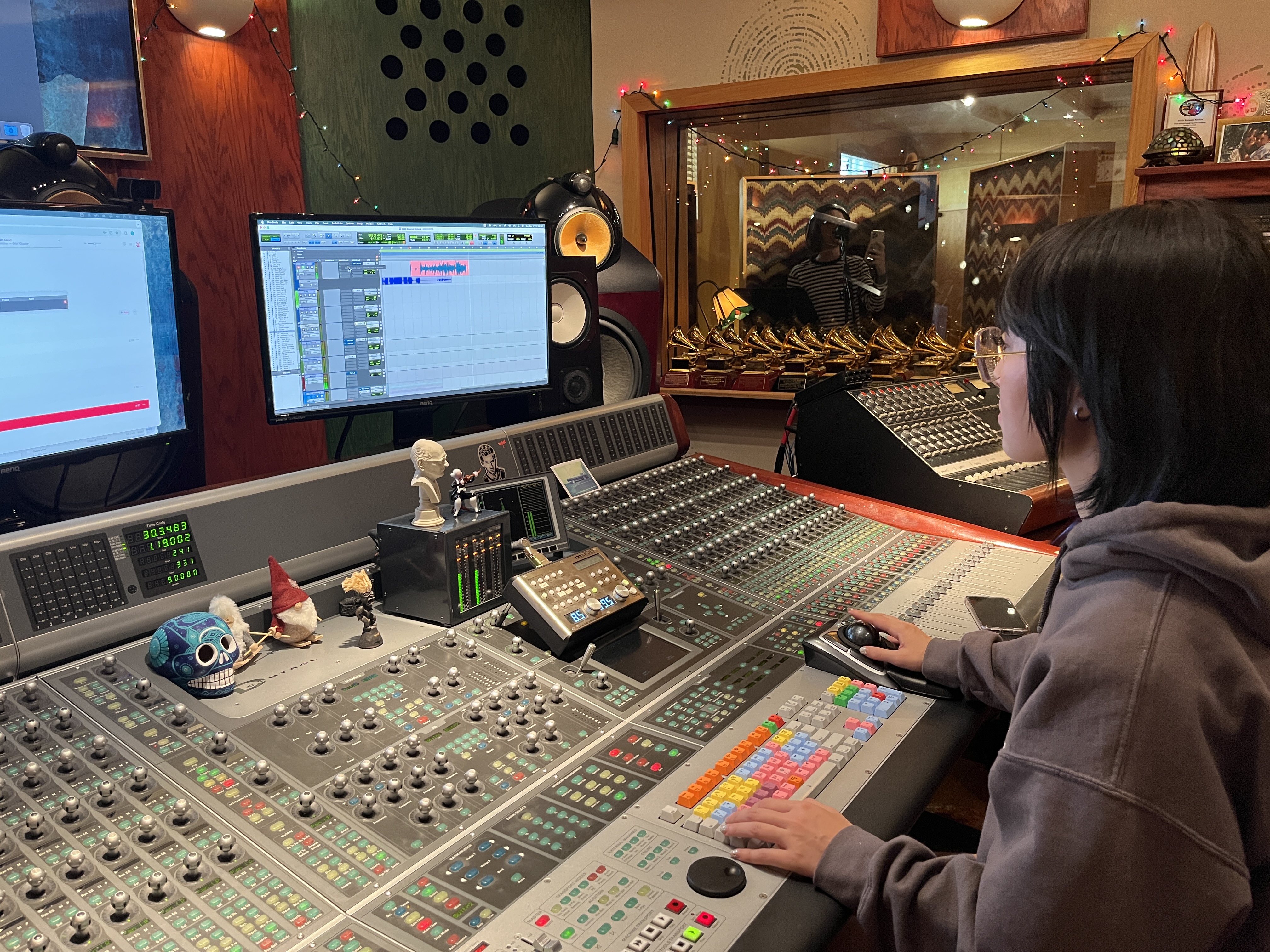
Syllous Mai stepped into this world of interactive storytelling as the voice-over audio engineer for Reverse: 1999 during sessions at One Line Studios. Known for her work as a sound designer and sound editor in numerous acclaimed international film and television productions, this marked her venture into video game production. Her transition into gaming highlights not only her technical versatility but also her ability to adapt creatively across mediums.

What made her particularly valuable on Reverse: 1999 was her recording studio expertise and her fluency in English, Mandarin, and Cantonese. Given the international collaboration behind the project, her multilingual abilities helped streamline communication among teams. Even when English served as the primary working language, the ability to clarify direction, confirm pronunciation, and ensure alignment across languages reduced friction and made sessions more seamless. This cross-cultural facilitation enhanced both efficiency and creative cohesion.

Her role on Reverse: 1999 also placed her within a large-scale international production environment. Game development often involves collaboration across multiple countries, departments, and time zones, requiring streamlined communication and technical precision to maintain workflow efficiency. Her fluency in English, Mandarin, and Cantonese supported alignment during recording sessions, particularly in clarifying pronunciation, direction, and performance intent. This contributed to smoother sessions and reduced the potential for miscommunication in a multilingual production setting.

At the same time, her background in film and television informed her handling of narrative material within the game. Maintaining emotional pacing, preserving subtle performance details, and ensuring technical stability remained central priorities. The experience reflects an expansion of her professional scope, demonstrating the ability to apply cinematic storytelling sensibilities within an interactive framework while meeting the structural and technical demands unique to gaming.

As gaming continues to expand worldwide, professionals who can combine technical mastery, narrative sensitivity, and cross-cultural communication will remain essential. In that evolving landscape, Syllous represents a new generation of audio professionals equally at home in film studios and interactive worlds.

Photo by Caffrey Chen

Challenging perspectives with esteemed screenwriter Varunn Pandya

The House_Headshot
Varunn Pandya, photo by Chaaritha Dheerasinghe

Christopher Reeves once said, “so many of our dreams at first seem impossible, then they seem improbable, and then, when we summon the will, they soon become inevitable.” For esteemed writer and screenwriter, Varunn Pandya, this mentality is all of the inspiration he needs to remind himself that with the right amount of hard work and dedication, he is able to achieve everything he sets his heart to. Growing up, the talented creative found himself inspired by Reeves’ interpretation of one of society’s token superheroes and credits his ability to play Superman as being one of the characters that initially sparked his interest in film. From there, he immersed himself into every avenue that the industry has to offer and found a love for the profession he now calls his own. As for his desire to create, it is stronger than ever before, and he has a knack for finding unique ways to showcase that will to the world.

“As a writer and screenwriter, I develop stories that I aim to show or display to the world in a way they’ve not necessarily experienced before. As I also like to direct, I try to write stories that I can bring a unique perspective to. Because I was born in India, I like to think that I bring some unique ideas to the United States and that I help to break some of the stereotypes associated with living on the Eastern side of the world,” told Pandya.

As he continues to navigate his way through the arts and entertainment industry, Pandya often finds himself taken aback by the breadth of opportunities and the amount of creative freedom he is allowed to use in order to imagine without limits and tell truly compelling stories. He has a reputation for finding areas of film that touch his audiences and he manages to do so in a way that keeps content fresh and engaging. In addition, he takes great pride in knowing that through his words and the stories that he brings to life, he has a grand platform to challenge the minds of his viewers and allow them to open their eyes to societal issues that they may or may not even be aware of. For instance, in his script XYZ where Pandya, alongside Badar AlShuaib, cast an important light on the unconscious, and sometimes conscious, bias that human beings exhibit toward their own race. In another of his scripts, The House, Pandya attempted to step outside of himself and allow his audiences to see the world from a perspective other than their own.

The House tells the story of Carl, a homeless man living in Los Angeles struggling to find a human connection amidst the repercussions of a rough upbringing. The storyline follows Carl’s daily routine as he collects metal scraps from the areas surrounding him and food from the trash in order to sustain himself. One fateful day, however, Carl comes across a family in his neighborhood and he grows a fascination for them. As the story progresses, viewers are taken on a journey through Carl and the family’s interactions. The story reminds us that regardless of our life circumstances, our skin color, our nationality, or whatever other features we use to distinguish ourselves from others, we are not all that different on the inside. We share similar emotions and at the end of the day, we are all human. Sometimes it just takes a little reminding from people like Pandya.

For The House, Pandya managed to develop a script in just four days. Writing it felt natural and he did everything in his power to keep the content as raw and powerful as possible. Wherever he could make the script seem realistic, he did just that and attempted to ensure that the script demanded empathy from its audience. He also made a particular effort to cast Carl in a different light than most homeless individuals are seen in. He wanted to show the world that not all homeless individuals intend to be, nor does their living situation make them any less human than the rest of us.

Up until The House, Pandya had only really ever worked with thrillers. What he loved most, therefore, about this project was the fact that it allowed him to step into unchartered territory and to explore an area of society he hadn’t otherwise given much thought into. He takes great pride in knowing that his script has the power to change the minds of many as they engage with the script and consider their actions from there forward. In the end, Pandya was not the only one who found a love for the script. In fact, The House went on to win a number of prestigious awards, such as Best Short Screenplay at the Five Continents International Cult Film Festival in June 2018 and at the Calcutta International Film Festival in September 2018.

“It feels great to know that the script has been widely appreciated by people all over the world. This script will always remain one of the most memorableprojects I’ve written as I think it’s the most personal story I have written despite it being based on a character that is very different from me,” he concluded.

Writer and Director Claire Leona Apps takes showcases the Great North Run in acclaimed film

Writing has always come naturally to Claire Leona Apps. She loves telling stories and loves how they serve society; they can teach us and warn us, they can entertain while serving a greater purpose. A good story can create conversation and express ideas that help us relate to new points of view. It’s a powerful tool, and Apps understands that. Her passion for storytelling translates directly into her work as both a screenwriter and a director, from the words she puts down on a page to the way she puts it together in front of a camera, and she captivates worldwide audiences with films.

Apps is an in-demand writer and director, with a series of decorated projects highlighting her esteemed resume. These include her acclaimed films Gweipo, Aceh Recovers, Ruminate, and And Then I Was French. She is known for her ability to showcase the lives of underrepresented characters and bring a dark sense of humour to a story.

“I try not to get so caught up on the real world with my work. I have to deal with that every day anyway. I like a little surrealism, a little irony, and films that are a little self-aware,” she said.

That is exactly the message Apps puts out with her film Girl Blue Running Shoe. The film follows the daughter of a runner participating in the Bupa Great North Run as she makes a film as he trains and runs the race. The film begins calmly with a serene domestic set-up, building pace as the race begins, cutting between the training day and the marathon. At points which demonstrate the intensity of running, a special zoetrope effect is used, breaking down the movement of running into paused actions, reflecting the rhythm of the action – the steady thumping of shoes on gravel, a beating heart, breathing. The piece is shot solely on Super 8, edited to emulate both the excitement of the daughter as an observer and the adrenaline of the participator. With a soundtrack of enhanced natural noises, Girl Blue Running Shoeis an evocative celebration of the human body whilst also telling the simple story of a father-daughter relationship.

“It’s a story about loving and sharing in the experiences of the people you love. It also dissects the movements of running,” said Apps. “Usually I do pretty dark things. It was nice to do something that ended up in a children’s film festival line up. It’s nice to just show love, simple straight forward love between a father and daughter,” she said.

Apps wrote the story and pitched it to the British Arts Council to commission the film. When she got the commission, she immediately began directing, coming up with a new camera technique for the film. The story has two components. One is a daughter watching her father run the race. He is doing his hobby, running, and she is doing hers, filmmaking. She films him running on a Super 8 camera. Therefore, as the director, Apps decided to shoot the whole film on Super 8 cameras. This truly allowed audiences to immerse themselves in the girl’s point of view. Apps also had the idea to use the sprocket holes of the physical film and the division between the different pictures to create a zoetrope like film effect. She did this all by hand: slowing the footage down and cranking it through a projector to be re-filmed.

Shooting took place at the Great North Run in Newcastle, England, one of the biggest half marathons in the world. This presented a unique challenge for Apps, who had to shoot a fictional story around a live marathon. Therefore, the actual shoot was extremely fast. She had to make quick decisions to deal with whatever came their way. There were roads shut off, spectators everywhere, and of course the runners themselves, and they had to move all around them with a child actress.

“The hardest thing about this project was finding the right kid to play the lead. It is a large ask to have a child give you full energy for a few hours of extreme intensity, but Adrianna Bertola, who played the lead, was a dream,” said Apps.

The film premiered on BBC during the Great North Run the following year. It went on to be at the Great North Museum for an exhibition. It was also an Official Selection at the Cork International Film Festival. The success was wonderful for Apps, as the shoot was a chaotic and fun experience.

Now, Apps is currently working on another feature film. She is a truly exceptional filmmaker, engaging viewers of all ages, which is evident with her work on Girl Blue Running Shoe. She knows the key to her success is working hard, and she encourages all those looking to follow in her footsteps to do the same.

“Prepare yourself for a lot of hard work and don’t expect anyone to discover you. We live in a world at the moment where you can generate a lot of attention by yourself and you can make films on your phone. Make something and keep going,” she advised.

Copywriter Aahana Pereira teams up with celebrity DJs for Motul Rhythm campaign

Despite always having a love for writing, Aahana Pereira never expected in her youth that her passion would translate into advertising. In junior college, she was studying science and math, but she hated it. She quickly switched to Mass Media, not because of an interest in communications, but simply because it would mean she no longer had to take math. However, those three years changed her life. The more she learned about advertising, the more she knew she would be happy in the field. She would watch old advertisements from all over the world, read long copy print ads and learned a great deal about famous copywriters. She wanted to be like them. Combining her interests in writing and advertising, Pereira decided to pursue a career in copywriting, and has never looked back.

“On most days as a copywriter I follow a brief and write copy with as many options I have time for. It is not every day that we get an exciting brief or a project, so day to day is, so to say, average. That being said, I still push to make average better. Most days we work on small budget campaigns, and I aim to make each and every campaign, whatever the size, achieve greatness and make something I am proud of. Then, once in a while, we do get a brief where we get to showcase our creativity at the highest level, and that is just plain fun,” said Pereira.

Throughout her esteemed career, Pereira has worked on many projects for prolific corporations known worldwide. She has travelled the world doing what she loves, and consistently finds unique approaches to promote a product. This is exemplified with her work on commercials for Palmolive, Colgate, IBN 7, and many more. The highlight of her career came when she was given the opportunity to work on the Drink Up campaign, an initiative by First Lady, Michelle Obama in partnership for a Healthier America that encourages people to drink more water. Most recently, she worked with Falcon Agency in Malaysia on several successful campaigns, impressing all she collaborated with.

“Aahana and I have worked on several projects since we first met in 2017 – Motul Rhythm, Meet the Sydneyporeans, just to name a few. I really enjoy working with Aahana as her ideas are strong and always on brief. I love the passion she has for her work,” said Liz Leow, Regional Account Director, Falcon Agency Malaysia.

Working on Motul Rhythm was a project that excited Pereira. It was one of the first projects she worked on at Falcon Agency as a solo copywriter. Motul, a company that produces high-performance motor oils and lubricants, is not typically associated with music, making the campaign extremely original. The idea was to hold an online contest across the Asia-Pacific area where anybody could submit their original music, made completely from the sounds of their motorcycles. They asked fans to create sounds and upload it to the Motul Rhythm website. The prize for the winners was a chance to co-produce their own music track with Asia’s most well-known DJs, such as Terence c, Idham and Flickswitch. The selected winners were also sent to the MOTO GP event held in Malaysia in 2017, and the music track mixed by the DJs was then launched at an event in Kuala Lumpur.

“I thought the idea was good. A brand like Motul, which is such a low involvement category, was getting its fans excited. The idea was true to the brand values that stands by performance. In this campaign, performance has dual application – performance of the lubricant and oils meets performance in music. It was a synergy,” said Pereira.

Although the idea of Motul Rhythm already existed before, Pereira and her team adapted it. The idea was to get audiences to participate in a competition, where they had to submit sounds from their bike and reputable DJs would take the best sounds and mix it into a music track especially for Motul. However, the challenge was to entice them in a way that would encourage motorbike fans. As a team, they concluded that the hook would be that participants would get a chance to co-produce the music track by submitting their audio clip. This was discussed over a period of discussions. However, Pereira had never worked on Motul before or even the oil and lubricant category, so this meant she had to do a lot of research to figure out just the right way to target consumers. She had a sense of the Asian market but wanted to find just the right way to reach bike enthusiasts. It was more than just making them aware of the competition, it was getting them to participate in it. With the help from the team in Singapore and support from the team in Malaysia, they managed to launch this campaign, and those lucky few consumers managed to have their dream come true by working with DJs to create a track.

Other than launching the Motul Rhythm microsite, Pereira’s team created Facebook advertisements and digital banners to get the word across. This was the first point of communication and a way to generate awareness. It was very important to write copy that would make people stop and click, not to mention character limits in digital ads. Pereira met the task with determination and commitment.

“This project was fun. It incorporated bikes and music. I loved working on it and it was amazing to hear what people could create with the sounds of their bikes,” she said.

The Motul Rhythm campaign is just one example of Pereira’s creativity and determination. She took a unique idea and targeted just the right audience. Such talent is required to be a success in her industry, and for those looking to follow in her footsteps, she offers some important advice.

“One, be persistent. Keep aiming for good work even if they are not the big budget briefs.

Two, watch films, shows, read books that will expose you to different stories and styles of writing. You never know what will inspire you. Three, have a voice in your team. No matter what your title is, say something,” she advised.


Photo by Biel Calderon

Filmmaker Shaan Memon celebrates the holidays in commercials for Dickens Fair

Article04-dickensfair01
Shaan Memon

As far back as Shaan Memon can remember, his family had a VCR player at their home in Ahmedabad, a city in Gujarat state in India. Every Sunday, he would watch all of his favorite cartoon shows, and his father used to help him record the shows on video cassettes. When his father would travel to Bombay for work, he would return with movies for Shaan and his elder sister. It was then, in his living room in his childhood home, that his love of film was born.

Now, Shaan is an in-demand Screenwriter, Director, and Editor. He first impressed international critics with his work on the horror The Unreal and continued to do so with his films Fitting In and Bullied, as well as the documentary Purpose Driven Study for Dharoi Canal Command Area. He is extremely knowledgeable in every aspect of filmmaking, from pre-production to post-production, and using this knowledge to expand his skillset. At the end of last year, his work on a commercial for the Dickens Christmas Fair showed that in addition to Director and Editor, this versatile filmmaker can even take on the role of Videographer and achieve tremendous results.

“I found Shaan to be reliable, assiduous, hard-working, and intuitively creative – as well as being extremely patient in performing multiple re-cuts of the material. Shaan impressed me so much that I recommended him for other work and hope to engage his services next year on a separate video for the Dickens Fair,” said David Hakim, Producer/Director who worked alongside Shaan on the commercial.

The Great Dickens Christmas Fair is a one-of-a-kind holiday adventure into Victorian London and is an elaborate party with around 800 of costumed players performing and interacting with patrons in over 120,000 square feet of theatrically-lit music halls, pubs, dance floors, and Christmas shops. It’s a twilight evening in Charles Dickens’ London Town – a city of winding lanes filled with colorful characters from both literature and history. Enticing aromas of roasted chestnuts and hearty foods fill the air. Cries of street vendors hawking their wares ring out above the bustling crowd. Dozens of lamplight shops are filled to overflowing with Christmas gifts. The Dickens Christmas Fair is a treasured Bay Area tradition since 1970 and a splendid way to celebrate the holidays. Thousands of people attend this event every year.

“I had never visited the fair before, so the first time when I visited it, I was spellbound. They have created a different world in itself. One can never imagine what would it be inside until they visit it, and that is exactly I wanted to capture. I therefore insisted on not visiting the fair before shooting, as I wanted to feel like a traveler who is experiencing it for the first time and I captured those moments,” said Shaan.

Shaan is a multi-talented filmmaker with an outstanding about of expertise in writing, directing, editing, videography and sound design. Because he has so much experience in such a variety of roles, he is a one-man army who can execute a project as clearly and as nearly to how it was conceived during the consultation. Having thorough knowledge of different fields makes him a force to be reckoned with and proved vital while shooting this commercial.

“Every filmmaker works hard with his/her sweat and blood to make a project the best it can possibly be and make their name in the industry. I had huge responsibility as Diane Baker put trust in me and suggested me to work on this project. I’m happy that I could reach her and David’s expectations,” said Shaan.

When Diane Baker and David Hakim were trying to find someone who could make a captivating commercial for Dicken’s Christmas Fair, they immediately thought of Shaan and approached him to take the lead on the project. Initially, Hakim had planned on creating a competition to decide who would create the commercial, but after seeing Shaan’s work, he knew he no longer needed to find someone to take over.

Working closely together for the entire shoot, Shaan consulted Hakim regarding what kind of shots, pace and feel would be required. After brainstorming, they decided on getting more front faced shots of the visitors, showing how happy they were and enjoying their time. Getting the best shots of artists performing, vendors selling beautiful products, the decorations, the grandness of the fair and much more. Shaan then attended the fair with his assistant to get as many shots as possible. During the editing process, he consulted with Kevin Patterson, Executive Director of Dicken’s Fair. He edited the best possible 30-second commercial. He is now working on the 90-second advertisement after the success of its predecessor.

“This is what I love about filmmaking. I never get bored of being a filmmaker. I enjoy working every time I have to go through this process of starting a new project, working on it and at the end looking at its result. Every project takes me on a whole new journey. In this one I met around hundreds of artists working together at same place. Watching Dickens’s characters alive and performing in front of you was a treat! This project was great to work on and entertaining also. David was very supportive throughout and I’m happy that he trusted my creativity and I could deliver up to his expectations,” Shaan concluded.

Check out Shaan’s work on the commercial on the Dicken’s Fair website.

Victor Osorio On Living to Write

Victor Osorio is part of the 0.1 per cent of the general population that suffers from a rare neurological disease characterized by recurrent, severe headaches. The disease is called Cluster Headaches, but sufferers often refer to their condition as “Suicide Headaches” due to the often insurmountable pain that it causes. Osorio, on the other hand, sees his Cluster Headaches as the driving force behind his unwavering passion to write. Despite the massive amounts of pain and suffering that he has endured over time, he has only grown stronger and more determined to enlighten the world with his ideas. For the Spanish-native, writing is his reason to wake up in the morning, and although it isn’t the simplest profession to master, he has done so with ease. He doesn’t write because he wants to share something, he writes because he has something to share, and he has crafted a remarkable career around it.

When Osorio was a child, his parents deterred him from spending too much time in front of the television. As a result, he became an avid reader. He was fascinated by each author’s ability to awaken his imagination in ways they might not have ever intended. He loved learning the various styles and techniques that his favorite writers would use and he was inspired to develop his own unique methods. Today, the renowned writer can be credited as being the successful mastermind behind works like his children’s book, Cosas Que Nadie Sabe (translated in English to: Things Nobody Knows). He also worked for the longest running child and teen magazine, Dibus! Magazine, as a children’s comic writer for their hit feature, Alienados. Osorio’s talents, however, are not limited to writing for children’s publications. When he expanded his reach into the television and film industry, he lent his expertise to the award-winning web series, Hollywood and later earned himself a position working for Origo Media.

 For Osorio, working with Origo Media is unlike anything he had ever worked on in the past. The job requires him to write short commercials and corporate videos for Origo Media’s clients. In addition, he is expected to deliver material on a weekly basis, according to very strict deadlines. Fortunately, he thrives under pressure and can produce high quality content in a very short period of time. The videos that he writes, which appear mainly online and on television in Central and South America, would not be the success that they are today without Osorio’s unprecedented ability to turn a minor concept into a piece of artwork. In his time spent working with Origo Media, Osorio has written over 200 commercials and corporate videos, as well as a spec pilot.

When asked about his position at Origo Media, Osorio would tell you that he felt lucky to expand his skill set and learn to succeed under a different kind of pressure. “Working at Origo Media was a big deal for me because it allowed me to work on a series of projects with the same people for a year. By now, I consider myself to be very skilled at being concise and to the point, without sacrificing flavor, entertainment, and quality writing. Working on commercials really brings those skills to light and being able to put them to use within the context of this job has been extremely satisfying,” said Osorio.

Those who have worked with Osorio, however, would tell you luck has little to do with it. Luiz Santiago, who is the CEO at Origo Media, considers Osorio to be an invaluable asset to his company. “Victor is a very good writer with a big imagination and his command of creative writing techniques highlight his prowess as a writer. He also takes any potential set and post-production complications into account when developing his scripts to make everyone else’s work easier. Beyond that, he writes interesting, dynamic characters for our actors to explore,” told Santiago. Given the fact that Origo Media creates commercials and corporate videos in Central and South America, it is also important to bridge the gap between American and Hispanic culture in their work. Osorio’s life experiences allow him to do so flawlessly, in a way that resonates well with his audiences. For this reason, Santiago went on to say that, “Victor’s Spanish heritage and culture give him a unique perspective into American culture that infuses his work.”

Working at Origo Media has added a new and interesting dynamic to Osorio’s career. His eagerness to write and his passion for spreading his ideas across the world make him particularly open to expanding his horizons into new mediums and genres wherever possible. He enjoys stepping out of his comfort zone and striving for excellence in each new territory that he embarks on. A quick glance into the future of Osorio’s career looks bright. Recently, his children’s book was translated into English and eventually, he hopes to see it on as many bookshelves as possible. He is also working on a second children’s book, as well as a feature film script. He has no shortage of ideas in his brain, and will continue to craft them for success. From the outside looking in, Osorio writes for a living but if you ask him, Osorio simply lives to write.